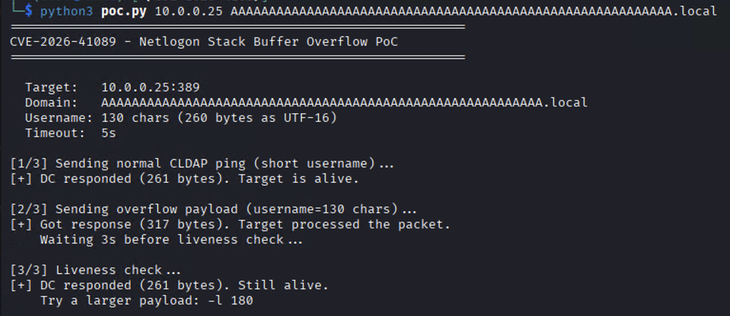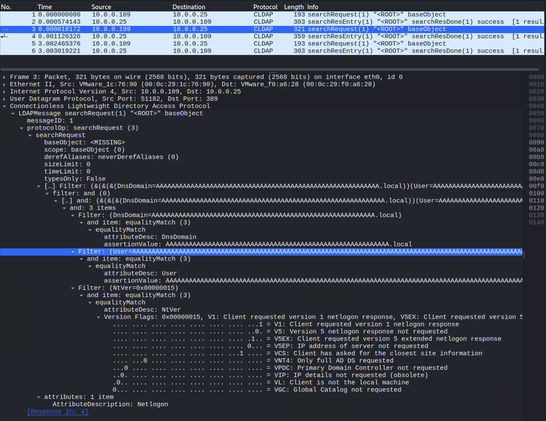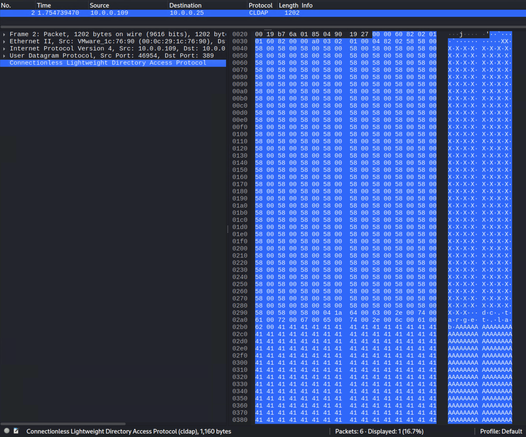
So CVE-2026-41089 (CVSS 9.8) in Windows Netlogon can be triggered by sending a username that is AAAAAAAAAAAAAAAAAAAAAAAAAAAAAAAAAAAAAAAAAAAAAAAAAAAAAAAAAAAAAAAAAAAAAAAAAAAAAAAAAAAAAAAAAAAAAAAAAAAAAAAAAAAAAAAAAAAAAAAAAAAAAAAAAA or longer.
How original.
@christopherkunz
Reference?
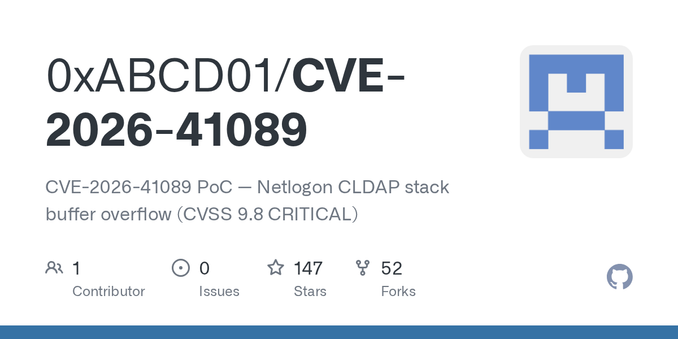
CVE-2026-41089/poc.py at main · 0xABCD01/CVE-2026-41089

CVE-2026-41089 PoC — Netlogon CLDAP stack buffer overflow (CVSS 9.8 CRITICAL) - 0xABCD01/CVE-2026-41089

GitHub

@christopherkunz
Ah, so you've confirmed that it works?
With AI and clout seeking these days, we've long passed the "PoC exists on Github" thing having any meaning whatsoever. 😂

Personally, I couldn't get that one to do anything.

@christopherkunz
Yeah, I've seen what it claims to do.
But either they are hand-waving over a critical requirement of what it takes to repro, or it's fake.
CVE-2026-41089 — Microsoft Windows Netlogon BuildSamLogonResponse Stack-based Buffer Overflow RCE

1. Overview A stack-based buffer overflow vulnerability exists in the Windows Netlogon service’s DC locator ping response handler. When a domain controller processes a CLDAP search request, it serializes response data including attacker-supplied and server-side strings into a fixed-size stack buffer without adequate bounds checking. An unauthenticated remote attacker can send a single crafted CLDAP packet to a domain controller’s UDP port 389, causing the Netlogon service to crash the LSASS process and force the domain controller to reboot. The exploitability depends on the target domain controller’s DNS naming configuration — domain controllers with longer DNS domain names and hostnames are vulnerable. Microsoft addressed this vulnerability in the May 2026 security update.

Aretiq AI

@christopherkunz
😂

I miss the days when things like this were written by humans, using logic and facts. As opposed to statistically plausible slop.

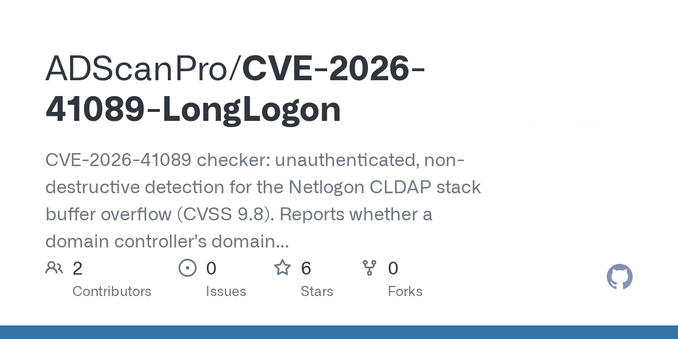
@wdormann From what I read in the writeup (and the sparse other sources), you need a long enough DNS name on the victim host to trigger the overflow. I think 54 chars or more? This github has a possible explanation why the PoC fails under most normal conditions: https://github.com/ADScanPro/CVE-2026-41089-LongLogon
GitHub - ADScanPro/CVE-2026-41089-LongLogon: CVE-2026-41089 checker: unauthenticated, non-destructive detection for the Netlogon CLDAP stack buffer overflow (CVSS 9.8). Reports whether a domain controller's domain is long enough to crash, without sending the overflow. The binary-verified analysis the public PoCs got wrong.

CVE-2026-41089 checker: unauthenticated, non-destructive detection for the Netlogon CLDAP stack buffer overflow (CVSS 9.8). Reports whether a domain controller's domain is long enough to crash,...

GitHub
@christopherkunz
Yes, my test environments (unpatched Server 2016, 2022, and 2025) all had a maximum DNS suffix of 64 chars. (Longer isn't allowed)

@christopherkunz
I also tested another PoC and it was even more fake. i.e. it didn't even create a CLDAP structure that made sense.

I get that PoC||GTFO is a thing, but we've clearly entered a phase where it needs to be Verified PoC||GTFO. 🤦‍♂️

@wdormann Of all the writeups, I think I like this one best, especially with it having a human name in the byline: https://adscanpro.com/blog/patch-diffing-cve-2026-41089-netlogon
"read advisories carefully before deciding how to allocate research time." made me chuckle.
Patch Diffing CVE-2026-41089: Locating the Netlogon Bug in 4 Hours Without a Public PoC

Walkthrough of how to bindiff a Patch Tuesday Windows CVE end-to-end — from MSU acquisition to function-level bug identification. CVE-2026-41089 (Netlogon pre-auth RCE) as the running example. Methodology, tooling, and the honest limits of trigger development without weeks of exploit engineering.

@christopherkunz @wdormann Here's a new one to take a look at. I haven't gone through it and can't vouch for its legitimacy, but y'all know what you're doing more than I do anyway: https://github.com/Vanquishermacdetach/CVE-2026-41089-509
GitHub - Vanquishermacdetach/CVE-2026-41089-509: CVE-2026-41089 PoC — Netlogon CLDAP stack buffer overflow (CVSS 9.8 CRITICAL)

CVE-2026-41089 PoC — Netlogon CLDAP stack buffer overflow (CVSS 9.8 CRITICAL) - Vanquishermacdetach/CVE-2026-41089-509

GitHub
@cR0w @wdormann Yeahhh.... so that one looks fishy. It seems to be a fork of the earlier one, but added a setup.py which seems to do slightly weird stuff.
@christopherkunz @wdormann Nice. So it's only been published for ten minutes and already debunked. LMAO.
@cR0w @wdormann How many 🚩 do you need? "Some security systems may block the installation. If the setup does not start, add the folder to the allowed list or pause protection for a few minutes." Yeahhhh right.
@cR0w @christopherkunz @wdormann fake, tries running powershell 😂
@cR0w @christopherkunz
I'm going to go out on a limb here...
@wdormann @christopherkunz Guess I should have actually looked. I came across it while looking for something else and it was published "3 minutes ago" so I figured I'd share. Didn't expect it to be that bad this long after the CVE was published.
@cR0w @wdormann @christopherkunz maybe I should go write crap POCs, doesn't seem like it's a barrier to success ;)
@cR0w @christopherkunz
Every PoC on GitHub these days needs to be assumed fake until proven otherwise.
@wdormann @cR0w We, as a community, should be more welcoming to new members, especially those who possess the ability to produce a reliable PoC for a high profile, hard to exploit vuln!
Their other repo looks promising, too: rkpzcqwj
/s for good measure