
It is okay to release a F/OSS project where the expected set of users is you.

It is okay to declare that a F/OSS project that you maintain is feature complete and stop.

It is okay to stop writing new code in a F/OSS project and just review patches from other people.

It is okay to stop reviewing patches once other people are familiar enough with the codebase to do so.

It is okay to admit that a F/OSS project that you created has so much technical debt that people would be better off reimplementing it than depending on it (especially if you write down the lessons that they should learn).

It is okay if your F/OSS project doesn't meet the requirements of some potential group of users, as long as no one applies pressure to force them to adopt it.

It is okay to tell a company that depends on your F/OSS project that it's unsupported and they can pay developers to contribute if they really need it.

It's okay to say 'I created this F/OSS project to meet my personal needs, but someone else made something that meets those needs better and so I'll use theirs instead'.

It's okay to say 'I made this F/OSS project as an experiment, and the result was that I learned that this approach is a bad idea'.

@david_chisnall In short, "this code is provided as is" is a part of every open source license.

@deshipu @david_chisnall Yes, it is part of the license, it is the last fallback for not having other people demand that you work for free.

But if you actually expect other people to use your F/OSS, you generally need to supply some level of support. We can't have a functioning F/OSS system without some maintainers taking the job very seriously.

The point is that not every project needs to be equally serious, and it is okay to aim lower. (But preferably tell your potential users up front.)

@NohatCoder But why would you ever want other people to just use your work? They are all made of meat and are horrible and unhygienic. There is this tendency to measure the success of a project by how many people are using it, but those people are useless, they bring nothing, and the companies are doubly so. Just ignore them, it's the noise. What you need for a functioning system are those people who can work together, and contribute back, and that is a reward of its own.
@alda @NohatCoder @david_chisnall Who is paying for a hobby? The hobbyist, of course! It's not a business.
@david_chisnall if we're at the point where people need to be actively reminded that it's okay to not treat F/OSS like a job then things are truly getting dire
@david_chisnall The vast majority of the repos I have on my git server are experiments and stuff that I wrote for myself either because I needed that tool or because I found it was fun (or both). And when it wasn't fun I just stopped working on them.
I don't even think of all that as a contribution to F/OSS in general, but it's out there in a small museum.

@david_chisnall

Wow, that's 1195 characters, (with spaces) you must be with privilege.

@SCALETHEORY

infosec.exchange has a 11,000 character limit, which is big enough that I've never hit the limit.

Smaller limits exist because of a theory that it encourages concise posts. There is zero evidence that this actually works. In practice, people write long things and split them across many posts, and write 3/11 or whatever at the end. This ends up being much worse both for usability and performance: sending a single 4,000-character post across ActivityPub requires almost the same amount of data transfer as a 280-character one. But sending ten 280-character posts takes a lot more.

I wish Mastodon would make the defaults sensible instead of requiring instances to patch it.

@david_chisnall @SCALETHEORY I, personally, hate this Rather stupid character limits that prevent any kind of serious posts on this platform.

@david_chisnall

I have evidence it works on me specifically! I very rarely use chain posts, (but it happens when I really really need to).

It has forced me to write more concisely, when I would make my point in 501-850 characters. Inside that 500 characters though, it does nothing to stem the flow of my madness.

@SCALETHEORY

@theeclecticdyslexic @david_chisnall @SCALETHEORY

I’m on a server with a 500 char limit and sometimes write chain posts. There are very few that wouldn’t be better as a single consolidated post.

A few of these actually do work better as chain posts because they are just fun sequential stories with pictures.

https://ruby.social/@stepheneb/116669599349993468

Stephen Bannasch (316 ppm) (@[email protected])

Attached: 1 video Chewing a stick is a very important job! 1/3 #DogsOfMastodon #Stella

Ruby.social
@david_chisnall Mastodon makes this even worse: If you follow someone, it will put every segment of that */11 thread into your TL, making a mess of it. Its why I don't follow Cory Doctorow and a few others, sadly.
@SCALETHEORY @david_chisnall Let the man share his hard-won wisdom. Juking off to the side, leading the talk astray, is just casting shade on his thoughtful post, which had merit.

@gtsadmin @david_chisnall

Had no clue, excuse my ignorance. I do hate limits as freedoms are also stripped from us by trillionaires.

@david_chisnall It's okay to not have issue trackers, public mailing lists, IRC channels or any social collaboration aspects in a F/OSS project.
@david_chisnall
If you have no intentions on providing support to potential users of software you've built (not including yourself), then why make it accessible to the public? Is there some benefit I'm not seeing?

@zm

For a bunch of things I've open sourced:

I release the code because it solves a problem for me. If it solves a problem for you, then you have three choices:

  • You can ignore my code entirely.
  • You can fork my code and start from a better (or, at least, different) point than if you started from scratch.
  • You can send me a patch to make my code work better for you (and, hopefully, me).

Two of these choices may be less effort for you than if I didn't open source it. Of those, one may make the code better for me.

None of these choices by you cost me anything.

Releasing the code costs me nothing and enables better outcomes for you, some of which can also lead to better outcomes for me.

@david_chisnall
That's a fair assessment. I guess my own fear would be misconstrued intentions and expectations which aren't really in your control.

@zm

I can do things that make life better for some people. I can't control how other people interpret that. And I don't want to allow myself to be paralysed by the fear of how people might perceive my actions.

@david_chisnall
and also: so that people can read the code and learn from it
@zm
@zm @david_chisnall if you have no intention of giving a shit and reading the license why would I give a shit about your opinion?

@zm

I don't think that follows from @lil5 's post and seems needlessly aggressive and confrontational. I read their post as a genuine question and attempted to reply. I am not able to find a positive way of interpreting your post. If it was intended to contribute to the discussion usefully, perhaps you'd be willing to take a couple of minutes to rephrase it to better communicate that intent?

@david_chisnall
@lil5

I interpreted that as a viewpoint of the developer. Like, if you make a project open source and make your intentions known through your license, and someone doesn't read it and expects free labor, then why should I care what their expectations are.

That could be a valid way to think about it, but I think that's what I'm trying to avoid because of the adversarial mindset.

@zm @lil5

I am also not keen on framing the social contract as governed exclusively by the license. The license describes obligations. You get my code, I get attribution, neither of us owes the other anything, in a legal sense.

But that doesn’t mean that we can’t build a community where members do more than the absolute minimum.

@zm @david_chisnall Project gets used widely -> Get name as lead developer in the Wikipedia infobox -> get invited to lots of conferences -> Profit! -> retire (I know some of these steps sound tenuous, I didn't make the rules)

@nske @zm

I don't have a Wikipedia page (this is emphatically not me, and neither is the professional darts player who shares our name but also doesn't qualify for a Wikipedia entry).

I must be doing something wrong.

Dave Chisnall (rugby league) - Wikipedia

@david_chisnall @zm sorry I didn't mean you personally. I've just sat through too many presentations by the kind of people I was describing!
@david_chisnall @nske @zm I always delete mine when someone feels the need to make one.
Let me exist in obscurity.
What you do when I'm dead and gone I do not care about.
There's a lot of abandoned code with suitable licenses that I have chosen to use for my own needs. Either incorporating it into other projects, or patching it up enough that it would do what I needed and then using it.

You don't have to be an active maintainer for me to read and use your code.

CC: @[email protected]
@zm @david_chisnall it's out there. Maybe it saves someone some time down the road maybe not.
Use it or don't seems to be a rather difficult concept for some.

@TheOneDoc @zm @david_chisnall

Free "customers" are the worst customers.

@jamesbritt I think the capitalism brain damage that immediately starts to pigeonhole everybody else as "customers" instead of neighbours or friends is a big part of the problem.

@TheOneDoc @zm @david_chisnall

@bigiain @jamesbritt @TheOneDoc @zm

There’s also a problem that came to the Free Software movement that equates ‘contributor’ with ‘programmer’. People contribute in many different ways. Good bug reports with reproducers are worth more to me than most code contributions. Improvements to documentation can have a multiplicative effect on code contributions, yet are often viewed as second-class efforts.

@bigiain @TheOneDoc @zm @david_chisnall

I'm thinking of people who feel that, since they are using something you are offering, they are your customers and you owe them. That they are entitled to some level of "service".

@zm @david_chisnall I mean... people like making things and then showing the world what they made. Does it have to be more than that?
@zm @david_chisnall code is art, and art is expression. I've released things just to show the world that they exist. If it's useful all the better.
@david_chisnall Torvalds did #3 iirc.
@david_chisnall it's okay to put your code out there. State that people can take it or leave it and never as much as look at it again.
It is okay to release a F/OSS project where the expected set of users is you.


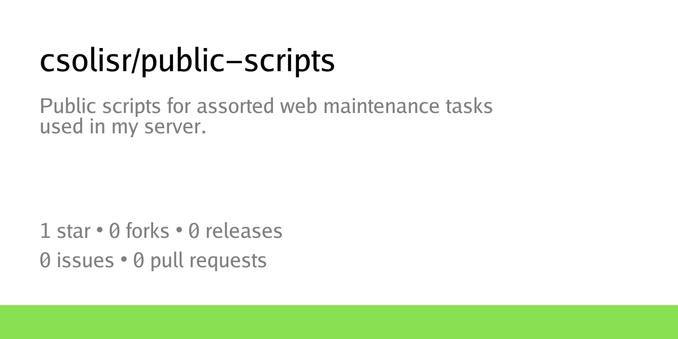
Which explains this: code.azkware.net/csolisr/publi… I sure use my own scripts a lot - and if somebody else can take them as inspiration, well go ahead

public-scripts

Public scripts for assorted web maintenance tasks used in my server.

Forgejo
@david_chisnall And is it also OK to use AI to code it, because I'm fine with it and if you aren't then just move on and use something else?
@david_chisnall@infosec. Sometimes building something requires strong will and ideals.Thank you for providing the community with inspiration.
@david_chisnall ... --- ... ... --- ... S. O. S. We need Sustainable Open Source

@PEAK Yes.

I disagree with @david_chisnall where they say:

"It is okay to stop reviewing patches once other people are familiar enough with the codebase to do so."

In my opinion, it's OK to stop doing anything at any time. Sharing and open-sourcing your code should not come with future responsibility to do anything. If I gove you a gift, it's not on me to maintain and upgrade it forever. I _might_, but if I don't you can choose to keep using it, fix it yourself, find someone else to fix it, maybe offer to pay me to fix it for you - but all that's on you, you can also stop using my gift and throw it away if you choose.

(I think I'd have preferred tridge went sailing, and left it to people who cared enough to step up and fork/maintain rsync when they noticed - ideally without vibe coding it)

@bigiain @david_chisnall In the DEnglish they say jain. Ja und nein. Yes and no at the same point_t in time_t.

Well, IOW it d€p€nd$.

@david_chisnall

Oh that very last one. Spent a month of weekends trying to optimize something I wrote 25 years ago.

Very elegant. Very functional. Very slow for initial usage as it built itself. Some improvement over the original, but that first time sink sucks.

So the regexes stay for now. Sorry not sorry.

@david_chisnall I once wrote and published a code-golfed Tetris clone in 4 kB of JavaScript. People started filing feature requests for it 😆
@david_chisnall in other words, it's okay to not attach hubris to your project. Which is something many people starting projects have a hard time to recognize and accept.

@david_chisnall After all, that is why just about every FOSS license allows you to fork and develop onwards on your own.

It’s okay to just use my project as a stepping stone towards the project *you* want, without expecting me to get involved.

Feels like a lot of folks out there don’t consider that option for whatever reason.

@philip @david_chisnall

I clone the code, compile it, debug my problem and make changes to a project, sometimes reporting back/making a pull request. In fact I also do consider forking, but for often loosing focus/attention and for having to interact/judge other people's work I let it be.

Also it has the potential to generate confusion amongst the users and it makes it more unclear on where to find/report/address security issues.

Yet there are successful forks. LibreOffice and NextCloud, to name prominent examples.

@david_chisnall The second to last one means a lot to me.

If there had been a free software project that did what I needed for making books, in a way that worked for me, I wouldn't have developed my project.

I still feel that if something better came along, I'd use that project instead. There's nothing wrong with that, to the contrary, that's a good thing.