The #EU is about to release its #Tech #Sovereignty package. You can listen to @HennaVirkkunen 's press conference here.

I'll be livetooting in this thread as soon as it gets started 🧵 ⬇️

https://audiovisual.ec.europa.eu/en/ebs/grid?ebs=yes&ebsplus=yes&date=20260603
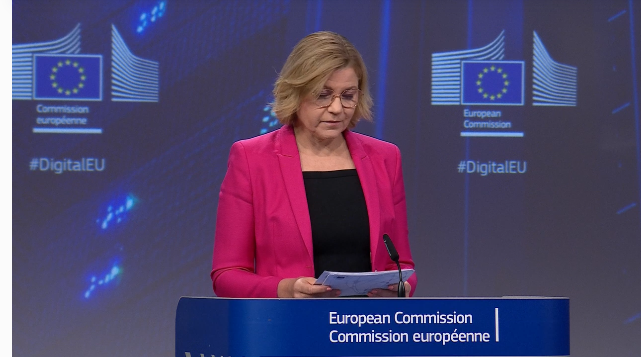
#EUpol #OpenSource

Audiovisual Service

The Press Conference will begin at 14:00 CET!⬇️
FYI: during the livetooting, I may make some references to the OSI feedback on Open source and tech sovereignty, which you can find here: https://ec.europa.eu/info/law/better-regulation/have-your-say/initiatives/16213-European-Open-Digital-Ecosystems/F33369993_en ⬇️

As an FYI, the strategy itself is now public, too! You can find it here!⬇️

https://ec.europa.eu/transparency/documents-register/detail?ref=COM(2026)503&lang=en

Henna Virkunnen has started the press conference, by announcing the appointment of a new advisor on AI. I couldn't catch the name but i'll get back to this!⬇️

Henna opens by defining tech sovereignty, not as protectionism, but as not being dependent on "one company or one country", and being able to make its own choices. She highlights geopolitics and tech now go hand in hand.

She highlights the fact that currently, we rely on foreign companies for 80% of our tech, and this is a problem for autonomy but also our economies
⬇️

She highlights the mistake of "borrowing instead of building, adopting faster than developing, and consuming more than creating". Says this has to change.

She says Europe has everything we need to compete ourselves and great potential in our startups and scaleups.

There are 3 objectives:

Transform our economy by driving new tech
Reenforce supply chain resilience
European way for tech sovereignty⬇️

There are 4 elements to the package:
Chips act 2
Cloud and AI development act
Open Source Strategy
Strategic roadmap for digitalisation and AI in Energy
⬇️

On Chips:
1. Chips act 1 was good, progress was made, but the landscape has shifted because of tech developments: we need to take a share of the AI chip market too!

2. Chips act 2 will stimulate demand and consolidate supply chains, getting rid of administrative burdens.

3. We will boost demand for European Chips by changing supply system (?)

⬇️

On Cloud & AI:
1. we need infra to meet demand: we want to triple AI infra.
2. This is what CAIDA is about.
3. Sovereignty is important :we need to make sure our vital data is in Europe.

She talks about "reliable european providers". but doesn't detail⬇️

Onto the Open Source strategy: she highlights Europes huge potential: the 3mn European Open Source contributors and 500 for profit Open Source companies.

But we spend €260bn on non-EU digital products and services: its time we harness what we have to take control of our future.

This is the aim of the strategy. It aims to strengthen the autonomy of users, companies and public orgs.⬇️

Now she is highlighting the need for investment, saying Europe is falling behind and has a critical investment gap.

She says public funding is a good start, but taxpayers can't foot the bill alone! Private capital is urgently needed!

To bridge the gap, a consultation will begin on building a "European Equity Capacity" to make sure European companies get the funding they need to compete and win on the global stage.⬇️

Virkunnen ends: this is a defining moment for Europe's future: a future where our factories can run on european compute, our hospitals are free to choose ai developed in europe, our innovators can use european software to develop ideas, our startups can grow into global champions right here in europe.

This is a choice we must make now together.

She hands the floor to the EU's energy commissioner.⬇️

Dan opens by highlighting the energy cost of AI, but says that if we want to be leaders, we need to ensure it brings positive change in our societies: we need to do this in a European way.

We need to manage new energy demand in a responsible way while making the best of the new opportunities at our fingertips.

He says, "There can be no digital sovereignty without energy sovereignty".
⬇️

He highlights the issue of Datacenter energy consumption at a time when we need to electrify our whole economy, saying in 2024 datacentrers in the EU currently use enough power to power 20mn households, by 2030 this demand is expected to more than double⬇️

Announces a European rating scheme for datacenters. The Commission focus will be on grid integration, clean supply and flexibility, together with water use and environmental standards.

The goal: grow digital economies without raising energy costs.

Good news: AI can also be used to help steer and control generation. Digitalisation of grid can bring a lot of benefits.

Also highlights how demand flexibility can cut bills⬇️

Calls to accelerate the rollout of smart meters and smart grids across the Union.

Announces the development of an AI model for the energy sector and a EU framework for cross-border energy data exchange, to make the grid more flexible.

"This can help deliver savings across europe".

He also raises the issue of the cybersecurity of energy installations.⬇️

Question time! ⬇️

The Guardian: What is the scale of the Commission's ambition on semiconductors ? What does it look like ? 1/3 ? 50%? What about the strategic project on advanced manufacturing of AI chips?

Virkkunen: Quantity matters but quality is also important, we are already good at this, but we will focus on investing on design capacity and manufacturing in the future. Aim for pilot phase in 2030. The new chips act focusses more on the demand side, pushes use of European chips⬇️

Luca from Euronews: on the AI envoy announcement: why did you choose to create the post?

(fyi: https://ec.europa.eu/commission/presscorner/detail/es/ip_26_1243)

Virkkunen: focus will be industrial AI.

(this is good news in my opinion: a focus on industrial AI will actually provide return on investment, unlike LLMs! See this article: https://jmar.is/jekyll/update/2025/10/13/How-Europe-wins-the-AI-race.html )

Question from politico on energy: will nuclear be included ? Are smartmeters going to require people to use less energy in evenings?

Jann: no, smartmeters are for measuring, but they can help us save in households.
labels will reflect technological neutrality (so nuclear will be in, likely). On an unrelated note, he calls for reuse of heat from datacentres for home heating ⬇️

Q: CAIDA will mean datacentres have an overridding public interest, meaning they can get around some environmental/permitting rules, is that not incompatible for sustainability of datacentres?

Jann: it will be made sustainable by the norms and standards we create.⬇️

back to tech.

Contexte: Cloud and AI development act will require risk assessments for public admins on cloud. Commission will issue guidance to help member states. Regulation talks about implementing acts from which member states can diverge. How much can commission harmonise evaluations? Does the commission want to? What about the cost of switching to sovereign cloud providers? Have you assessed the cost of switching?"

reply in next post ⬇️

Virkkunen: a definition of sovereign cloud across the union is needed, that's why we have 4-tiered definition. When it comes to the risk itself, member states do know best though. If this doesn't work, though, then we can take more action.

On costs: it depends on the member states risk assessments, and the services they are currently using. From our experience in the Commisssion, EU cloud providers aren't necessarily more expensive ⬇️

Question: Elephant in the room: how much of this is driven by the #Trump admin.
Some have worried the push for tech sovereignty comes at an economic cost? What would you say to them?

Virkkunen: we aren't planning to go into isolation, but it is important to identify the parts where we have risky dependencies and how we address those risks. We have to continue operations no matter the circumstances!⬇️

It's especially important that Europeans data is in Europe.

It is true that there is a lot of uncertainty which is why this is needed.

At the same time we want to work very closely with our trusted partners in the future.

On the economic cost: for now, these risk assessments are for government not companies, but we do encourage companies to too.

⬇️

Politico: on Trusted Partners: can the US administration "exercise control over cloud providers or compel them to disrupt continuity?" (a criteria for the 3rd level of tech sovereignty in CAIDA)

Virkkunen: from level 3 upwards, the criteria are strict, we want to make sure there are no kill switches. With the US's cloud act, it's difficult for US providers to reach level 3.⬇️

Matthew, Mlex: follow up on trusted partner: is the fear about the CLOUD act specifically about government intereference? The Commission aim for a wider European cybersecurity certificate, when might you do that?

Virkunnen: ENISA is working on a cloud certification scheme, and the Cyber Security Act is under revision now. The clouid & AI dev act exists to define what sovereign cloud means. Most of the cases will be level 1 and level 2, but critical ones will be higher ⬇️

Euronews: on Killswitches, it hasn't happened, so how present to you is the threat? Have you wargamed a scenario where this happens?

Virkkunen: we know how important a role these technologies play, we are not at war but we are not in peacetime. we are facing many threats, and need to plan for crisis situations. Our operations are digitalised so we must be able to control the tools we use, especially in crisis situations.
⬇️

Theo, Euractiv: Sovereignty Criterea level 3, there is a capacity to designate trusted partners, you just said it would be hard for US companies to reach this level. Does that mean the US will not be designated as a trusted partner?

Virkkunen: I'm not the one who is auditing this, but I said that with the CLOUD act it's difficult to reach this (Really good to see virkkunen giving a clear answer on this).

The press conference is now over! I'll publish some takeaways later! 🫡

First thoughts after the conference

The Choice of the European Commission to appoint Jim Hagemann Snabe, the chairman of Siemens, as its AI envoy, seems to hint at a focus on Industrial AI rather than LLMs.

At a time when the return on investment on Generative #AI is unclear, a focus on AI with a clear potential for ROI is the right move!

I wrote about this in October last year! ⬇️

https://jmar.is/jekyll/update/2025/10/13/How-Europe-wins-the-AI-race.html

Europe can still win the AI race: here's how

If despondent LinkedIn posts and press articles are to be believed, our insistence on putting citizens rights before growth has lost us the AI race. But as AI’s momentum stalls in the US, Europe has a unique opportunity to catch up, if it plays its cards right.

@jmaris Obviously they can win. By not playing.
@jmaris Thanks, that was very interesting to follow.
@jmaris Amazing live thread, thank you for posting about this! (I couldnt watch due to meetings, but this was so helpful!!)
@Gina Glad it was useful! Keep up the amazing work at the OSPO 👏
@jmaris Maybe instead of building "smart"-things we could try to be smart and use less energy.
@ledeuns I understand where you are coming from, but smartmeters can help us measure energy use to reduce transmission infrastructure load, and smart devices, even extremely simple ones, can help us cut energy demand at peaks.

RE: https://eupolicy.social/@jmaris/116686131079723903

@jmaris the issue is not the nationality but the licensencing.

Actually all software is global, attributing nationality to software is silly and shows misunderstand of the industry and anti Open Source Software prejudice.

@DiogoConstantino I don't disagree
To be clear, @jmaris, I wasn't trying to reply but to post quote you. The intention wasn't trying to show disagreement with you, now I do know your opinion (previously I suspected), but this wasn't meant as opposition to your toot, since you're reporting what the Commission is saying.
@DiogoConstantino @jmaris yeah but FOSS we develop is still a strategic soft power advantage, because technology always comes with a set of values that drive design decisions

@Profpatsch @jmaris we as in?

I participate in global open source projects, we share some ideals, we don't share others. But usually, we're more aligned on ideals that impact the way the project is run and that drive design, but we're not only from Europe, and it's insulting saying that being European is the threshold there are people that share our values from all over the world, we're also (re-)using other pieces of FOSS that was made from people all over the world.

@Profpatsch Europe has no moral superiority. I don't believe that values come from nationality.

EU Commission is proposing Chat Control, weakening GDPR and other regulations, that's not being better, it actually is bad. Maybe others can in some cases be clearly worst, but the difference is the values, not the nationality.

@jmaris

@DiogoConstantino @jmaris it does not matter if you don’t believe in European moral superiority, because the Commission does, per their mandate.

@Profpatsch it matters to me and to all those who care about my opinion.

@jmaris

@DiogoConstantino @jmaris yeah of course, but it’s not what this thread is about

@DiogoConstantino @Profpatsch I don't disagree with Diogo that Open Source is a global thing, and I'd warn against segmentation.

On the other hand @Profpatsch is absolutely right that this is not about that: it's about building capacity in Europe, which is a strategic goal for the EU.

@jmaris building capacity is obviously a good thing because it will not only benefit all those who use Free Software, but also the European economy, I was just point out that, we have to be careful about how we present it, and we should want that politicians should have motivations aligned with the values and advantages, not with the nationality argument.

@Profpatsch

@DiogoConstantino @jmaris yeah, agreed, but the thing is that it’s a good thing to fight for values foremost because they are upstream of everything.

e.g. I believe that “free software at all cost” is just a pretense value that many people in FOSS have been indoctrinated to believe, at the cost of real values like anti-monopoly, human dignity, “from each according to their ability, to each according to their needs” etc

@Profpatsch most of those are not really into FOSS. FOSS does help prevent and defeat certain monopolies, it's however not the only tool for it, neither is it enough, same for the human dignity, it's also not a tool to solve all the problems, and shouldn't be seen as that, however it's definitively the minimum acceptable for software.

@jmaris

@jmaris @DiogoConstantino I would push back on this in the sense that yes, physical data centers are well and good, but they are really just infrastructure. We (the EU) can build roads maybe 30% more effectively (debatable!) than a random other country, but we’ll never gain a fundamental advantage from infrastructure commodities.

But the design we embed in our software is exactly the thing that can make us opt-out of e.g. extractive US policies or logic of monopoly building.

@Profpatsch unfortunately those policies are not exclusive of the USA, we must be careful about it because what they are, and what they cause, and not focus on the nationality part, we might find ourselves doing the same, if we don't focus on the values.

@jmaris