 Nicholas B.
 Proton
(If I hadn't shared them) which would be the best password and why?
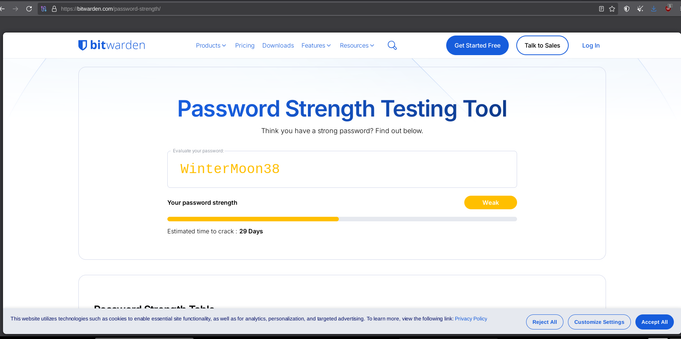
A) WinterMoon38
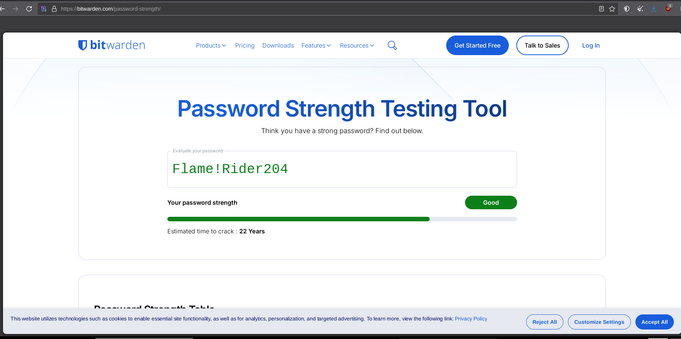
B) Flame!Rider204
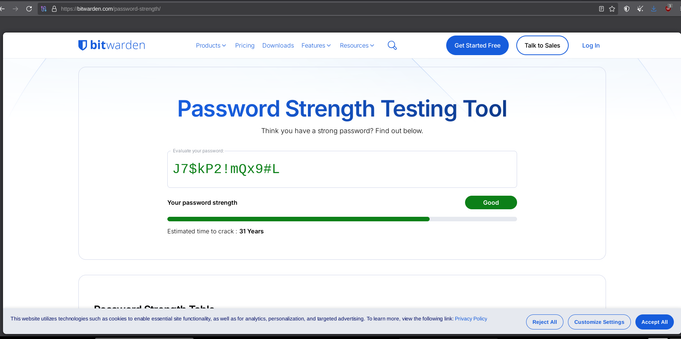
C) J7$kP2!mQx9#L
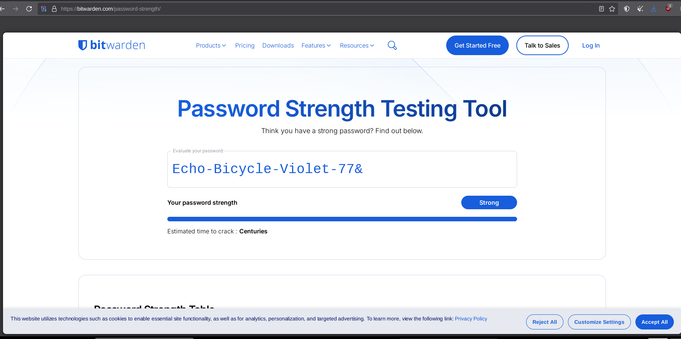
D) Echo-Bicycle-Violet-77&
(If I hadn't shared them) which would be the best password and why?
A) WinterMoon38
B) Flame!Rider204
C) J7$kP2!mQx9#L
D) Echo-Bicycle-Violet-77&
@protonprivacy
C: because it consists of random characters, including lowercase and uppercase letters, numbers, and special characters.
The others may be included in word lists because they appear in dictionaries.
@juergen fyi: https://xkcd.com/936/
The entropy of D is far greater than the entropy of C.
@protonprivacy No Unicode non-ASCII character? That's bad.
@protonprivacy I'd probably go with C), because it's the least human-readable (mind you, programmatic hacking tools don't care about human readability). D) is longer, and is more memorable (although if you use a password manager, you shouldn't require memorability).
A) is weak because it contains consecutive o's -- which I was always taught was a bad thing -- and has no special characters. B) is probably okay.
Tricky one. I dunno.
What's the correct answer?
@CatsofArrakis @protonprivacy When the words themselves are plentiful enough, have no discernable reason to be used together, and have at least a couple extra characters to poison the dictionary attack, then you're only going to be able to brute force it and at that point entropy is all that matters.
The only thing I'd change would be separating the words with just dashes. I think you could keep the password memorable enough by using something else or varying the separating characters.
D) assuming you have a sufficiently large diceware-type dictionary 🤓
D, but only as long as that schema was not mandated or the attacker knows that you're using it.
After that C.
But Really just use a local non-cloud password manager like KeePassXC and generate a 120 character password that just gets filled in on the correct website after clicking on it...
@MurrayWindripper @gareth @protonprivacy
Devtools and remove the event handler for paste with a single click.
C for its complete randomness. Then D because of length, but using the same separator between words is a pattern and that words are capitalised normally, when it should be more random are flaws.
@protonprivacy
Obviously B, because it's the coolest.
And jokes aside: D, because size matters
' OR 1=1 --
@protonprivacy D I guess? Length 🤔
Below are screenshots of the test results
f) realize passkeys are really non standard and all over the place implementation wise, used different on various websites, depending on what OS or OS family you are in handled completely different and backing them up or replacing them when a device is lost you accidentally (or was enforced) to use is a nightmare and then simply cry and use d)
/s :)
@ginkgotrees @protonprivacy Yeah I know mathematically more length makes for more entropy. But as I put 50 zeroes I am not making it more secure, then putting words from a dictionary should reduce entropy. Because I can count how many bytes are "truly" random makes me say C has more entropy than D.
There's no relationship among its components while the other is 90% made up of relations. One just need to figure out an attack on that relationship. It's more secure because i don't know the attack.
There is no best answer. C looks as if it has the highest entropy, but it's also the most likely to be written on a note taped to the underside of the keyboard.
A mix of C and D would be best, because it combines high complexity (random characters) with greater length, making it more resistant to brute-force and dictionary attacks.
@steve_lebt_in_freiheit @protonprivacy
It's so popular, so it must be good
@protonprivacy D by me. Easier to remember, long, uses special characters, lowercase/uppercase & numbers.
Although, using password manager (self-hosted) and having passwords consistent of at least 40 characters would be better, or a passkey (not-synced)
E) magiclink 😏
@protonprivacy
Depends on the purpose.
J7$kP2!mQx9#L is best for password managers because it's long, random, and has multiple special characters. It is difficult for a human to memorize, though, which is why it's best to use a password manager, like ProtonPass, to remember it.
Echo-Bicycle-Violet-77& is best as a master password, although technically slightly weaker than the other, but a human can remember it and can type it in when necessary. It's good though because it has special characters too, is long, and has upper- and lowercase letters and numbers.
Dictionary words aren't a problem unless you only have one.
Crunching a random string of characters is only as strong as the string is long, so 13 characters like in C is not great.
 Pixel Dunn
 Karl
Karl

 Juergen M. Bruckner
 BypassBlues 🌻 🇪🇺 🇺🇦
 Stéphane Bortzmeyer
 Graham Downs
 Cats of Arrakis
 Dirge
Dirge Flock of Cats 🐈 🐈 🐈 ❄️
 Klaus Frank
 Gareth 🏴
 Murray 🇪🇺
 Guillaume Betous
 SirWumpus 👾🍁
 Progenitus
 Hactario
 gram
gram Sascha Presnac 🙄🤦♂️
 K501
K501 정아름
정아름 Urix Turing
 Alex
Alex
 🐦🔥nemo™🐦⬛ 🇺🇦🍉
 WILLIAM B PECKHAM
 Ketumbra
 Jens
Jens Gregoire
 Splinux
 ginkgotrees
 Felipe Cerda
 Bart Smit △ ⲁⲗⲍⲓⲙⲟⲛ 🇪🇺🇺🇦
 C++ Wage Slave
 Louis
Louis Lazou
Lazou _marco_
 Steve lebt in Freiheit
 Androcat
 The_Universality
 radar man from the moon
 Sproid
 Jerry on Mastodon
 Lunar 🛸 ♾