#NZPol
Take time to explain the basics.

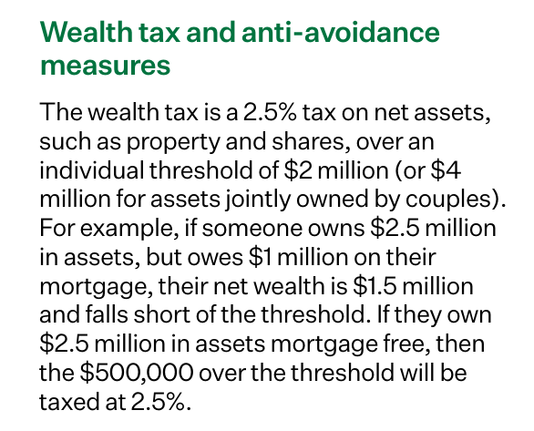
Wealth/asset taxes are generally based on 'Net Worth'. If you don't know what this means you will likely think an asset tax will hit you harder than the reality.

Your Net Worth is your assets minus your liabilities
Eg you have a $3 million house, a $2 million mortgage and $100k of loans. Your net worth is $900k and that's what a wealth/asset tax would be based on.

I thought a co-worker was trolling me when he loudly proclaimed he wouldn't be able to afford the Green Party wealth tax so he'd never ever vote for them. After asking some questions I realized he genuinely did not understand 'net worth' and after explaining the above he said fairly quietly, 'I did not know that'.
#Accounting #Econ
#Democracy #TaxWealthNotWork

@Niall

It’s awesome what you did.

@Niall thanks. Good info 👍💚
@Niall any policy or campaign will need to very carefully explain how it works. It’s too easy to assume people understand.

It would be good if there is a calculator. Put in your mortgage, bank account amounts, salary, and it'll tell you how much you'd owe.

All the details are here and it's explained in text but that's on page 33:
https://www.greens.org.nz/green_budget_2025

I also think it needs to be more progressive. Once you get over $1,000,000,000 then there's a higher rate, and once you exceed $40,000,000,000 you get the 99% tax rate.

@Niall

@futuresprog yes, a calculator would be great. However from that snippet the person wouldn't be liable at all even if he had no debt. He's part of a couple so they could have $4mill before getting pinged an extra cent.
Says something that someone who's actually worth 1/2 of 1 million thinks this tax would destroy them. Marketing, we need more marketing.

@Niall @futuresprog there is also the problem that people think they are going to have to pay the billionaires' tax because they're going to become a billionaire.

On the other hand there is the council rates problem where we want to pay less than things cost.

@va2lam as someone said years ago, 'people vote like they are temporarily embarrassed millionaires'. It is sad. @futuresprog

@Niall You appear to have a coworker from the superior range.

“… he said fairly quietly, 'I did not know that'.“

@Niall the downside is that if you have a 3million house (I assume this is based off market value) despite paying a lot less 15 years ago and paying off your mortgage you might not be able to afford your own house anymore. So hopefully you didn’t have a family or anything awkward like that.
@dianshuo read the other replies, its not so likely. If you're a couple you don't pay anything on net assets below $4million.

@Niall “it’s not so likely” ?

I don’t object to wealth taxes when they actually do what they say but most of these bright ideas actually end up squeezing the middle not the top. I can’t see how this is different.

@dianshuo that's good that you don't object to the principle. How would you structure one? Ideas are useful.
@Niall @dianshuo What successful international models are there?
@worik @dianshuo I'm not Google
Edit: sorry that was too blunt. Try here for a good discussion: Gary interviews Gabriel Zucman https://pca.st/episode/74fcf109-e47a-4069-92f2-2da641606793
The economist billionaires fear: this is how we get a wealth tax. Meeting Gabriel Zucman

Gabriel Zucman is the most important economist in the world today. And the one billionaires fear most. His wealth tax proposals have passed France's lower chamber of parliament – and will likely…

Pocket Casts

@Niall @dianshuo

I do not really have time to listen to another podcast!

Are there any examples of wealth taxes being applied in comparable economies to ours?

@worik @Niall I think the obvious answer is no. Everyone uses some form of progressive tax band. Norway is probably one of the more effective ones where it’s obvious what the state provides in return for “higher” tax. Having said all that - most of this comes down to what you are doing with the tax and no-one puts down a statement showing full income vs expenditure.
@worik @Niall @dianshuo in that podcast Zucman suggests setting up the tax thresholds so that the richest 100 people in the country pay around 2% of their wealth every year. He also suggests setting up tax in general such that if you are a citizen, you still have to pay taxes to the country for a few years after you leave. He's not suggesting anything as draconian as the USA tax policy of "you pay taxes to the country for your whole life" but thinks a few years would be a good idea.

@mu @Niall @dianshuo

> in that podcast Zucman suggests setting up the tax thresholds so that the richest 100 people in the country pay around 2% of their wealth every year.

Ok. I am not arguing that that seems sensible on the face of it

But what I would like to know is what has been tried, how has it worked, what went wrong, what can be done better.

Activist economists (me too) can say anything they please. Data from policies applied is gold.

Look at the experience with rent control...

@worik
If we can only try things that have already been done, are we stuck forever with a system we know does not work?
@mu @Niall @dianshuo

@RedRobyn @mu @Niall @dianshuo

If we do not pay attention to what has gone before...

...we are fucked

@worik @Niall @dianshuo I think all economists are activists.

Where has it been tried before? None of the concepts are new, we have had wealth taxes in the past, we have had thresholds in the past. Most countries tax assets in various ways

I feel you're looking for more detail here than I'm able to give. It would probably be faster and more accurate to listen to the podcast. You may also be able to find a transcript somewhere?

I don't claim to be an expert in this area, that's why I'm listening to the experts.

@mu @worik @Niall opposed to the tax after leaving. That is essentially a migration/free movement control.

2% on assets seems like a bodge that doesn’t address disguised earnings/tax avoidance directly. Again squeezing the middle unless the “100 richest” is dynamically determined.

@worik you seem to want others to do the hard work of searching and you only offer negative feedback. Either deliberately or accidentally you are sealioning.
@dianshuo I feel you are nearly as bad. I have already asked you for your ideas once but all you do is provide reasons why other's ideas are bad. This is not helpful or useful.
@mu

@Niall @mu @dianshuo

What?

Do I have to watch a podcast to get asimple answer to a simple question?

What do you expect of me. You do not know me or what I've done.

I am asking people with opinions about their opinions

I offer more than negative feedback, that is all you heard. Look again.

You are gaslighting me.

Get beyond the slogans (tax the rich - fine slogan good concept) to the policy nitty gritty

Where have wealth taxes been tried? What did and did not work.

@worik @Niall @dianshuo wealth taxes have been tried in the past. Some of them haven't worked, in particular France exempted billionaires and it collapsed the whole thing.

What do you think wouldn't work? If I can get a feel for your concerns, maybe I can suggest something that might ally them?

@mu @Niall @dianshuo France's is one of the few I've heard of.

IIn my mind I compare it to rent control, about which I know more.

Famous for rorts and distortions in New York yet with more careful policy i know European cities have had success

I'm interested in stories.

France is one.

The other day I heard a liberal tory dismiss the idea "50 attempts at a wealth tax, only 5 still around". It surprised me as I'd only heard of France

Hence I keep asking, despite the flaming I'm getting

@worik @Niall @dianshuo

I can't give you one summary, but Wikipedia has a pretty good overview of wealth taxes, their criticisms and benefits

https://en.wikipedia.org/wiki/Wealth_tax

It's in a bit of depth.

One thing to note about this proposed wealth tax is that it's much simpler than any of these historic taxes, which all seem to have been captured by the ultra-rich over time

Wealth tax - Wikipedia

@worik @mu @dianshuo I'm sorry, you're right, I only heard your constant nagging to provide information about an idea you don't like so that you can pick holes in it. I didn't engage with your ridiculous 50% GST suggestion other than to nudge it towards an idea supported by the majority of economists-a carbon tax.
You harry me for data about an idea that is perfectly researchable by yourself. It is not my idea, not my job to do this for you. The starting point I offer for you to begin your research, you reject.
Meanwhile the ideas you put forward have no popular or academic support AFAIK and you have provided nothing of the data you are demanding from me to support them.
I stand by my summary of your behaviour. Do better or get blocked.
@dianshuo @worik @Niall the 2% is worked through in Zucmans work. The rest seems to be fairly straightforward?

@dianshuo @mu @Niall

> opposed to the tax after leaving.

What does that mean? Is some text missing?

The 2% wealth tax is a kite being flown, not a concrete policy. Concrete wealth tax policy will be ,such harder than that if it is to work.

Have to start somewhere

@worik @dianshuo @Niall Zucman had a book that outlines the policy, that would probably be a good option to get the detail that you're after.

@dianshuo @Niall Well, maybe that's just the way it has to be. The null hypothesis is that we continue to pile more and more taxes onto people who earn a wage, which means your hypothetical pays no tax at all, and we continue to crush everyone else.

Yes, paying taxes sucks.

@Niall

I see why people want wealth taxes, and I have (years ago) looked closely at them

The big problem is how easy they are to avoid in a society with economic freedom. I believe strongly in upper limits to private wealth, but I know no way to achieve it in a social system based on private property

@Niall so perhaps we should have a social system that is not based on private property.

That is harder to organize.

The attraction of capitalism as a social system is its incredible resilience. Been two centuries now, still going

Can we separate our social systems from our economic ones? I think we can, and that is the way forward

@Niall so I want to see from political parties:

Housing treated as essential infrastructure and planned.

Housing treated as an unalienable human right, not to be horded

Plannng generally. Markets find prices, they do not make plans.

Incomes policy. Prices at the supermarkets are not too high, incomes are too low

Education, healthcare and infrastructure to take the lions share of state revenues

A target of never letting government spending drop below 50% of GDP

@Niall as for taxes the only taxes reliably paid by the rich are consumption taxes, and they are very regressive

But citizen dividends are very progressive

We should combine them

Increase GST (and charge it on overseas money transfers) to 25%. The extra 10 percentage points to be redistribute equally (yes billionaires in New Zealand, both of them, get it too) to anybody resident in Aotearoa with an IRD number

Do the dividend quarterly and make it ineligible for means testing calculations

@worik I like the idea of citizen's dividends. I would rather pay for it from a carbon tax but that's a minor point.

@Niall To shave a minor point even finer a carbon tax is a consumption tax

I fear carbon taxes were a fantastic idea in 1997. A bit late for marginal instruments now, unfortunately as far as the climate catastrophe is concerned.

@worik @Niall I think you'll find that closing the worst loopholes in a wealth tax will be a lot simpler than attempting to impose communism (whether it'll somehow work as advertised this time for sure or not being a completely different question).

@Salty @Niall I do not propose "imposing comunism". I propose keeping a conceptual and concrete separation between economic and social systems

Some policy points I know of that help get there:

* Fully subsidised health and education

* Socialo housing expanded to the point It is the dominant landlord

* Social housing rents based on minimum wage not household income

* UBI (duh!)

@Salty @Niall

I think a civilised society would eliminate private property and money, but we are not ready, culturally, to make that leap. So I do not propose that as a policy

@Salty @Niall I confess I find the "[you're advocating] imposing comunism" trope very tiring in 2026
@worik @Niall You may not see it that way but I guarantee that the kind of people you actually need to convince will.

@Salty @Niall Yes. "Communisim " in that context is a meaningless curse

But we are at an inflection point now, and anything can happen

@Niall The only weakness I can see with that calculation is there may be people who own their home but have no income or other assets to speak of. How would they pay the wealth tax on their home? Is the expectation they'd liquidate (sell) that asset (their home) then they'd have the cash to pay the wealth tax? [edit] just to be clear, I'm not in the situation I describe above and I strongly support the introduction of a wealth tax]