Asking German speakers on Fediverse.

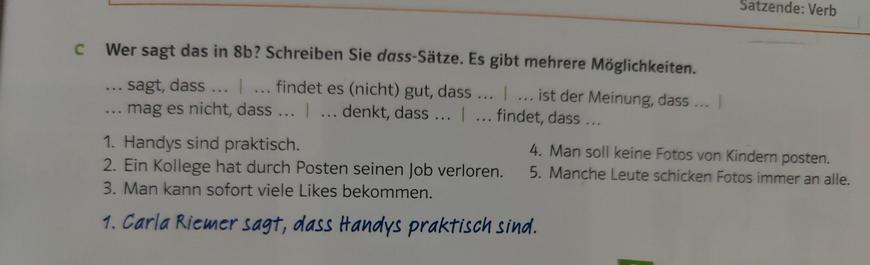
The attached photo is from Goethe Institute's A2 level coursebook and has a sentence:

> Man soll keine Fotos von Kindern posten.

We had to formulate a sentence with "dass", so in the class we got the following sentence:

> Ich bin der Meinung, dass man keine Fotos von Kindern posten soll.

Shouldn't we use "sollten" (Konjunktiv II of "sollen") here instead of "sollen"? I think the following conveys correctly that we want to say:

> Ich bin der Meinung, dass man keine Fotos von Kindern posten sollte.

What do you think?
#Deutsch #AskFediverse #German #languagelearning

@ravi Native speaker here. Your first sentence is lacking the "dass", it should be

> Ich bin der Meinung, dass man keine Photos von Kindern posten soll.

(btw, most German speakers will spell it "Fotos" these days.)

"sollte" instead of "soll" works too and is probably more formally correct, but in everyday speech people will use either and not think about the difference.

@scy @ravi

I'd say that "soll" is correct as well, though the meaning would be more categorical than "sollte". It's perfectly grammatical to use an indicative form there, IMO.

(remark: *"sollten" doesn't really exist as an infinitive.)

@quincy @scy @ravi shall vs should

@jens Which one is more appropriate in the sentence? Do both work here but mean different things?

> Ich bin der Meinung, dass man keine Fotos von Kindern posten soll/sollte.

@quincy @scy

@ravi @quincy @scy Depends on how strongly you want to state your opinion, no?
@jens I am trying to learn the difference between the two forms, which means I cannot answer your question. @quincy @scy

@ravi @quincy @scy well, "soll" means "shall", "sollte" means "should".

One shall not take pictures of kids is definitely more strongly worded than when one should not.

@jens @ravi @quincy @scy "Shall" and "will" are for most if not all purposes the same now. "Shall" sounds a bit archaic/formal to most people, though there are some dialects where "I/we shall" but "you will".

I was absolutely not aware that there was a semantic distinction between "soll" and "sollte". As far as I knew, they are just different forms of the same verb. Interesting to learn.

@kauer @jens @quincy @scy "sollten" is konjunktiv II of "sollen".
@ravi @jens @quincy @scy Yes - different forms of the same verb, no?
@kauer What do you mean by "semantic distinction"? @jens @quincy @scy

@ravi @jens @quincy @scy A difference in meaning (beyond mere tense).

So "gehen" and "stehen" have a semantic difference, but "gehen" and "geht" (or "stehen" and "steht") do not, given the same context of course.

@kauer @jens @quincy @scy sollte- is konjunktiv II of sollen and not a different verb.