Your kanji app lied to you about 衝撃 (shōgeki), the word for "shock." It cuts the character 撃 into a car, a weapon and a hand and hands you a story: an attacker speeding at you, weapon raised. There is no car. There never was. And look at what that story can do: it gets you through this one character, and not a single other. That is the flaw in every made-up mnemonic, and it is exactly what our method fixes.
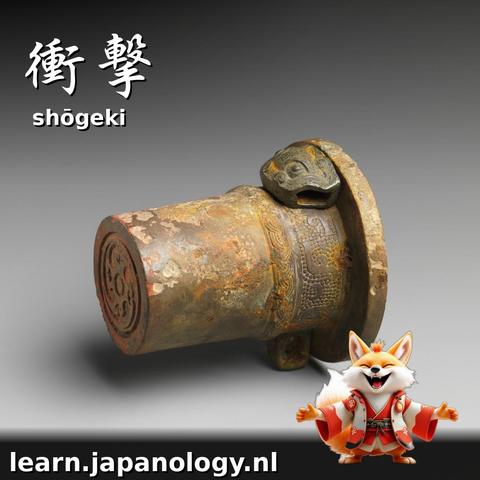
Follow 撃 back. The working part is 毄, and inside it sit two real things: the bronze cap on the end of a chariot axle, and 殳, a hand swinging a striking staff. When the wheel had play in it, the spinning hub slammed against that bronze cap, and 毄 froze the clatter. Add 手, a hand, and 撃 is to strike something hard enough to ring like that. The bronze axle cap in the image is real, twenty-five centuries old. Now the part that matters.
The app called that piece 殳 a "weapon" and moved on, and that label dies inside 撃. But 殳 is a hand swinging a striking staff, and once you hold that, look what opens: 殴る (naguru), to beat someone, the staff coming down; 投げる (nageru), to throw, the same hand hurling. One component, understood once, and 撃, 殴, 投 and a dozen more stop being separate flashcards. Now the other character, 衝. The app calls its outer piece 行 "go. " Hold that thought.
衝 sets 行 around 重, here a worn-down form of 童, which carries the sense of breaking straight through. A road that breaks through everything: that is 衝, a thoroughfare, and then the charge that storms down it. The oldest Chinese poetry already uses 衝 for the siege ram that beats a city wall down. And here is the app's "go" falling apart. 行 is not "go. "
 Loek van Kooten, MA