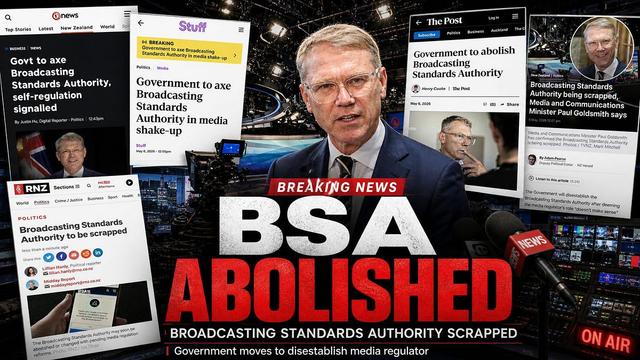
"Removing content standards such as accuracy, balance and fairness, I think invites a significant political risk. You could end up with a rogue media operator with significant market power that chose to ignore them, with impunity. And I think that's politically dangerous, democratically it's indefensible."

#DrPeterThompson, 2026

https://www.rnz.co.nz/podcast/mediawatch?share=bdb1a4a8-a91f-48a0-ac5e-f81f354a7021

https://www.rnz.co.nz/news/political/594762/mediawatch-putting-down-the-watchdog

This is a very complicated issue, and I'm still figuring out what I think.

(1/?)

#BSA #MediaWatch #RNZ #podcasts

Mediawatch podcast

A critical look at the New Zealand media.

RNZ

A younger Strypey, working with Indymedia, would probably have celebrated the scrapping of the Broadcasting Standards Authority. Perceiving it as a Mary Whitehouse style entity, enforcing stuffy, anachronistic rules on media, like the rules that used to police what songs could be played by a radio station.

But even then, someone making Thompson's point would have given me pause. It's not a bad thing to have some limits on a mega-rich prick's ability to pepper the public with propaganda.

(2/?)

As mentioned elsewhere in the linked edition of MediaWatch, even the people running the BSA admit that its statutory function has not been updated as the wider media ecosystem has evolved. It dates back to a time when TV and radio were the most powerful way to convince the public of things. Which hasn't been true for at least a decade if not 2.

(3/?)

The BSA was created as part of comprehensive media reforms, which also included allowing for-profit entities to set up (or buy) TV and radio stations in NZ. The government of the day feared the media tail wagging the dog of democratic governance. Using the disproportionate opinion-shaping power of terrestrial broadcast media to artificially constrain or expand what's politically possible, in the interests of its owners.

Which is exactly what's happened since with social media platforms.

(4/?)

By moving with the times in investigating a complaint against The Platform (not a traditional wireless broadcaster) the BSA has opened up a Pandora's box of potential complaints against livestreaming channels that reputation launderers have been using with impunity. Podcasts are broadcast-like too, what if they're next?

Billionaires and their political pets don't want to lose the power that this propaganda machinery has allowed them to hold onto - or even increase - so the BSA has to go.

(5/?)

But I don't think a knee-jerk defence of the BSA is necessarily the right response.

As busy citizens, we do rely on media to keep governments and other institutions of state accountable, and we need them to have a reasonably free hand to do that job. We don't want the government of the day to be able to shut down programs or channels they find politically threatening, using spurious accusations of indecency or whatever.

(6/?)

So if there is a media regulator empowered by the state, it needs to be very carefully designed. Its power constrained and tightly focused. Its purpose, structure and operations regularly reviewed. Ideally by a review board including representatives from media entities and civil society orgs (eg Better Public Media, InternetNZ), as well as Parliamentarians.

We need to pressure the government to put this new body in place as part of abolishing the #BSA. Not after, maybe never.

(7/7)

#PolicyNZ

Just listening to Duncan Greive's 7 May special edition of The Fold on the government's decision to abolish the BSA;

https://thespinoff.co.nz/podcasts/the-fold

I stand corrected on my suggestion that the BSA could theoretically accept complaints against podcasts. Greive mentioned that "on demand" services are specifically exempted from BSA jurisdiction. Confining them to regulating only live broadcasts.

(1/?)

#MeaCulpa #BSA #TheFold #TheSpinoff #podcasts

| Podcasts | The Spinoff

The Spinoff

But obviously if online channels like The Platfarm and Reality Chuck Radio were regulated by the BSA as live broadcasts - which they clearly are - that would reduce the disinformation bandwidth available to parties whose success relies on a post-truth media environment. Even more so if citizens started making BSA complaints against other far-right livestreamers on YouTub, FarceBook, Xitter and elsewhere were also regulated.

(2/?)

So therefore the knobbling of the BSA, and which parties have stood up for it, tells us a lot of about who's committed to truth-based politics. It's clearly not any of the parties in the NatACT First coalition. So far, it doesn't appear to be Labour either, whose performative criticisms of the coalition's decision are, as usual, a cover for a complete policy vacuum.

(3/?)

So what would the Strypey party propose? I think our food regulations offer some policy models we could apply, in 3 ways.

First, food products have to list their ingredients. Maybe media services ought to as well?

If media entities present themselves as news outlets (or even news-like), maybe they should be held to basic journalistic standards? If necessary, by a regulator who can use the power of law to make media outlets label themselves accurately based on what they carry.

(4/?)

#PolicyNZ

Second, our food regulations take into account the scope of the vendor. A fundraising sausage sizzle isn't held to the same standards as a multinational food conglomerate, and neither should they.

Maybe we need something similar in the media space? I do want to see multinational conglomerates being forced by law to take responsibility for the practices of the media outlets they own. But I *don't* want heavy-handed regulation of citizens or small groups publishing blogs, podcasts, etc.

(5/?)

Third, NZ food regulation is done in cooperation with regulators in Australia, via bodies like FSANZ. At least partly in recognition of the fact that some companies providing food products and services in Aotearoa are more powerful than the NZ government, both financially and politically.

Harmonising our food regulations with our much larger neighbour, in a systematic way, gives us a better chance of getting powerful companies to follow them. You can guess where I'm going with this.

(6/?)

Perhaps we need a formal pan-Pacific media standards body? One anchored by the size and market power of Australia, but which NZ and other smaller Pacific governments can join, and have meaningful input into the regulations it enforces.

Taking into account the last point, the jurisdiction of a pan-Pacific media regulator could apply only to cross-border media activity. With media outlets owned and operated only within Aotearoa exempt, and subject to something more like the Media Council.

(7/?)

That domestic regulator could be a form of industry self-regulation, like the Media Council, but maybe with legislation that obliges any media outlet presenting what they do as non-fiction to join. So Reality Chuck Radio would either have to join the self-regulation body and subject themselves to its jurisdiction, OR clearly promote their channel as an entertainment service broadcasting fiction.

(8/8)

"The BSA chose, for its precedent-setting foray into digital jurisdiction, the loudest, best-funded, most politically connected antagonist available."

#BryceEdwards, 2026

https://www.democracyproject.org.nz/p/democracy-briefing-the-bsa-is-dead

I'm not sure that's fair to the BSA. As Edwards says, the BSA opened itself up to complaints about digital broadcasts in 2020. I doubt it was their desire that the first actionable one happened to be against The Pratfarm.

(1/2)

#DemocracyProject #NZPolitics #BSA #ThePlatform

Democracy Briefing: The BSA is dead. Now what?

The announcement was brief: a ministerial press release, mid-afternoon, a few paragraphs.

The Democracy Project

Also, if that first complaint about an online broadcast had been against another outlet, the Taxpayer's Onion and Free Preach Onion would still have piled on. As would ACT and Winston First. Defanging the minimal media regulation that remains, and blocking any attempt to update it, is critical to the success of all 4 of these groups. Although for different reasons.

(2/2)

"Chris Trotter described the BSA’s approach as “a naked power-grab by a statutory authority with a strong aversion to untrammelled political expression.” When critics come from both left and right, you’ve usually got a problem."

#BryceEdwards, 2026

https://www.democracyproject.org.nz/p/democracy-briefing-the-bsa-is-dead

Chris Trotter has been working closely with the Free Preach Onion for years, since very publicly falling out with Bomber Bradbury and TDB. 2026 Trotter is hardly representative of the left or our opinions about the BSA.

Democracy Briefing: The BSA is dead. Now what?

The announcement was brief: a ministerial press release, mid-afternoon, a few paragraphs.

The Democracy Project

@strypey It’s interesting - regulation of public spectrum (radio, TV) is partially done because it’s public spectrum and is finite. So, in the US, over-the-air TV is regulated while cable TV is not.

However, podcasts and other online services are still regulated by libel law, truth in advertising laws, etc etc. It’s just that there aren’t specific regulation for online services in the same way.

The UK also regulates the EPG (the list of channels); and specific things like subtitles (you have to have them if your audience is bigger than a certain size). Canadians regulate percentage of Canadian content, primarily to stop them being squashed by US influence.

Fascinating to watch…

(1/2)

@james
> regulation of public spectrum (radio, TV) is partially done because it’s public spectrum and is finite

Another comment on a related media regulation thread pointed to this too. As well as making the excellent point that effective anti-monopoly enforcement in the media industry would reduce the opinion-shaping power of individual outlets. Making peer-review amongst media - both formal and informal - much more effective.

(2/2)

But as I said to them, there's a consumer protection angle here too. For example, if a media outlet represents what it does as journalism, when it's actually misinformation or propaganda, that's false advertising, and arguably, unfair trading.

The service that media outlet offers is not fit for purpose. So there's exactly the same argument for public action against them as when a restaurant is routinely serving horse as beef, or giving people food poisoning.

@strypey Agreed about ownership rules (which is the anti-monopoly thing). I also quite liked the political bias rules from Ofcom (and until Reagan, the FCC). To require equal time, and/or an absence of political bias, seems utterly sensible to me. The result of a lack of that - like in Australia for example - seems to lead to total distrust in anything the media does.

However, as is visible in the UK press, you can end up with a situation where a gentleman’s agreement exists not to criticise each other. This is where RNZ’s MediaWatch perhaps, and certainly the ABC’s Media Watch (and, perhaps, the UK’s Private Eye) perform a vital role in keeping the industry honest.

(1/2)

@james
> as is visible in the UK press, you can end up with a situation where a gentleman’s agreement exists not to criticise each other

This only works where all the media outlets with a significant audience are owned by a handful of gentlemen. The more diverse media ownership is, the more genuine competition there is, and the more likely it is that someone will break ranks. So robust anti-monopoly enforcement helps with this too.

(2/2)

@james
> RNZ’s MediaWatch perhaps, and certainly the ABC’s Media Watch (and, perhaps, the UK’s Private Eye) perform a vital role in keeping the industry honest

Definitely. Which points to another key plank of a pro-democracy media policy; sufficient funding for noncommercial, public interest media. Both RNZ and ABC produce these media commentary shows as part of carrying out their public interest mandate, and don't have to risk losing ads or subscribers if they reporting upsets someone.

@strypey Off-topic: does restaurant, street and bakery food in NZ also have to list its ingredients? If so, that's cool, I'd like this policy to become more world-wide, because currently I just live with the assumption that most ready-made food out there isn't edible for me by default, unless specifically marked as such.

@cashew
> restaurant, street and bakery food in NZ also have to list its ingredients?

Yes. If you ask, they're obliged to give you an ingredients list.

Many people don't know that, or don't bother to ask, so vendors aren't always prepared to supply that list. But that's something that can be fixed by customers advocating for ourselves. If we only we can get past our conflict avoidant cultural habits, part of the inheritance from a century of English cultural imperialism.