BobTop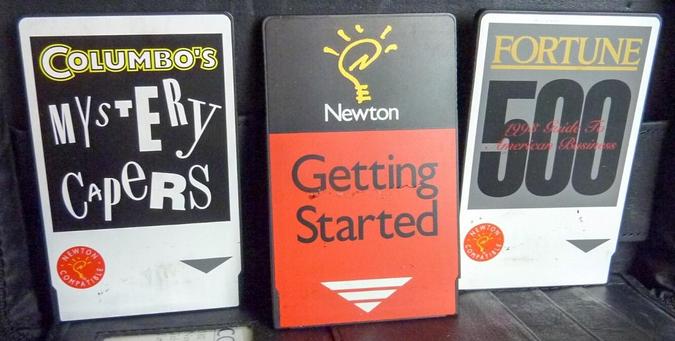
 pablo_marx
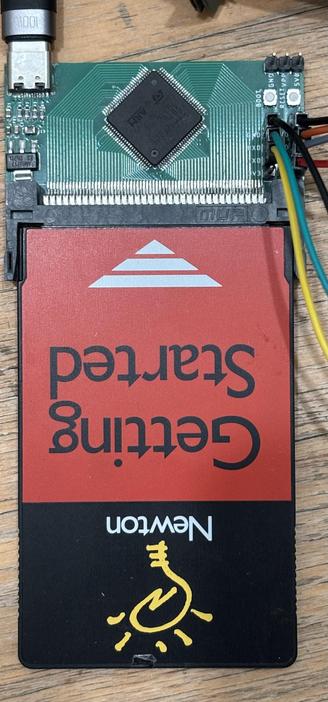
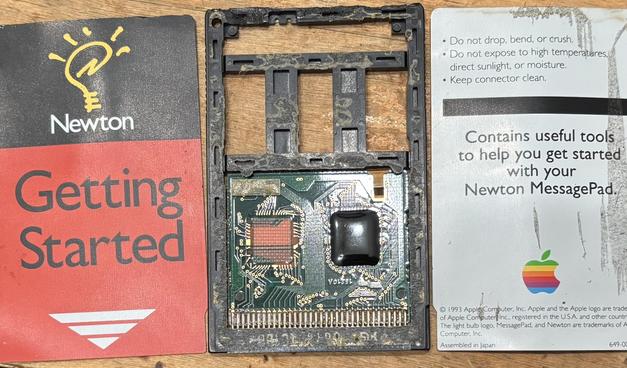
@BobTop Annoyingly I have two Getting Started cards that no Newton can read and when I attempt to read them on a card reader I made, it seems like they have some stuck bits. I'll poke around with them more and see if I can tweak the timing or pull-ups / pull-downs to get better results.
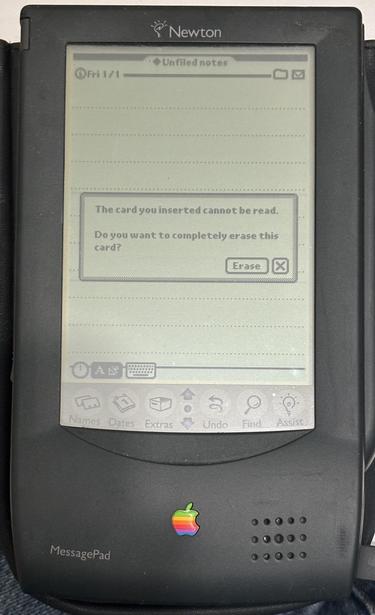
@pablo_marx As far as I understand, the dumps were made using exactly the same device as yours, in xxx.pccard format. But I can't figure out what's inside.))) Your Newton 1.xx PDA had a lot of software that only worked on Newton 2.xx PDAs.
@BobTop I tweaked a lot of things and still can't get a good read from Getting Started. Bit 0 is almost always stuck and bit 15 very often is. I cracked the card open hoping maybe there was just some corrosion on the legs of ROM, but discovered a chip on board epoxy blob. I could try decapping it in a month or two.
I bought a Fortune 500 card off eBay and read/dumped it without a problem. I need to do some more sanity checks with it, but I'll get it uploaded in the next couple of days.
@pablo_marx Is there any progress in this?
@BobTop I was trying to get it to work in Einstein since the card worked fine in my MP2100 (and this seemed far easier than writing PCMCIA support for Leibniz). Einstein itself doesn't like its CIS data - I can get around that by just making a pccard file in a hex editor. NewtonOS in Einstein doesn't like that though, and I've been trying to figure out if its an issue in my handcrafted pccard file or a shortcoming in Einstein (seems unlikely as there isn't much difference to a flash card).
@BobTop I've gone ahead and uploaded the raw dump to: https://archive.org/download/AppleNewtonROMs/Fortune%20500%20-%201993%20Guide%20to%20American%20Business.bin
Superficially things seem fine - see expected WALY, DiskSoup, etc. Rest of it looks like what I'd expect out of a soup (based on having written a parser for the soups in ROM).
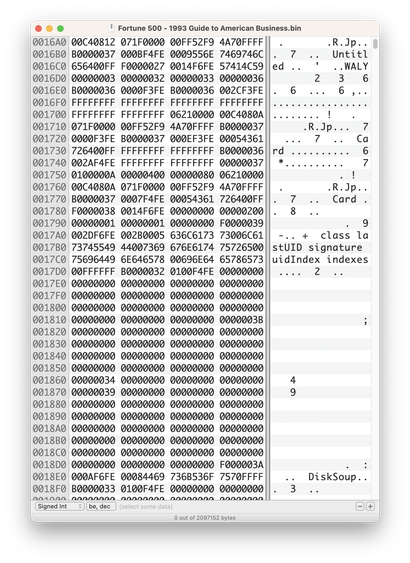
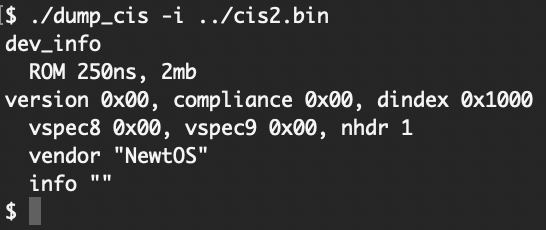
@BobTop And I should note, the card doesn't seem to care about REG#: Whether or not I assert it, the CIS data is always there, followed by the card data. Ideally it should only return the CIS data when REG# is asserted, and the read would be handled in 8-bit. Given the cards behavior, this is a raw dump of the 2MB space with REG# de-asserted: So every other byte of the first 4096 bytes would need to be removed (to match the expected 8-bit) and then 2048 bytes of 0x00 appended.
@BobTop I'll add that the CIS data that is there, while scant, seems valid. The card is 2MB, and "NewtOS" makes sense as the vendor.