@amydiehl OK, but the paper was focused on that demographic:
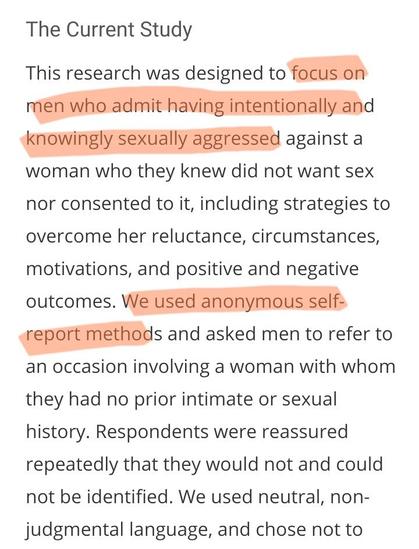
"This research was designed to focus on men who admit having intentionally and knowingly sexually aggressed against a woman who they knew did not want sex nor consented to it, including strategies to overcome her reluctance, circumstances, motivations, and positive and negative outcomes."

I'm not coming to argue "not all men", but from reading the tooth one walks away with the idea that 95% of men force women to have sex, and that is not what the article says at all. What it claims is that of a population that admits to intentionally sexually aggressed woman, 95% report to use strategies to get a woman to have sex when she hasn't consented.
I mean, clearly the paper itself claims "not all men".
As I say, not me, is what the paper says. You can read it yourself and make up your mind.
I think we need to understand the literature to be able to have strategies to curve this situation. It would be very different if we are talking of 95% of the population or if it the number is different.
Therefore it is important to clarify, in my mind, what the study actually claims.
@ratel @gabriel as long as yall are "not" here to quibble about "not all men" you stopped reading before the directly relavant part:
"The study was described as exploring positive and negative interactions between men and women in sexual situations. The consent form indicated that the survey was men’s opportunity “to provide their side of the story given that we have heard so much from women” about male–female sexual interactions, repeatedly assuring them of their guaranteed anonymity."
So yeah, when framed as their chance to tell their side *without fear of personal consequences of any kind*, this is what they volunteered. This is a large and broad enough community sample to draw broad societal conclusions from. The researchers knowing in advance who and what they expect to find doesnt change the results or make these men suddenly victims of a smear campaign or anything else untoward. It means yes, measurably all men.
@ratel youre quibbling over a small point and in so doing deflecting from/missing the larger picture while also serving to make the very point youre quibbling over. If your point is "yes all men" and your argument as that the data make that same point, you already agree with the authors. Move on.