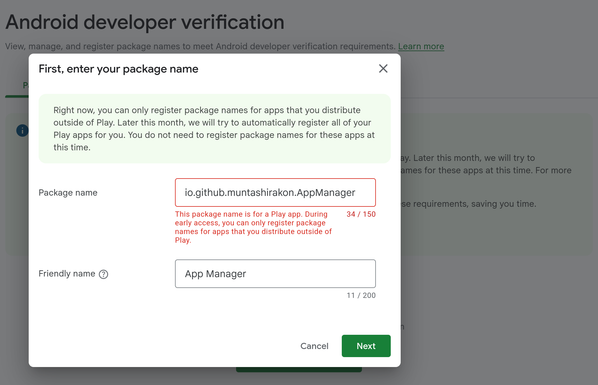
It appears one or more impersonators have already registered some of the #Android applications that I maintained, including @appmanager. I've reported this to #Google, but not sure what's going to happen. The Android developer verification is still in beta, and it doesn't have a lot of features now to deal with this kind of problems.
Another issue is the 50% download requirements. Traditionally, most people would download the apps from #FDroid which historically used their own signing keys to sign the apps. Since most people have used #FDroid instead of other methods, only that signing key shows up there, and currently, it doesn't offer an option to choose a different key.
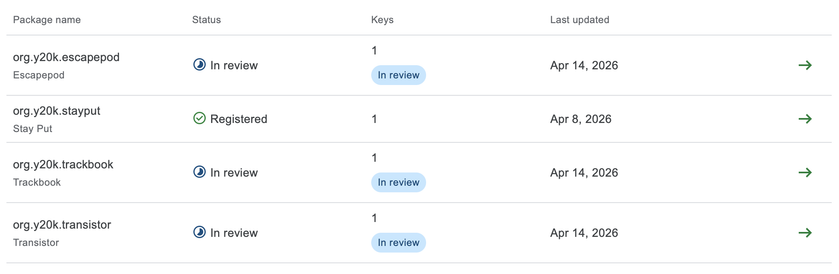
@muntashir Same here. I am the developer of a couple of small apps that are only distributed via F-Droid. I registered an account at the Android Developer Console, only to find out that my apps had been claimed by another party. That was a shock at first. Then I found out that the keys associated with my apps belong to F-Droid. 😅
@muntashir But still, this is a dilemma. I want users to be able to install my apps without any issues when they download them directly from the repository. Therefore, I will try to claim my apps when the Android Developer Console offers a way to do so. On the other hand, I want F-Droid users to be able to install my apps without the 24-hour penalty. I am not sure what I can do to keep my apps available through F-Droid and through my repository.
@y20k
The big issue still is that users can't use F-Droid itself (and most other apps there) without going through the advanced 24h flow. Independent app distribution will become a lot more fringe than it already is, even if your own app is registered.
@muntashir

@grote @y20k This issue can be addressed in several different ways depending how the app was published on F-Droid.

For apps published with the explicit consent from the maintainer: F-Droid can ask the maintainer to include an `adi-registration.properties` with the maintainer's own unique key if the developer has an account with Android developer verification program. Otherwise, they can ask the maintainer to use F-Droid's own key and let F-Droid claim the package ID instead.

If the developer doesn't care, inactive, or no explicit consent has been given, F-Droid can claim it using an skeleton package (https://github.com/android/security-samples/tree/main/AndroidDeveloperVerificationAPKSigningExample) for verification. But this can be complicated depending on the package ID. If F-Droid uses a different package ID, it should be easy. If not, F-Droid needs to ask Google to explicitly allow them to use the same package ID since Google wants to reduce collision as much as possible.

security-samples/AndroidDeveloperVerificationAPKSigningExample at main · android/security-samples

Multiple samples showing the best practices in security APIs on Android. - android/security-samples

GitHub
@muntashir @grote For now I am trying to claim my package names. After all, I think it is best if Google accepts my key as the legit key for my apps. It does not hurt to keep an `adi-registration.properties` in my repo if that enables F-Droid to continue to distribute my apps.
@y20k Once F-Droid makes a successful build, you can add the key to your existing package ID and upload the APK built by F-Droid for verification. After that, Play Protect will stop complaining about the app if it's installed from F-Droid.