#Oil101: 6/14 #climateDiary

…“That is a single 42-gallon barrel of oil.

Now multiply it by the total amount we burn every year, and we’ll see what this looks like at scale.

We use around 100 billion barrels of oil-equivalent of fossil hydrocarbons per year, globally.

At around 5 years of labor per barrel, that’s 500 billion human labor year equivalents – running, working alongside around 5 billion actual human workers.

100 fossil-powered ghost workers for every living one…
#Oil101: 7/14

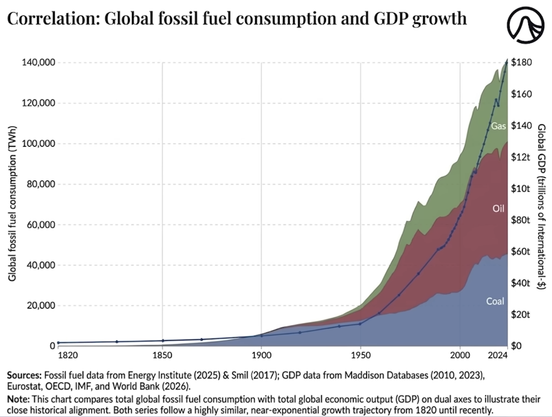
…“This giant labor subsidy when combined with machines is primarily what explained and underpinned the explosion of wealth globally.

It boosted wages.

It boosted corporate profits.

It slashed the price of goods and transportation, so things show up at your door the next day in a brown truck.

It’s supercharged agriculture to increase our population from 1 billion to 8 billion, and it dramatically increased per capita consumption…

#Oil101: 8/14

…“On top of that. Every economic miracle of the last 150 years was underwritten by this invisible workforce.

What does this actually look like at an individual level?

Oil alongside gas and coal has made the average person significantly richer than historical royalty.

The average American uses roughly 40 barrels of oil equivalents of oil, gas, and coal combined, compared to a global average today of around 10 barrels of oil per person…

#Oil101: 9/14

…“That level of energy service with the associated billions of helpers surpasses what kings and queens had access to a few centuries ago:

- hot water on demand
- refrigeration
- personal travel by car
- global travel by plane
- year round, fresh food
- climate-controlled sleep conditions

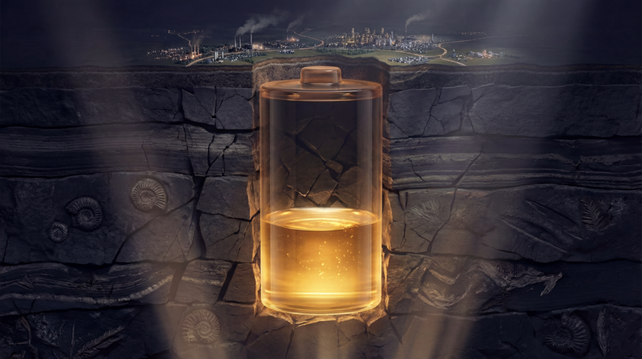
all from ancient sunlight, powering the research, the innovation, the manufacturing, the infrastructure, the factories, the transport, the supply chains, and the commerce all around the world…

#Oil101: 10/14

…“And yet almost no one sees it.

That’s because we swim in energy the way a fish swims in water.

Every product, every service, every bit of GDP first requires an energy conversion, no exceptions.

The average American home has around 40 items constantly plugged in, draining power around the clock, even when they’re turned off.

But because energy has become abundant and growing our entire lives, we have become… energy blind…

#Oil101: 11/14

…“I got my master’s at the University of Chicago and my 3 Nobel Prize winning professors never once mentioned the word energy as a contributor to economic productivity because during their lifetimes, the supply just kept growing.

So they treated this exceptional period of human history as if it were normal based on ingenuity and technology…

#Oil101: 12/14

…“Here’s one way to feel how blind we are to this.

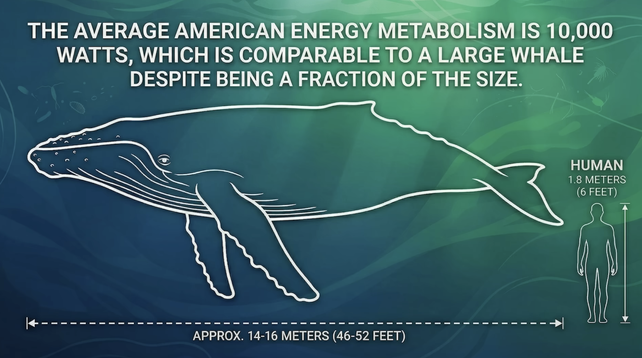
Your body needs around 2,000 kilo calories a day to stay alive. But the average American – when you count all the energy consumed on their behalf through heating and transport and manufacturing and lighting, and food systems and supply chains – uses roughly 200,000 kilo calories a day. A hundred times more than our bodies require…

#Oil101: 13/14

…“Most of us wake up in a climate-controlled room and we flick on a light switch and turn on hot water for a shower, and we make a coffee and put on synthetic clothes. All possible from oil and hydrocarbons.

You are living at a metabolic rate that no organism in the history of life on Earth has ever sustained, and almost none of it is visible to us in our cultural stories in the media…

#Oil101: 14/14

…“This all sounds like a miraculous gift, and in many ways it is.

Here’s the kicker.

This ultra cheap energy in the form of coal, gas, and especially oil, will not be available to us forever at today’s price and scale, and it may well be gone sooner than we expect.

We’ll explore this in part 2 of our intro trilogy on oil.”

- - -

End of transcript of part 1 of https://www.thegreatsimplification.com/frankly-original/135-oil-101

Oil 101: What You Actually Need to Know About Oil - The Great Simplification

This week’s Frankly is the first in a three-part series on the role oil plays in modern civilization, prompted by the recent flow disruptions and geopolitical conflict surrounding the Strait of Hormuz.

The Great Simplification

#Oil101 Postscript:

The irony that I’ve corrected, edited and then posted the above with ease due to The Great Simplification’s team using an LLM to translate their audio signal into text is not lost on me.

Part 2 in the series is already out, but I’ll defer that until tomorrow.

Have a good Saturday. Please integrate the above into the awareness of you and yours 💚

…The transcript above represents 10 minutes of audio across 14 posts for #Oil101.

I’ve just prepped the equivalent for part 2, which is close to 50% longer, and in segmenting it into coherent blocks it will make 27 posts.

I’ll post it tomorrow under the #Oil201 hashtag if you want to follow along – or the opposite, to mute it!

…I said yesterday I would do this, so here goes. Follow or mute or ignore #Oil201.

As a follow-on to #Oil101 above, the following 27 posts are the words of Nate Hagens from the 14 minutes of https://www.thegreatsimplification.com/frankly-original/136-oil-201

Oil 201: What Happens When the Oil Stops Flowing - The Great Simplification

This week’s Frankly is the second in a three-part series on the role oil plays in modern civilization, prompted by the recent flow disruptions and geopolitical conflict surrounding the Strait of Hormuz.

The Great Simplification

#Oil201: 1/27

“In the last part [#Oil101], we explored what oil is and how it’s effectively acting as invisible fossil pixie dust through many of our lives.

But the parallel associated risk is that we have built everything: our institutions, governments, stories and expectations about the future on this cheap energy input. And now its scale and affordability is no longer guaranteed…

#Oil201: 2/27

…“When energy prices spike, entire systems can become fragile and often break because oil’s been so cheap, pretty consistently. The economic logic has been to imagine and then engineer thousands of mechanical processes around that cheapness.

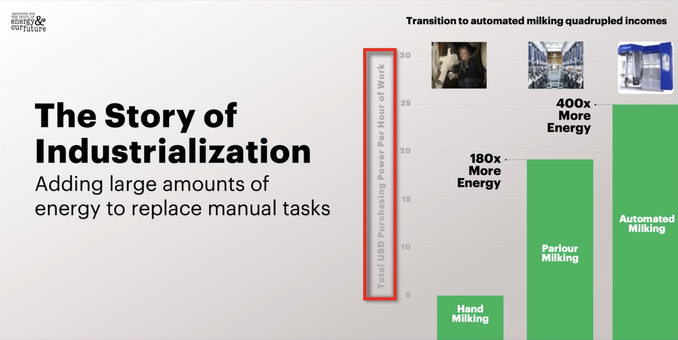
The industrial evolution is really the story of adding hundreds or thousands of units of fossil energy to tasks that humans used to do by hand…

#Oil201: 3/27

…“A dairy farmer milking cows by hand was limited to a few dozen animals. Modern industrial dairy applies enormous quantities of diesel, electricity, refrigeration, and transport to the same basic task producing. Orders of magnitude more milk at a much lower price and higher profits, but importantly at a very different cost sensitivity.

The energy payoff of processes like this is terrible in pure physics and efficiency terms, because lots of energy is wasted…

#Oil201: 4/27

…“However, the *financial* payoff has been enormous because the primary input to the process is energy that effectively costs almost nothing.

This is why energy price spikes hit so hard in the global economy.

Our processes around the world were designed around cheap energy, especially oil…

#Oil201: 5/27

…“Even at $500 a barrel oil would still be a remarkable gift for the work it performs for us. But our current industrial system could not function at anything close to those prices because every margin, every business model, every supply chain was calibrated to cheap, stable energy inputs.

The margins were always thin and when cheap energy turns expensive, the margin disappears and often turns negative…

#Oil201: 6/27

…“And nowhere would this be more consequential than in the thing we all do three times a day…

Eat.

To some of you, this might sound like an exaggeration, but when we sit down for a meal, what most of us are really eating is processed fossil fuels.

Contrary to all of human history, our food system now runs in energy deficit and a huge one at that.

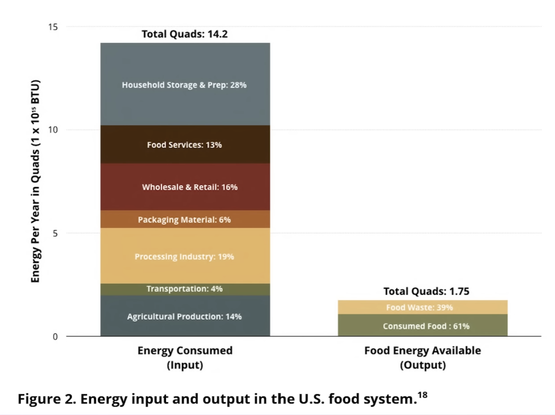
Roughly 10 calories of fossil hydrocarbons go into every one calorie of food on your plate…

#Oil201: 7/27

…“The tractors run on diesel. The fertilizer comes from natural gas, the pesticides from petrochemicals, and the food is packaged and shipped on trucks and container ships and kept cold the entire way. And here’s the truly staggering part…

Roughly half the nitrogen in your body today carries a chemical signature from the Haber Bosch process, which makes synthetic fertilizer from natural gas. That single industrial process is what allows us to feed about 4bn of our 8 bn humans…

#Oil201: 8/27

…“And beyond food, our clean water pumping, treating, desalinating and distributing also all requires fossil fuel inputs.

So when people say oil and gas, most think of our cars. We should also be thinking of groceries and dinner.

But even food is only one part of the story. Oil is woven into virtually everything we touch…

#Oil201: 9/27

…“Only about 40% of a barrel of oil becomes gasoline. The rest is diesel, jet fuel, heating oil, bunker fuel, asphalt, and feed stock for roughly 6,000 other products like medicines, plastics, surgical devices, synthetic clothing, electronics, contact lenses, tents, kayaks, the interior of our cars, and the list goes on.

The assumption that electric cars would eliminate our need for oil misses the overwhelming majority of what non-gasoline oil actually does…

#Oil201: 10/27

…“And these products are woven into global supply chains now of extraordinary complexity. Tiny invisible components. Each with its own petrochemical ancestry, each manufactured somewhere, shipped somewhere else, assembled somewhere else, and only then is it shipped to the stores and to us.

When people talk about supply chain disruptions, what they usually mean at the root is energy and material disruptions, which brings us to why geography is destiny…

#Oil201: 11/27

…“The United States sits on ancient ocean beds once filled with water and life millions of years ago, ultimately resulting in immense reservoirs of oil and gas, which is a primary reason why the USA has produced and consumed more oil than any country in history.

But remaining ‘conventional’ reserves are mostly concentrated elsewhere.

Around 60% of the world’s remaining conventional oil sits inside a 600 mile triangle in southwest Asia, AKA, the Middle East…

#Oil201: 12/27

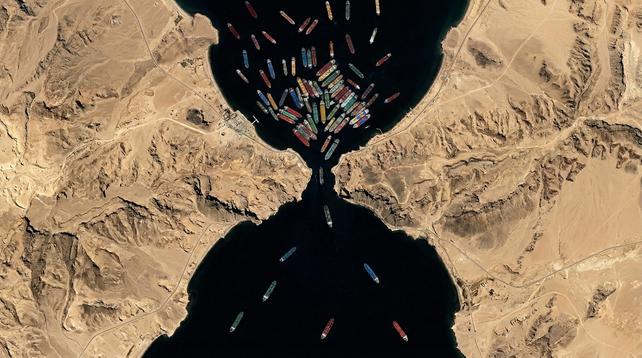
…“Much of [that 60%], around 20% of global oil supply – which is around 40% of what’s actually available for purchase internationally – passes through the narrow strait of Hormuz, which has become the center of the world’s attention for the last few weeks.

And as we’re quickly realizing there are no alternative routes at anything close to that capacity, and now we’re seeing a war for its control…

#Oil201: 13/27

…“A side note here. People like to blame Exxon and Shell and the like for both oil price spikes and climate change, and so on.

The reality is that only about 12% of global oil reserves belong to publicly traded oil companies.

The other 88% belong to national oil companies like Saudi Aramco, Rosneft, and the national companies of Iran, Iraq, China and Venezuela.

So swapping out Exxon’s executive for Greenpeace leadership would change almost nothing about global oil production…

#Oil201: 14/27

…“Oil is a story of nations and geology, not corporations. So the oil is concentrated in a few places, many of which are the center nodes of global conflict today.

But there’s a deeper problem.

Earth’s crude oil isn’t running out – well, technically it’s always been running out – but today’s availability and low priced oil is running out faster than most people and our financial system realizes…

#Oil201: 15/27

…“Most people are unaware of the depletion rate at which we’re drawing down and drying up oil fields and wells.

It’s accelerating.

Especially in the United States, conventional oil globally has been on a production plateau for about 15 years. Exxon itself shows existing global production will decline to 10 to 20% of its current level if there’s no new drilling or tertiary extraction…

#Oil201: 16/27

…“The growth in global oil of the last decade or so is mostly from US shale, but shale is a fundamentally different beast.

We widened the straw with fracking technology, so it looks like plenty is flowing, but we have to drill more.

We have to drill deeper and faster just to keep production flat, and that brings us so much closer to the eventual slurping sound from the straw, because shale oil is found in the source rock, which is where all the other oil migrated from…

#Oil201: 17/27

…“and after that, there’s nothing left.

Okay. Some of you might be thinking that I’ve been ignoring other forms of energy throughout this brief analysis: hydro, nuclear, and especially solar and wind, but there’s a reason substitutes can’t simply step in.

Energy quality matters almost as much as energy quantity.

Oil is liquid at room temperature, energy dense, portable, and storable. And these qualities are what made modern civilization possible…

#Oil201: 18/27

…“Replacing oil isn’t a matter of just matching kilowatt hours from another source.

Our entire mining, shipping, rail, trucking, and personal transport system runs on oil.

And despite the headlines about solar and electric vehicles, that is likely not going to change.

But here’s a key distinction.

Energy is the total amount of work available. Power is the rate at which you get that energy per unit of time…

#Oil201: 19/27

…“Biological creatures on Earth do not optimize for energy. We optimize for power.

Organisms and economies that get more energy sooner out-compete those that don’t.

Oil and its products – like gasoline, diesel, heating oil and jet fuel – contain unbelievable power when burned. They give us ginormous work *fast*, and importantly, whenever and wherever we want it…

#Oil201: 20/27

…“Wind and solar deliver energy intermittently when the sun shines and the wind blows. Sometimes giving an enormous power burst, but sometimes giving us nothing, especially depending on your location.

Nuclear power can give us a constant stream of high power, but it’s difficult to ramp up and down and requires connection to a larger grid and is capital intensive and costly…

#Oil201: 21/27

…“Alternative energy sources will play a role in the human energy portfolio, but our current system was built around the qualities of oil.

These time, land and material dimensions are almost never discussed, but they’re some of the main reasons that direct substitution is so much harder than people assume, and why there are now warships in the Persian Gulf…

#Oil201: 22/27

…“So if oil is this hard to replace, what is this energy transition?

We keep hearing about solar panels and wind turbines but they do not reproduce themselves. The sun and the wind are renewable, but the technology we use to harness them is best labeled ‘rebuildable’, not renewable.

Because they require massive inputs of material and energy and complexity to build, and they need to be rebuilt every 20 or 30 years…

#Oil201: 23/27

…“Most alternative energy tech only produces electricity, which is very important, but represents only a fraction of what fossil hydrocarbons do in the world – currently around 20%.

Diesel for shipping, jet fuel, aviation, petrochemical, feedstocks, none of these have clean substitutes at scale.

But beyond these limits, there’s a deeper pattern. The current popular stories of an energy transition are built upon a myth, a false narrative about the history of humans and energy…

#Oil201: 24/27

…“The reality is we have never in human history fully transitioned off an energy source. We always *add*.

There’s a name for this pattern. It’s based on Jevon’s paradox.

When we find a more efficient way to use a resource, we don’t use less of it. We use *more*.

Coal efficient steam engines didn’t reduce coal consumption. They made coal available for more things, so demand exploded…

@urlyman the never transitioning off/use more is verifiably incorrect.

1) we’ve largely transitioned off using animal dung as an energy source (I’m sure it’s used in some very rural contexts, but certainly not using more)
2) peat as an energy source is fading away
3) whale oil as an energy source is gone (really using all animal oil directly, outside a small % of recycled biofuel)

Unless you get massively broad, like oil == any oil from any source not just like FFs, etc.

@linux_mclinuxface @urlyman In some cases, supply ran out eg whales were over- fished. Whale oil was mainly used for lamps.

@anne_twain @urlyman whales still exist. We stopped using them for fuel because of environmental (extinction) threat.

The thread on oil specifically talks about lighting as energy usage.

I don’t think we widely used whale oil->electricity but it was definitely used by Inuit peoples for heating fuel.

@linux_mclinuxface They do? You mean those humpbacks I've seen off the coast of Australia weren't plastic blow- ups?
@anne_twain har har. I’m just saying the supply didn’t run out, policy stopped the usage.