
Interview done! Now time to dig in to this really thorough, horrifying paper by Olivier Hainaut about what the night sky will look like with future satellites https://arxiv.org/pdf/2604.09427

This is similar to the kind of modelling that I've done with my collaborators, but using totally different code and methods. This is how science works! Predictions are being tested, and unfortunately for the sky, this paper's predictions line up with ours. It's bad.
The main conclusion is that *if* satellite operators could actually make their satellites fainter than mag 7 (as Starlink promised to do and hasn't managed to do yet because they keep making their damn satellites bigger and on lower orbits) and there's "only" tens of thousands, the night sky and astronomy research are in pretty good shape, actually. (Unfortunately this is still a pipe dream, because nobody has managed to get fainter than mag 7) https://ui.adsabs.harvard.edu/link_gateway/2025MNRAS.544L..15M/PUB_PDF
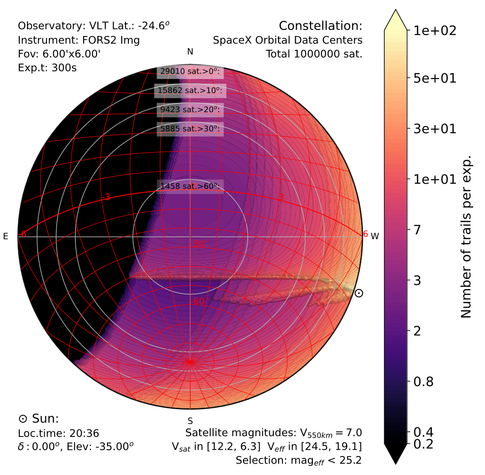
This figure shows that SpaceX's million data center stupid idea would result in dozens of satellite streaks per exposure (from the FORS2 instrument at Paranal) over half the sky, even an hour after nautical twilight. The part of the sky where you could still do astronomy research would be extremely limited.
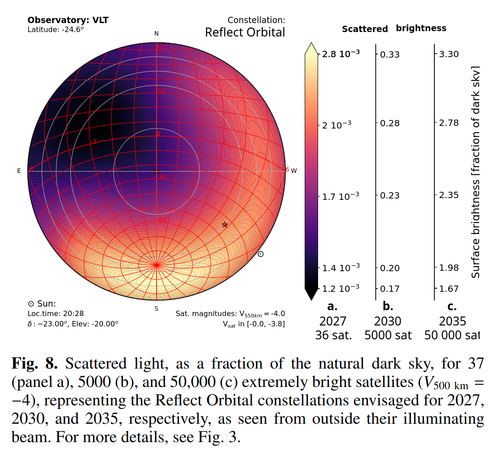
They also model Reflect Orbital's stupid idea, showing that with giant mirrors in orbit, the entire night sky worldwide would become as bright as in a typical suburb, even if you're outside their beams.

"A mega-constellation of one million or more satellites would fundamentally alter observing conditions, ensuring that most exposures contain multiple trails during a large fraction of the night. The field-of-view losses then rise to 10%–20%, making satellites the dominant source of data loss, ahead of weather and technical downtime."

But don't worry, we'll be in full Kessler Syndrome long before we get to one million satellites! 😭

@sundogplanets I hate that I'm currently legit wondering whether astronomy would be *less* impacted if we go full Kessler Syndrome than it would be if this million-satellite constellation gets launched and actually fails to eat itself.

(modulo the whole "we can't launch space-based observatories any more" thing)

@sundogplanets I wonder how much fuel is budgeted to do the "LEO weave"?
Never mind, what are the odds that there isn't a failure of controlability (uplink comms, onboard processing, thrusters, etc): Tl;dr vanishingly small
@sundogplanets Has anyone modelled the Kessler syndrome sky? I wonder what it would look like.
@szakib I've thought about doing that simulation, and decided it was too depressing
@sundogplanets the debris will be worse than the million satellites
@sundogplanets I just had a horrible thought that the businesses who'd be using the "sun any time" service would be car lots. They already try any trick to garner attention, so having their cars lit up like daytime into the dark night might be too much to resist.
@jerzone Well, "fortunately" the spotlight size is like 5km. So it wouldn't really "benefit" the car lot only. (Lots of quotes because this is all awful)
@sundogplanets I might be tempted to say this is another consequence of the US abandoning the rules-based order. But in reality, pretty much every space-capable nation is doing similar things, or soon will.
@sundogplanets I don’t understand why they are even seriously considering this. The sheer cost has to far outweigh any potential benefits, right?

@ramsey @sundogplanets

Ubiquitous surveillance needs ubiquitous satellites.

China, Russia, & the USA want control & the fossil fuel industry will buy it for them.

The oil industry desperately wants to stop a fossil fuel phase out.

Wasting energy is part of the strategy to thwart a switch to solar & wind renewables.

Satellite launches uses huge amounts of energy.

@sundogplanets

The shit hands billionaires and we shouldn’t let China off either because they have their own ideas and I forget what the third major system is now.. but Elon specifically projects this image of the stars as our inheritance. He’s the fucktard that’s all but guaranteeing to cut off our access to space, for I don’t know how long.

He’s gonna blow up space.

@sundogplanets Talking of satellite streaks, how fast, in degrees per minute (or other suitable timeframe) do satellites in starlink level orbits appear to cross the sky?
@sundogplanets Unfortunately these satellites also emit powerful radio waves, adding a lot of noise to the radio sky.
@redshiftdrift I am extremely aware of that. Just can't fit all the many problems into one thread.