
Interview done! Now time to dig in to this really thorough, horrifying paper by Olivier Hainaut about what the night sky will look like with future satellites https://arxiv.org/pdf/2604.09427

This is similar to the kind of modelling that I've done with my collaborators, but using totally different code and methods. This is how science works! Predictions are being tested, and unfortunately for the sky, this paper's predictions line up with ours. It's bad.
The main conclusion is that *if* satellite operators could actually make their satellites fainter than mag 7 (as Starlink promised to do and hasn't managed to do yet because they keep making their damn satellites bigger and on lower orbits) and there's "only" tens of thousands, the night sky and astronomy research are in pretty good shape, actually. (Unfortunately this is still a pipe dream, because nobody has managed to get fainter than mag 7) https://ui.adsabs.harvard.edu/link_gateway/2025MNRAS.544L..15M/PUB_PDF
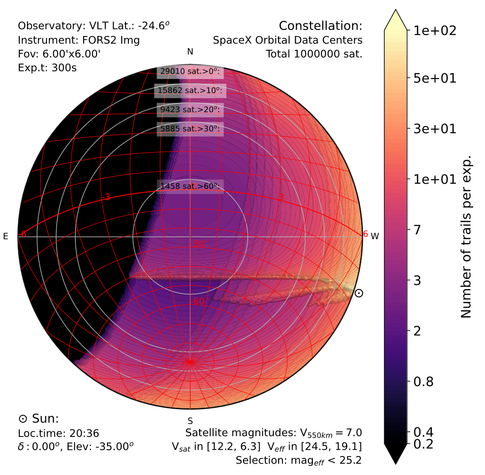
This figure shows that SpaceX's million data center stupid idea would result in dozens of satellite streaks per exposure (from the FORS2 instrument at Paranal) over half the sky, even an hour after nautical twilight. The part of the sky where you could still do astronomy research would be extremely limited.
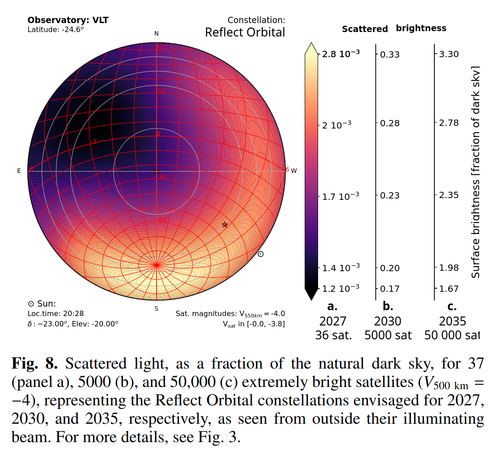
They also model Reflect Orbital's stupid idea, showing that with giant mirrors in orbit, the entire night sky worldwide would become as bright as in a typical suburb, even if you're outside their beams.
@sundogplanets I just had a horrible thought that the businesses who'd be using the "sun any time" service would be car lots. They already try any trick to garner attention, so having their cars lit up like daytime into the dark night might be too much to resist.
@jerzone Well, "fortunately" the spotlight size is like 5km. So it wouldn't really "benefit" the car lot only. (Lots of quotes because this is all awful)