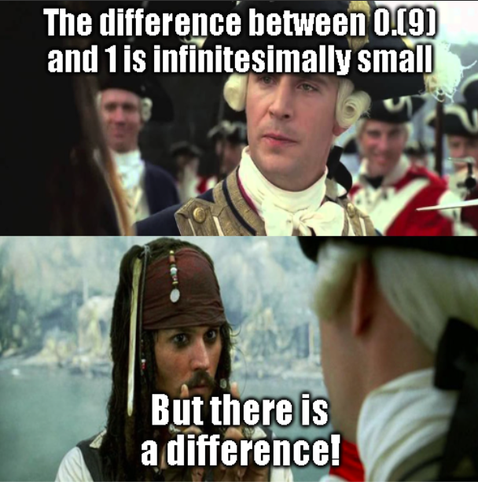
@silasmariner yeah, so this is where it gets unclear in which direction to go. First off, you could adjoin a single infinitesimal value i = 1 - 0.999..., and study the field you get by taking the closure under the field operations. This is clearly not what he's talking about, because 0.999... and 1 are then separated by infinitely many values: 1 - i/2, 1 - i/3, etc, and you need infinitely many actual infinities (1/i, 2/i, for example) in your structure. The structure resembles the hyperreals but I remember reading that it's not isomorphic.
So let's not close under the field operations and go for a ring instead. We are then not forced to have many values between 0.999... and 1, but we do have to have distinct values 1 + i×n for each integer n.
If we work this out as a set of decimal sequences with strict equality, I guess we represent i as the sequence given by i(n) = 0 for each natural number n, but permit sequences of length omega+1, so that i(omega) = 1. 0.999... is then truly the "last real number before 1". I don't know what 1 - 2×i should be, though. Any ideas? It's possible this isn't even a ring.
I feel like you can get something resembling this also by taking ℝ×{0,1} where operations in the ℝ part are standard, and operations in the binary bit are modulo 2! You wouldn't get a ring if you had saturating arithmetic in the binary part, right? (Like a dirty bit).
 💡𝚂𝗆𝖺𝗋𝗍𝗆𝖺𝗇 𝙰𝗉𝗉𝗌📱

 Hugh Simpson
 Fish Face
 sed
sed