1/9
#MathsMonday #Mathematics
This rubbish article https://www.scientificamerican.com/article/mathematicians-cant-agree-on-whether-0-999-equals-1/ popped up in my feed a few times, and I've already debunked the various points, but will cover it with specific links for each (non-)point.

"Mathematicians can’t agree on whether 0.999... equals 1" - yes they can, it's not, as per division, limits, infinite decimals, and other #Maths topics, all found in #Math textbooks

"by Manon Bischoff" - "is a theoretical Physicist". Maybe just stay in your lane dude... πŸ™„

2/9
"Countless debates in classrooms" - there are no debates in classrooms. Students are taught all of the topics which prove they're not equal.

"Teachers, professors and math-savvy Internet users repeatedly affirm that it does" - nope! Teachers most definitely do NOT say they are equal. Dude has clearly not ASKED any teachers, and is outright just making this up!

"many others still refuse to believe them" - people who can show you actual proofs and textbooks... πŸ™„

3/9
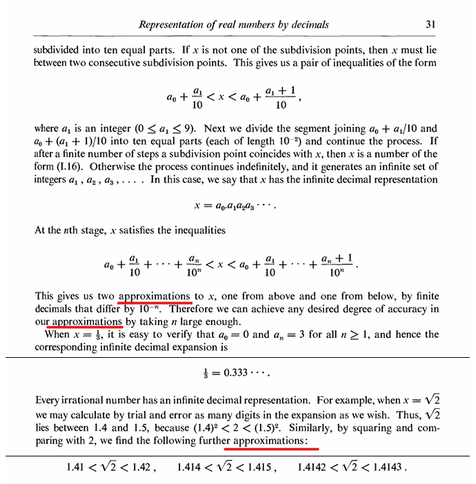
"the decimal representations of some fractions are infinite, such as 1⁄3" - which we know are APPROXIMATIONS https://dotnet.social/@SmartmanApps/116316765092652161

"one therefore chooses a symbol because a decimal notation would only approximate the actual value" - that's true of ALL infinite decimals. You so nearly had it!

"1⁄3 corresponds to the decimal number 0.333...." - corresponds, but is only an approximation...

πŸ’‘πš‚π—†π–Ίπ—‹π—π—†π–Ίπ—‡ π™°π—‰π—‰π—ŒπŸ“± (@[email protected])

Attached: 1 image 1/5 #MathsMonday #Mathematics #Math This week I'm coming back to the topic of 0.(3) only being approximately equal to 1/3, which I discussed previously at https://dotnet.social/@SmartmanApps/115207065189190900 At the time, I knew this was true simply from knowing doing the division always leaves a remainder of 1. Since then I've now seen 2 #Maths textbooks which explicitly spell this out, that all non-terminating decimals are only approximations, and that only terminating decimals are exactly equal to fractions...

dotnet.social

4/9
"multiply it by 3 to get 0.999...." - which goes against the rules of Maths, hence using symbols for them instead, such as pi https://dotnet.social/@SmartmanApps/115603725411319763

"They reason that because 1⁄3Γ—3=1" - and that reason is wrong. See above

"there are a few other proofs" - that WASN'T a proof. You violated the rules of Maths, meaning it's not a proof https://dotnet.social/@SmartmanApps/115603723212470958

πŸ’‘πš‚π—†π–Ίπ—‹π—π—†π–Ίπ—‡ π™°π—‰π—‰π—ŒπŸ“± (@[email protected])

3/6 Let x=0.(9) (multiply both sides by 10) 10x=9.(9) (substitute 0.(9)=x) 10x=9+x (subtract x from both sides) 9x=9 (divide both sides by 9) x=1 1. in the first place, we can't do arithmetic with infinitely recurring numbers. This is why, as I discussed at https://dotnet.social/@SmartmanApps/115365301522477363, the sum of the infinite series is DEFINED as being the limit of the series, because the limit is finite, and thus we can do arithmetic with it, but it's only an approximation of the infinite sum...

dotnet.social

5/9
"you have what’s called a geometric series, something mathematicians have known how to solve for several hundred years" - what we ACTUALLY solve is the LIMIT of the series, given the infinite sum can't actually be calculated https://dotnet.social/@SmartmanApps/115365301522477363

"the term 1⁄10n becomes zero" - no it doesn't. It can literally NEVER be zero - that's exactly what makes it a limit! See previous link. 0/∞=0, 1/∞ doesn't. A non-zero numerator means we have a non-zero fraction. This is so not-complicated!...

πŸ’‘πš‚π—†π–Ίπ—‹π—π—†π–Ίπ—‡ π™°π—‰π—‰π—ŒπŸ“± (@[email protected])

Attached: 1 image 1/5 #MathsMonday #Mathematics #Maths #Math So we've seen that 0.(3) is merely a decimal APPROXIMATION of 1/3, due to the limitations of using Base 10. It's also true, for the same reason, that 1 is merely an integer APPROXIMATION of 0.(9), since 9 is infinitely recurring. If we think of 0.(9) as being 0.9+0.09+0.009+... this leads some to make a false equivalence argument, which is wrong in 2 ways...

dotnet.social

6/9
"This example is just one of many proofs" - that ALSO wasn't a proof, for the reasons I just gave.

"if we switch to binary notation, which consists only of 0’s and 1’s, the same problem arises" - the problem being your lack of familiarity with Maths πŸ™„

"Even though mathematics is a subject in which you can derive correlations exactly, with minimal room for interpretation" - and yet here you are making up your own interpretations... πŸ™„

7/9
"if you look at the number line and pick any two numbers, there are always infinitely many more between them" - no there isn't https://dotnet.social/@SmartmanApps/115682175610484093

"You have found a break in the number line" - no you haven't. Numbers are discrete, there are no gaps between them. See previous link

"As soon as you calculate a sum, you have to round up" - no you don't. Calculators do https://dotnet.social/@SmartmanApps/115207066209800987, but there's no such rule of Maths. Again you're making things up...

πŸ’‘πš‚π—†π–Ίπ—‹π—π—†π–Ίπ—‡ π™°π—‰π—‰π—ŒπŸ“± (@[email protected])

Attached: 1 image 1/7 #Maths #Math This #MathsMonday Why there isn't an #infinite amount of #numbers between 0 and 1 on the #numberline AKA The number-line isn't a TARDIS! Firstly, one thing to point out is that people often conflate numbers with #numerals. This is important because #scalars also use numerals. Even though both numbers and scalars use numerals, they aren't the same thing! In #Mathematics, especially #arithmetic, we use numbers to count things. They enumerate how many things there are...

dotnet.social
8/9
"This rounding up also applies to multiplication, such that 0.999...Γ—1=1, which means a basic rule of mathematics, that anything multiplied by 1 is itself, no longer applies" - it's an Identity in Maths, that ALWAYS applies. 0.(9)x1=0.(9). πŸ™„ This dude sure does like making up imaginary rules of Maths - here the dude uses an imaginary "rule" of Maths to claim that an actual rule of Maths doesn't apply!...

9/9
"nonstandard analysis, which allows for so-called infinitesimals" - so does high school Maths, used in all the actual proofs that they aren't equal

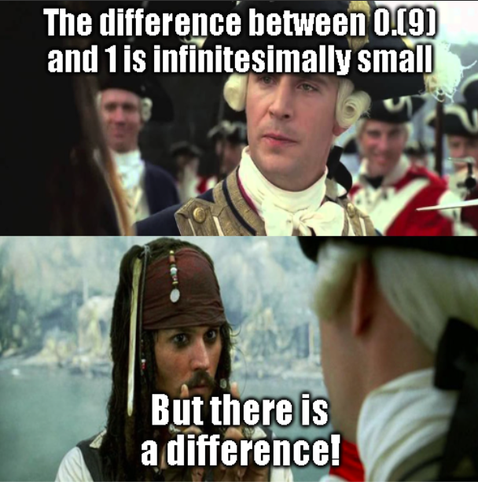
"if they differ by one infinitesimal" - they do! πŸ˜‚

"no more so than conventional calculus" - which ALSO says they aren't equal

"there is still a debate whether 0.999... = 1" - no there isn't. It's a fact of Maths that they aren't equal

"working with the numbers and calculation familiar to most of us" - but apparently not familiar to you πŸ™„

@SmartmanApps a field that includes real numbers, but excludes infinitesimals, is entirely consistent...? It's not like this is some hard-hitting truth to mathematics? Weird to me you accept infinitesimals but previously have denied the arithmetic of infinite series, essentially claiming that S(0,inf,9*10^(-n)) - S(1,inf,9*10^(-n)) should be illegal. I'm not sure how you can retain interesting or useful properties in such a system. Anyway 0.(9) is clearly the sum of the latter series. Which is ?
@silasmariner how much have you read from this guy? Do you know what you're getting yourself into?
@FishFace I had not read much. Was nice to remind myself of the relevant maths whilst thinking the claim through (and its implications in e.g breaking field axioms for the implied indivisible infinitesimal iota). I haven't thought about this sort of claim since back at uni, but I now have dug deeper and realise I should probably step back lol.
@silasmariner yeah I am on the same journey! My plan is to eventually write everything up because I agree it's very interesting to work out. It's tricky to get definitive statements out of him (like, I don't think he really knows himself whether he thinks 0.999... is a specific real number or whether it's a way of denoting all possible finite decimals consisting of 0. followed by repeated nines) so it's tough to balance covering all bases with writing something a) succinct and b) that is about maths rather than drama.
@FishFace I'm gonna be honest, I'm genuinely kinda interested in the implications of a model that's essentially just the reals plus some indivisible infinitesimals. So instead of a field you might think you get a ring, because you don't get multiplicative inverses.. But then iota is defined as the difference between a limit and a series, so its not well defined enough to even multiply.. Iota is like a dirty bit? Fascinating.

@silasmariner yeah, so this is where it gets unclear in which direction to go. First off, you could adjoin a single infinitesimal value i = 1 - 0.999..., and study the field you get by taking the closure under the field operations. This is clearly not what he's talking about, because 0.999... and 1 are then separated by infinitely many values: 1 - i/2, 1 - i/3, etc, and you need infinitely many actual infinities (1/i, 2/i, for example) in your structure. The structure resembles the hyperreals but I remember reading that it's not isomorphic.

So let's not close under the field operations and go for a ring instead. We are then not forced to have many values between 0.999... and 1, but we do have to have distinct values 1 + iΓ—n for each integer n.

If we work this out as a set of decimal sequences with strict equality, I guess we represent i as the sequence given by i(n) = 0 for each natural number n, but permit sequences of length omega+1, so that i(omega) = 1. 0.999... is then truly the "last real number before 1". I don't know what 1 - 2Γ—i should be, though. Any ideas? It's possible this isn't even a ring.

I feel like you can get something resembling this also by taking ℝ×{0,1} where operations in the ℝ part are standard, and operations in the binary bit are modulo 2! You wouldn't get a ring if you had saturating arithmetic in the binary part, right? (Like a dirty bit).

@FishFace actually shit we don't even have a group, do we, because we're past the Rubicon and you're not allowed to manipulated the sums of infinite series. So it's a magma I think? But it does have two operations that under most (??) scenarios we should expect to be allowed to be commutative, associative and distributive. I don't know the name for that.
@FishFace probably we're just in the realms of some highly-constrained constructivist mathematics and this is more like a Turing machine than an algebra

@silasmariner with saturating arithmetic yeah, because you don't have the cancellation law!

Not sure what you mean by it being like a Turing machine but I have wondered if there's a constructivist background here because he talks about practical limits from time to time.

@FishFace oh I only mentioned turing machine in the sense that the rules don't really have the neat fit of maths. Everything's all a bit too bitsy and case-by-case. It was a metaphor at best. I tap out about here I suspect, having exhausted my intellectual curiosity. Was nice to chat!