1/9
#MathsMonday #Mathematics
This rubbish article https://www.scientificamerican.com/article/mathematicians-cant-agree-on-whether-0-999-equals-1/ popped up in my feed a few times, and I've already debunked the various points, but will cover it with specific links for each (non-)point.

"Mathematicians can’t agree on whether 0.999... equals 1" - yes they can, it's not, as per division, limits, infinite decimals, and other #Maths topics, all found in #Math textbooks

"by Manon Bischoff" - "is a theoretical Physicist". Maybe just stay in your lane dude... πŸ™„

@SmartmanApps just to understand your logic, you don't accept that 0.(9) * 10 = 9 + 0.(9), right? For you this is an operation we can't do/write, am I correct?

@sed good luck.

From his dump before this one, it's apparent he conceives of 0.(3) as "(3)/1(0)". But I don't think he means this notation to literally denote transfinite numbers because his mathematical understanding is not sophisticated enough for that; instead judging by his wording "for any given number of digits we can rewrite 1(0) as (9)+1", he doesn't have a well-defined understanding of recurring decimals at all; to him they are, I think, a way of talking about decimals with an *undefined* rather than *infinite* number of decimal places. So he talks a lot like he thinks 0.(9) is 0. followed by an unspecified number of nines.

You're unlikely to get any confirmation of this; he seems to be aware this isn't how everyone else treats the notation so won't sign up to it (and he's blocked me so I won't get an answer; I'm still here because I find it all so fascinating).

But from that point of view, it *does* make a kind of sense that you "can't do" 0.(9) Γ— 10 because the former doesn't refer to a specific number. Buuut, if you do the obvious thing and treat 0.(9) Γ— 10 as "9. followed by an unspecified number of nines" the normal argument goes through.

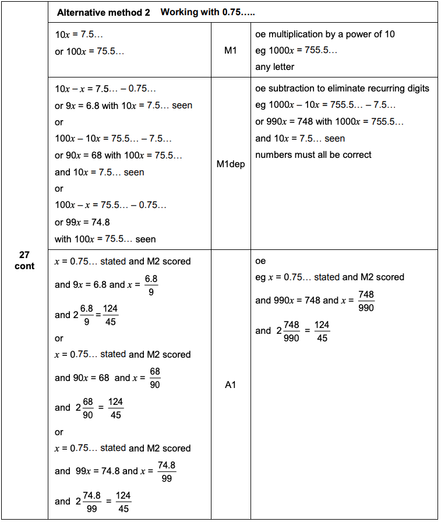
Not sure how he'd reconcile that with the textbooks he likes to bring up though - this is literally examinable material (example attached)!

Enjoy.

RE: https://tribe.net/@ahau/116400200666533607

@FishFace he/she gave a reply to my question. I think I won't go farther than that. He/She rejects some notations/operations for I don't know what reason, I think it's a waste of time to interact more.

I just now saw this: https://hostux.social/@[email protected]/116400200644462704

Either a joke or... something else.

@sed that at least looks like something designed with enough rational thought to appear coherent, even if wrong!

@FishFace I just read this https://www.quantamagazine.org/what-can-we-gain-by-losing-infinity-20260429/

it sheds some light on people (working in math and physics) fighting (or trying to get rid of) the existence of infinity

interesting reading

What Can We Gain by Losing Infinity? | Quanta Magazine

Ultrafinitism, a philosophy that rejects the infinite, has long been dismissed as mathematical heresy. But it is also producing new insights in math and beyond.

Quanta Magazine

@sed I haven't read it right to the end yet, but it is very interesting. It has been suggested that SmartmanApps is a finitist (not an ultrafinitist - I have seen him give a proof by induction!), but he rejected the label.

Nevertheless, he displays some characteristics of one: he seems to think of infinite decimals as a process rather than actual numbers, and in one of his flawed arguments against the infinitude of intervals of rationals, he goes on a tangent about measurement accuracy and atoms, suggesting he can't, or has difficulty, conceiving of numbers separate from something the number measures.

But his arguments about the finite nature of intervals are just wrong (he states, and does not prove, that there are finitely many rationals in an interval over a given denominator. He states as if it follows, that there are finitely many rationals in the interval.) A proper finitist would have an argument here that isn't completely bogus: she'd say, "we can conceive of a process for generating new rationals in the interval which will never run out, but it is fallacious to conceive of all of them at once as a completed whole because we can never in practice generate them all". (An ultrafinitist would say that there is some actual limit on how fine we can divide the interval, but wouldn't say what the limit is.)

It's kind of annoying that he touches on these very interesting topics but doesn't have the understanding to discuss them properly!

@sed
"just to understand your logic, you don't accept that 0.(9) * 10 = 9 + 0.(9), right?" - the rules of Maths don't, yes. That's why we use symbols like pi in their place for calculations, and then only substitute in a value for it when all arithmetic has been done https://dotnet.social/@SmartmanApps/115603723212470958
πŸ’‘πš‚π—†π–Ίπ—‹π—π—†π–Ίπ—‡ π™°π—‰π—‰π—ŒπŸ“± (@[email protected])

2/6 Something can be a proof if, and ONLY if, the rules of Maths have been obeyed at every step. For example, I could claim to prove that 2+3x4=20, by going... 2+3x4 =5x4 =20 But this violates the order of operations rules, in the second step by doing the addition first, and therefore is NOT a proof. The "proof" that 0.(9)=1 similarly violates, not just one, but multiple rules of Maths, and is thus not a proof at all. A reminder, this (fake) proof goes as follows...

dotnet.social