 JennyFluff
  💾
💾this toot is sponsored by square-circle
 Ignacy 🇪🇺
 fungus (penicillin producer)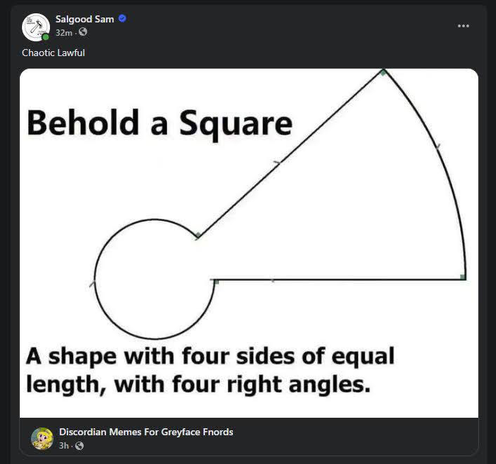
 Greyshley
 @hypha @JennyFluff I feel we owe h.p. lovecraft an apology, he was right about noneuclidian geometry bein freaky as hell.
@dhfir @JennyFluff we rarely owe apology to lovecraft
 Pino Carafa
@hypha @JennyFluff I'm too lazy but someone should work out the area within that construction. The area of a "normal" square with sides of length 1 is, well, 1. If these lines are all length 1 as well, what is its area?
 ticho
ticho Knud Jahnke
@rozeboosje @hypha @JennyFluff
Hmm, not completely obvious. Due to the right angles the tip of the pie-part lies at the center of the circle part. And due to that the "missing" part of the circle has the same shape as the wedge.
 Frank Davies
@rozeboosje @hypha @JennyFluff some fraction of the two arcs which combined make this shape, but it would take some effort to figure out what the radians of each arc are
@fd93 @rozeboosje @JennyFluff i spinned up CAD but it refused me to apply constraint on the arcs (regarding lengths)
and i'm too lazy to compute that lol (might need to switch to imaginary numbers or smth lol)
and i'm too lazy to compute that lol (might need to switch to imaginary numbers or smth lol)
 Richard
@rozeboosje @hypha @JennyFluff I got
every side = 1
inner radius r
outer radius R = r+1
inner missing part m = r*τ-1
outer curve C = 1 = m*R/r
inner circle area a = 1/2*τ*r^2
inner pie area p = a * 1/(τ*r)
outer pie area P = 1/2*τ*R^2 * 1/(τ*R) = 1/2*R
total area A = P+a-p
Which comes to A≈0.61 (if neither me nor Wolfram Alpha messed up somewhere along the way)
@rigrig @hypha @JennyFluff This is what I'm getting:
Area of a circle is Pi * r^2
The circumference C of a circle is 2 * Pi * r
So the area within a circle is 1/2 * C * r
That then also allows us to calculate the are of a segment S, likewise, as
1/2 * S * r
All the sides are 1 so S is 1 both for circle and Wedge and "r" for the large wedge is 1+r
Circle without Wedge = 1/2 r
Wedge = 1/2 * 1 * (r + 1)
Total: r + 1/2
I reckon you're right. I'm struggling a bit figuring out what r is
@rozeboosje @hypha @JennyFluff Yeah, that’s the tricky part.
Say you have the outer segment S (=1) with radius R, and the part that’s missing from the inner circle s (m in my toot above), with radius r. They’re the same shape, only scaled by the difference in radius, so you have S = s×R/r. The inner circle would have a total circumference of 2×Pi×r, which is 1 plus the open part, so you get 2×Pi×r = 1+s, and we know S = 1.
So now we have
  R = r + 1
  s = 2×Pi×r - 1
  S = 1 = s×R/r
and can solve for r. (But not easily, which is why I plugged it into WA and only posted the numerical result instead of the exact answer with lots of Pie-terms)
 laalsaas
@hypha @JennyFluff this goes into the square hole
@laalsaas @JennyFluff finally someone posting it :D
 The Cutest Panty Wetter 💗
 lilly
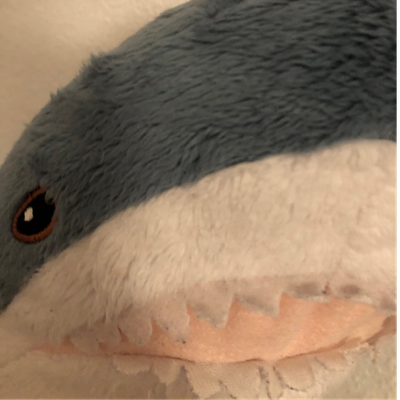
lilly@JennyFluff @hypha does this one fit into the square hole?
 Hunter King
@hypha @JennyFluff geometry textbooks should update to the much more encompassing definition: "C'mon, we all know what a square is"
 Beata
Beata@hypha @JennyFluff Reminds me of the joke about walking back to camp.
 Court Cantrell won't conform
@hypha @JennyFluff This makes me uncomfortable.
😆
 That Dud Bloke
@hypha Pythagoras is foaming at the mouth 🙂 @JennyFluff