 Jimmc414
US appeals court declares 158-year-old home distilling ban unconstitutional

In Norway alcohol is very expensive, so many people distill at home illegally.
Every travel guide tells you to not accept home-distilled drinks, since they can be poisonous.
I visited Norway and was blown away by the price of alcohol. Given that the sun only comes out for a fraction of an hour in winter I struggled to believe it. At a local bar... (I think I was in trondheim?) I asked how they afforded booze? (it worked out to 15$ USD per pint), "We don't, but we do it anyways"
Anything that decants below 78.4C is going to have methanol in it, I usually separate out the first 100ml or so that decants after 78.4C to play it safe.
I've been doing it for about 20 years, no poisoning cases yet. Home distillation has been legal in NZ since 1996.
This is actually a myth. I’ll have to see if I can find the papers I read but mass spectrometry has shown that methanol comes out throughout the entire process. The idea that things come out at their boiling temperature is a drastic oversimplification.
Methanol is really only present in significant amounts in fruit mashes because it comes from fermentation of pectin. Grain or sugar-derived alcohol barely has any at all.
The foreshots you throw out do have things that taste bad and which you would not want to drink much of, but even if you mixed it all back in and got drunk, it would be the same amount of all of those chemicals you’d get if you just drank the mash, which is itself basically just beer or wine.
We distillers are a lot more likely to burn our house down than any other form of injury.
> This is actually a myth. I’ll have to see if I can find the papers I read but mass spectrometry has shown that methanol comes out throughout the entire process. The idea that things come out at their boiling temperature is a drastic oversimplification.
Please do find those papers! They may be describing a radical new chemistry that I'm not familiar with.
To be clear - methanol boils at 64C and ethanol boils at 78C. Are you suggesting that in standard distillation, there is still some non-trace methanol coming over at 78C? If I personally observed that in a laboratory setting, I'd quickly assume measurement error or external contamination.
I suspect that the vapor of the mash is always a mix of the components, and even above the boiling point of methanol, it still produces a mixed vapor. At room temperature, all of the components produce some vapor and will evaporate. This continues as the temperature rises.
It's not clear to me that simple distillation of a methanol/ethanol mixture can produce either pure ethanol or pure methanol at any point, just as it's impossible to distill ethanol and water to pure ethanol (absolute alcohol) if the water is above a small percentage of the mixture.
Yup, distillation never produces a pure product. Cask-strength whiskeys contain quite a lot of water, even though nobody is stupid enough to distill at 100C. Even an industrial column still can't go over 96% ABV.
There is always some amount of vapor pressure, even below the boiling point of a substance. Otherwise, neither water nor alcohol would evaporate by themselves at room temperature! The temperature we call the "boiling point" is just the temperature at which the vapor pressure equals the ambient pressure.
You can't distill out pure methanol, as at the boiling point of methanol ethanol also has some vapor pressure, so you distill a mix. However above that boiling point you distilled out all methanol (with a mix of ethanol), and the remaining ethanol should be free from methanol.
This also matches what happens when distilling ethanol from water. You can't distill pure ethanol, but you csn distill ethanol-free water afterwards.
I would assume it depends on what you are distilling.
If you are making brandy from clarified wine, it probably separates better than rotten grape mash.
It is still a continuum with some methanol molecules likely remaining even in the tails.
For all intents and purposes, the distiller's rule of thumb of throwing away the angels' share is still going to work because low methanol concentrations are never an issue —for the antidote for methanol is ethanol.
>They may be describing a radical new chemistry that I'm not familiar with.
It's probably pot still vs. reflux still. Chemists use fractionating columns to get better separation. Home distillers won't necessarily do so, so official advice has to assume they will not.
We could be breaking new grounds with spinning band distilled moonshine.
https://en.wikipedia.org/wiki/Brownian_motion
Temperature is just an average, the individual molecules can have a higher or lower temperature and can therefore evaporate already below boiling point.
There are azeotropes - mixtures that distill together at a different temperature than either alone.
You can’t distill ethanol to higher than 95% because of the 95-5 ethanol-water azeotrope that boils at 78.2C, versus ethanol alone at 78.4C.
Methanol-water and methanol-ethanol don’t form an azeotrope so if properly done you can separate methanol via distillation.
>Anything that decants below 78.4C
do you mean distills? decanting is just pouring carefully
Yeah. No idea why I wrote decant.
This doesn’t make sense. Whether or not you have methanol depends on what you are distilling from. Distillation doesn’t create methanol and many sources of ethanol contain negligible methanol.
TBH, your assertion reads like chemistry word salad. It doesn’t parse.
It seems to parse just fine? They create some unknown mixture of methanol/ethanol (who knows what the ratio is, who cares, like you said, depends what you're making it from) and then raise it past the boiling point of methanol, throwing away everything that comes over while still under the boiling point of ethanol. It sounds like basic distillation to me.
Everyone is talking in circles.
As distillation continues the concentration of methanol drops.
The highest concentration is at the start. This is also generally full of undesirable flavours.
People also forget that ethanol competitively inhibits metabolism of methanol in a way that protects healthy adults from toxicity.
A safe alcoholic drink can have methanol in it, iirc it's about 80:1 ethanol:methanol by EU rules. And generally considered tolerable [0].
What is actually toxic is much higher ratios of methanol than that.
Unless you have severely f'd up your fermentables you shouldn't even have that much methanol in the starter!
This is why everyone is disagreeing with the safety in this thread.
It's also why people wonder why so many tourist destinations have been mixing methanol into alcoholic drinks. They probably could serve drunk people high concentrations relying on ethanol already in their blood and follow up drinks to stop noticeable harm.
Probably most adults could drink 5-10% methanol (if ethanol is about 50%) and never notice the toxicity.

Defining a tolerable concentration of methanol in alcoholic drinks - PubMed
Methanol, a potent toxicant in humans, occurs naturally at a low level in most alcoholic beverages without causing harm. However, illicit drinks made from "industrial methylated spirits" [5% (v/v) methanol:95% (v/v) ethanol] can cause severe and even fatal illness. Since documentation of a no-advers …
Genuine q then. Why don't the destinations serve watered down shots instead? If it is just to save money.
Good question, I think it's to get people drunk and buying more drinks.
As opposed to the crowd sobering up and leaving.
But also I believe the bar (staff) often genuinely don't know what their serving is harmful.
I should have added the limit to safety at low levels of methanol is actually that your body processes ethanol much faster than methanol. So it's more that the crowd goes home and then hours later (once ethanol has been cleared) the methanol finally is picked up by the enzymes that makes it toxic. If they stay drunk (on ethanol) for days the methanol might have been excreted before being toxified.
Probably because a- people can tell, and b- you sell more to already drunk people, so getting them drunk sooner is better.
So maybe the answer is water down the shots of your obviously drunk customers.
Ah I didn't realise methanol had the same psychological effect. I thought it was just tasteless poison.
I've never tasted it but from what I remember from high school chemistry class, it certainly smelled close enough to other alcohols, so I assume it would taste close enough as well.
TBH, I also had to do my own bit of googling because I barely drink alcohol to begin with, but it does look like "at the start", it's not very distinguishable from ethanol in taste and in effect.
If ethanol and methanol were readily distinguishable by taste, much fewer people would have died or gone blind drinking moonshine.
Whatever subtle differences exist between them are probably unnoticeable to people who are already drunk, not to mention drinking cocktails with all sorts of other flavors mixed in.
I went to Bin Inn in Masterton NZ because it was supposedly where you could recycle a certain brand of glass jar. The guy running the place clearly had no idea what I was talking about but took them anyway because he was nuts. I was looking around the place a bit as I'd never been there before, not realising he was following me. I paused to read a bottle on the shelf and suddenly he was talking very loudly over my shoulder:
You shouldn't buy those, terribly expensive.
Oh I don't really drin...
Used to be a chap in here all the time, made his own, beautiful stuff.
Ok well like I say I'm not rea...
I can sell you everything you need, you should make your own gin, much cheaper.
Oh, so did you drink his stuff too?
Nah I'd never touch it.
What but you said it was beau...
Yeah he drank it and died.
Definitely up on the list of bizarre interactions I've had here.
Alcohol is always poisonous (but mixed with methanol quite a bit more poisonous ) :-)
Distilling at home was fairly traditional long before high alcohol prices. Sure, high prices encourages some folks and helps ensure there is space for a black market. But technically, the high prices didn't cause distilling.
The article is devoid of any meaningful legal language. It is important to note that this ruling applies only to the states of Texas, Louisiana, and Mississippi as the fifth circuit is the court that decided this. That said, when parties bring cases to other federal circuit courts, they may cite this case. Frequently, circuit decisions can impact other district courts decisions.
The court invalidated IRC Sections 5601(a)(6) and 5178(a)(1)(B), finding they go beyond Congress’s taxation powers. The court’s reasoning was that these provisions amount to an “anti revenue provision” that prevents distilled spirits from coming into existence, since under 26 U.S.C. § 5001(b) taxation begins as soon as the spirit exists, so banning production eliminates the taxable event entirely.
Here are the official docs for the case
McNutt v. US Department of Justice
https://storage.courtlistener.com/recap/gov.uscourts.ca5.220...
I like the analysis of "necessary" and "proper" sections of this opinion. Hopefully, this ruling gets expanded to other circuits and eventually leads to the US Supreme Court ignoring stare decisis with regard to wickard v filburn and let it be thrown in the dust bin of history.
Sounds similar to the 'tax' power making it impossible to buy a tax stamp for a post 86 machine gun.
The Fifth Circuit tells us how the Supremes will vote.
Edit: According to AI, I've got this a bit backwards. The ruling hits the taxing power, not the commerce clause. It's nonetheless interesting, since the machine gun ban may be affected.
The court says that you can't use a tax to ban something outright, which is what the post-1986 machine gun ban is: refusing to collect a tax on post-1986 machine guns, effectively banning them.
That leaves the commerce clause as the remaining defense for all taxes-as-bans or general outright bans. And that suggests future cases where Wickard will be under scrutiny.
---
I am not a lawyer, but I think this ruling is far more interesting than it appears.
It is aiming a crosshair at Wickard v. Filburn, which ruled that a farmer that produced wheat on his farm to exclusively to feed livestock on that same farm was affecting interstate commerce, and could be penalized for overproduction to support price controls. Keep in mind, that this definition of "interstate commerce" is so broad that it essentially reduces the category of "intra-state commerce" to nothing, which seems dubious.
That ruling is the basis of a huge portion of the federal government's powers under the commerce clause of the constitution.
The supreme court will likely have to rule on this eventually, and how it threads the needle will be very important.
If Wickard were simply struck down, the U.S. would be reformed into a weak federation, akin perhaps to pre-EU Europe, where laws vary wildly between states, and the federal government has little power. No EPA, no federal minimum wage, no forced integration, reduced civil rights, only direct interstate commerce being regulated.
That's unlikely to happen, but the court would either have to reaffirm Wickard, or would have to come up with a new standard to keep, say, the $200 tax on pre-1986 machine guns effective (preventing a garage machine gun), but allow some notion of non-economic activity like home distilling to continue.
The OBBB reduced the tax on suppressors to $0, which strongly undermines the idea that home production of suppressors can be regulated by Wickard, since there is no tax interest to protect.
How it might affect the controlled substances act is more complicated, since there is no tax on illegal drugs, and the government has decided to entirely ban non-pharmaceutical street drugs, hence even "hobby" production clearly undermines that policy.
It's an area with lots of apparent but longstanding contradictions and questionable standards, but it would upend much of the New Deal to reverse it.
> No EPA, no federal minimum wage, no forced integration, reduced civil rights, only direct interstate commerce being regulated.
States can still do civil rights etc.
Another quick look at your history also tells you why a strong federal government has downsides. Life is full of compromises, but I like me some subsidiarity.
I mean you said it yourself, it's a compromise. Giving the states free reign to terrorise their populations didn't work out so great. The relatively strong federal government of more recent times however seems to have worked out not so badly. Now there's a retarded paedohpile in office starting random wars and of course all bets are off. The US political system actually probably is quite shit, but I don't think it's about centralisation vs decentralisation, but electing an unaccountable king every 4 years is just a retarded and easily exploitable system.
> Giving the states free reign to terrorise their populations didn't work out so great.
Be careful not to be anachronistic. When the US was a young country, before telegraphs and railways were widespread, most people's primary interface with the government was perhaps their municipality or at the highest level perhaps their county.
> The relatively strong federal government of more recent times however seems to have worked out not so badly.
I am not so sure. Different people in different parts of the country have different preferences. Much easier to satisfy them, if you don't centralise too much.
> [...] but electing an unaccountable king every 4 years is just a retarded and easily exploitable system.
Much better to elect 3,143 kings, one for every county. If you don't like the one your neighbours (and you) voted for, just move to the next town over.
You’re confusing a few of the issues here. This isn’t an interstate commerce case, it’s a tax power case, which does reflect on the NFA but not on Wickard v Filburn or civil rights. The important aspects of federal civil rights law aren’t legally justified by the commerce clause either.
Though I would gladly see Wickard v Filburn overturned. Commercial regulations already vary by state, and the US would still be more cohesive than the EU is today, but the amount of water that flows through my showerhead doesn’t have to be a concern of the federal government. In fact, we don’t even need Wickard v Filburn to be a more cohesive federation than Canada, which doesn’t even have free trade between provinces.
As tourists to sketchy places in Asia discovered, methanol poisoning is a real risk, even from large scale distillation. It is the quality control that matters. Illegal stills make quality control impossible, so legalisation and government certified testing can make it safe.
However, this ruling is not about alcohol, it is about dissolving Federal authority exercised via the trade and commerce clause of the Constitution.
The antidote to methanol is just ethanol.
If you find yourself drinking something untrustworthy you can at least cure yourself with a chaser of an equivalent amount of everclear.

The way you're saying it is deeply irresponsible. The way to deal with methanol poisoning is not "just ethanol", and you cannot "cure yourself" by drinking everclear.
If you ever find out you have been drinking methanol by all means do drink safe spirits if you have immediate access to them (after throwing up what you can if you're still in time), but get medical help now. Ethanol will not cure you from methanol poisoning, it will only help reduce and delay the damage somewhat while you're waiting for an ambulance or making your way to a hospital to get proper treatment.
While the treatment for methanol poisoning indeed includes ethanol, I don’t think your dosage suggestion is right. Your body would still have to process all the methanol, the job of the ethanol is just to slow down the reaction. If you suspect methanol poisoning you need the hospital, they will administer the ethanol intravenously and I think do dialysis to remove the methanol and the formic acid it metabolizes to (this is one of the toxins in ant venom)
From ~1906 through prohibition the Feds purposely poisoned industrial alcohol with methanol and other chemicals as a deterrent. 100 years ago, in 1926, they increased it, up to as much as 10%. This was true rotgut. Around 10,000 people, mostly poor, died from it. Blindness, organ failure, paralysis. This was legal and regulated by the Volstead Act. It was the primary source of methanol poisoning during prohibition.
Yep, never forget. The government literally poisoned people. Anytime I mention this I get eye rolls and immediate dismissal as a kook. It's quite frustrating.
Not parent, but after 1 minute of googling:
https://historyfacts.com/us-history/fact/the-u-s-government-...
Note that we are talking about industrial alcohol, which was not made for human consumption but could be distilled to make it palatable (before the toxic additives were added).
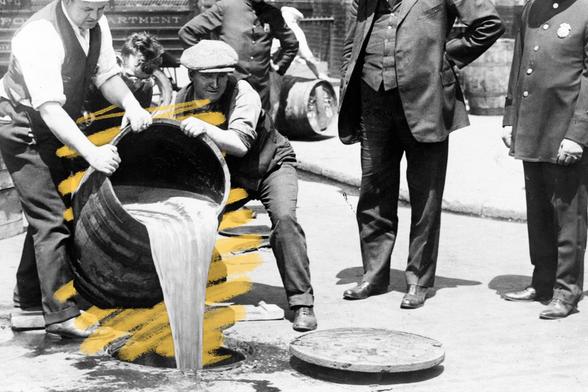
This is still routinely done to avoid ethanol taxes. It's called "denatured alcohol". Ethanol that has been poisoned is not considered drinkable alcohol, so not subject to the taxes on drinkable alcohol.
There are many hobbies with which people can kill themselves if they don't understand what they are doing. I don't see how brewing is different. A grown-up person has rights and bears the consequences of negligence and that's totally normal, that's what freedom is.
As long as the product is not sold outside but for personal consumption, it must be legal to make without any certifications.
Agree completely, though sadly we are a very long way from this. In a lot of places it is literally illegal and prison-time just for growing certain naturally-occurring plants for purely personal use. I don't see how this ruling helps with that at all though
I forget the exact wording, but the seat belt law are a good example of it. Laws are passed to protect the populace from self harm so that society doesn't suffer from it. It probably doesn't apply here because home distillation is very niche. However, if a bunch of people show up in emergency rooms and it drives up health care costs then expect a quick reversal in policy.
Right, and I, as someone living in France and paying a hefty part of my income to fund public healthcare, understand that the state would want to limit people doing stupid shit costing the society a fortune in fixing them (though, of course, this just creates a debate on where to draw the line).
But isn't the point of non-socialized healthcare, like in the US, that you pay for care out of pocket? Or maybe via your insurance, which will probably increase your premium if you repeatedly engage in stupid actions that need expensive fixing?