
Current situation re electric trucks in Australia, where lots of stuff moves long distances (quoting James Purtill’s ABC article) : “ About a fifth of trucks in Australia are prime movers used for "line haul" long-distance bulk transportation of freight between cities and towns.

“”Battery-powered models are available but have limited applications, Mr Hammond [the Trucking Industry Council's (TIC) chief technical officer] said.

"You'd be lucky to get 300 kilometres on any of the major transport routes before you need probably a two-hour recharge," he said.

More powerful chargers would reduce this time but place a greater strain on the regional power network.

The amount of power required to recharge an electric road train in the space of an hour was about equivalent to that of a small commercial building, which would be more than some towns' spare capacity.

Hundreds of dedicated charging depots would need to be built to electrify intercity freight, and this would be expensive.” [end quote]

#electricTrucks #Australia #AusPol #dieselTrucks #diesel #EVs #truckingIndustry
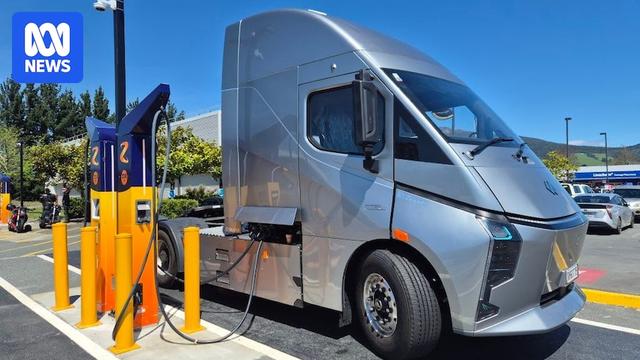
https://www.abc.net.au/news/science/2026-04-09/record-sales-of-electric-trucks-price-parity/106526476

A wave of low-cost electric trucks is heading for Australia

Diesel trucks are the backbone of the national supply chain, but figures buried in recent sales data could mark the beginning of the end for these kings of the road.

@Su_G https://januselectric.com/

They're not the only heavy vehicle battery swap operation, but they have trucks on the road in Australia.

It makes a lot more sense for trucking fleets to battery swap than it does solo car owners.

Especially given Australia's hatred of trains, especially electric freight trains. So we run thousands of trucks long haul between major cities. Exactly the highways battery swap stations would work best on.

Janus Electric

@moz
Really interesting that it’s already happening! So true: “makes a lot more sense for trucking fleets to battery swap than it does solo car owners.” Thanks for sharing that!! 🙏🏻

ABC article talks about how China’s really got a wriggle on with the 2nd generation of electric trucks designed from the ground up (rather than retro-fitted) but always good to have options & we have lots of small trucks as well as semis & prime movers. 🙂

@Su_G @moz So what does Australia have against diesel trains and intermodal transport? That seems to work ok in the USA. We have lousy passenger rail but the freight system works.

Has anyone considered a battery electric train that uses electrified track only for hills? Trains are pretty efficient on the flat land; most of the power required is for hill climbing.

@mike805
Good questions! 🤔 “So what does Australia have against diesel trains and intermodal transport? That seems to work ok in the USA. We have lousy passenger rail but the freight system works.

Has anyone considered a battery electric train that uses electrified track only for hills? Trains are pretty efficient on the flat land; most of the power required is for hill climbing.”

Probably need train experts & engineers for answers… 🤔

@moz

@Su_G @mike805 there are a few battery electric trains. One in Queensland in a heritage railway, the UK uses them for short non-electrified stretches where there's not enough traffic to justify proper electrification.

There's also a mine in WA that uses the difference between loaded weight downhill and unloaded uphill to hopefully never need to charge the locos :)

As usual it's not the technology that's lacking.

@moz @Su_G In the USA some electric railroads went to diesel. The diesels improved while the electrical infrastructure was a multiple of the cost of track.

Just thinking a train is pretty efficient on level ground. You could have battery cars behind the locomotive, park the battery cars on sidings to charge where power is available, and have electrified track only on grades.

That might be a lot more cost effective than fully electric freight rail. Also makes a good dispatchable load for solar.

@mike805
Sounds like a really good idea to me!: 🤗
“Just thinking a train is pretty efficient on level ground. You could have battery cars behind the locomotive, park the battery cars on sidings to charge where power is available, and have electrified track only on grades.

“That might be a lot more cost effective than fully electric freight rail. Also makes a good dispatchable load for solar.”

Clearly the pros & cons & efficiencies etc of train vs long haul truck vs urban delivery truck & so on are very different, but suspect that, given the addition of solar & battery, there’s an increasing number of neat solutions now coming on line. Potentially very exciting!🤗

Thanks for sharing your thoughts re trains; the current situation could be just what freight trains need to have a rennaisance!

@moz

@mike805 @Su_G mostly that the subsidies for roads are baked in and no-one really thinks of them in those terms. Politicians are more likely to boast "we spend $X billion upgrading the highway" than to talk about cost recovery, let alone whether the road (transport) system is profitable.

But rail? There's no profit in rail, don't be stupid. Rail is a cost!

The Inland Freight Corridor project is a huge project that will improve things a lot unless the far right parties cancel or gut it (NBN?)