 Marcus Adams
So I think moving forward I'm switching to #AGE for file #encryption instead of #PGP. I occasionally make backup archives of various things and use passphrase encryption with #GPG to encrypt them before storing them. However, GPG is very slow for bigger files, and in some testing recently I discovered AGE is multiple times faster. Also, with their latest release they now support hybrid post #quantum assymmetric key pairs. So for encryption it can fully replace GPG.
It's Friday so I finally got time to sit down and do some of these benchmarks for comparing #GPG and #AGE for #encryption speed. Here's the results so far on an uncompressed .tar file, and an already compressed .tar.zst file. Gonna try to add SequoiaPGP to the list, if I can figure out how to do symmetric/password encryption with it.
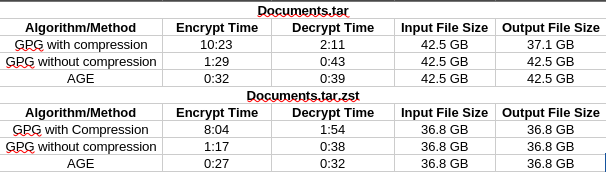
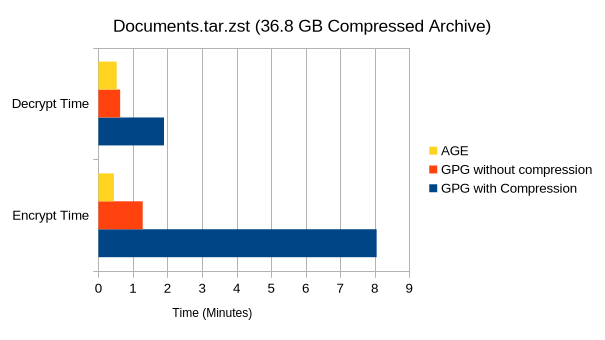
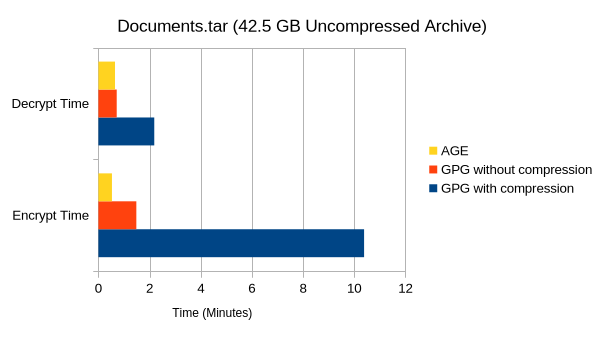
Apparently SequoiaPGP, at least the version I have from the Debian repos, does not support symmetric encryption without the use of a public key, and I can't find any mention of that functionality on their website, so it won't be included in my testing. Anyway, here's a couple of charts.
 Bruce Walzer 🇨🇦
@gerowen For GPG, does the platform have AES-NI instructions? Is GPG doing OCB, OCFB-MDC or OCFB mode?
@upofadown I finished writing everything down and have posted it here. GPG, as far as I can tell, doesn't explicitly tell you what mode it's using. All I ever see it say is "AES256", though I believe it defaults to CFB these days. I'm not a cryptographer though, so you can probably glean more information than I just by looking at my setup and results.
Link: https://open.substack.com/pub/gerowen/p/age-vs-gpg-pgp-encryption

@upofadown And yes, the CPU has hardware accelerated AES instruction sets available, and listed in /proc/cpuinfo.
https://www.amd.com/en/products/processors/laptop/ryzen/8000-series/amd-ryzen-9-8945hs.html