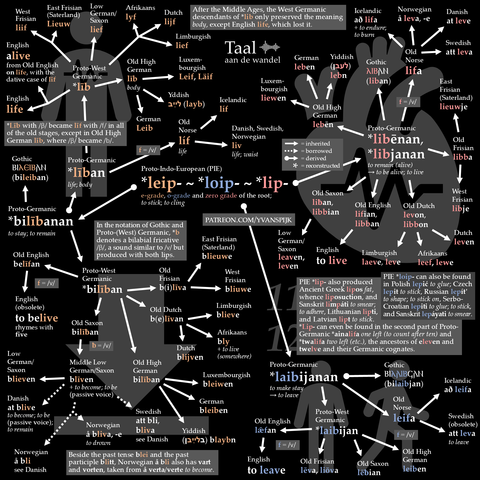
It will come as no surprise that ‘to live’ is etymologically related to ‘life’ and ‘alive’.

However, these words are also related to ‘to leave’ and German ‘bleiben’ (“to stay”), which used to have an English cognate: ‘to belive’.

Even ‘lipo-’ in ‘liposuction’ is related, as are the parts ‘-lev-’ and ‘-lv-’ of the numerals ‘eleven’ and ‘twelve’.

All of these words stem from a common Proto-Indo-European root meaning “to stick”.

Click my new graphic to learn all about this word family:
@yvanspijk One day, while I’m looking at one of your infographics, my eyeballs will just pop out of their sockets because it’s all just SO fascinating!!
@yvanspijk I am a bit confused on how it went from 'to stay' to 'to leave'. The meaning switched to the complete opposite?
@bartavi @yvanspijk I assume this is the sense of 'to leave behind', letting something stay where it is.
@lnkvt @bartavi Exactly. *Laibijanan was a so-called causative: with it, you expressed causing something or someone to stay, leaving them behind. It's like 'to lay down something or someones': you cause them to lie down.
@yvanspijk I look in the mirror and realise: Das Fett bleibt auf meinem Leib.
@yvanspijk so "cling to life" is now similar to the mountain with the name which basically means mountain 4 times or so?
@yvanspijk Today I learnt a new Norwegian Nynorsk ord: å bliva. I had to look it up, but it is, of course, in the dictionary.
@klefstadmyr Ah, good to know it's rarely used!
@yvanspijk And now I'm trying to pronounce V with both lips.
@klefstadmyr Try blowing out a candle while using your voice to make the buzzing sound of a v. 😊