 Yoïn van Spijk
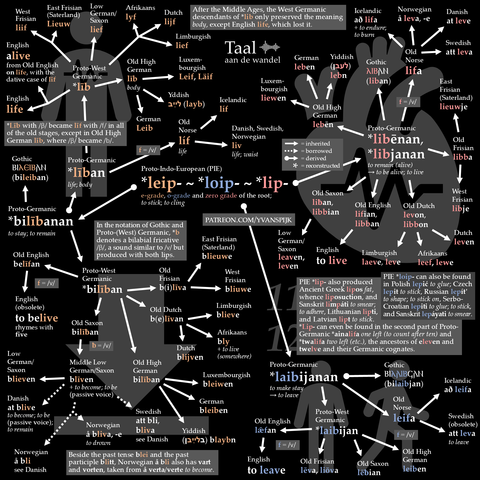
It will come as no surprise that ‘to live’ is etymologically related to ‘life’ and ‘alive’.
However, these words are also related to ‘to leave’ and German ‘bleiben’ (“to stay”), which used to have an English cognate: ‘to belive’.
Even ‘lipo-’ in ‘liposuction’ is related, as are the parts ‘-lev-’ and ‘-lv-’ of the numerals ‘eleven’ and ‘twelve’.
All of these words stem from a common Proto-Indo-European root meaning “to stick”.
Click my new graphic to learn all about this word family:
 Bart Groeneveld
 Leen Kievit