 Aral Balkan
RE: https://infosec.exchange/@molytov/116376968214888959
Gee, maybe Signal shouldn’t keep harassing people to turn on notifications and take no for an answer?
Thoughts, @Mer__edith?
RE: https://infosec.exchange/@molytov/116376968214888959
Gee, maybe Signal shouldn’t keep harassing people to turn on notifications and take no for an answer?
Thoughts, @Mer__edith?
@aral I must not see what you see (but also don't understand the logic in having a messaging app with no notifications; how would you know somebody messaged or called?)
last time I installed, I set notifications (just show there is one, do not show details) and that's the last I've ever seen or heard about it ¯\_(ツ)_/¯
@darkuncle “Yes / Ask me again later” is a hostile design pattern that shows a profound lack of respect for consent. Signal should be doing better.
You do not know better than the person making the decision whether or not they want notifications on.
(The opposite of “yes” is “no”.)
CC @Mer__edith
@aral I guess I haven't seen that particular design pattern (just disabled notifications, restarted Signal, and got prompted -- "not now / enable" -- so yeah, confirming what you see. It's IMO on a par with prodding the user about their PIN, which is at worst mildly annoying but serves a useful purpose).
(I still maintain that a messaging app that supports audio and video calls, but has no notifications enabled, is effectively useless -- but end users should have the option to choose that. I'd argue a better UX here would be "yes / no / ask me later" and if you pick "no" you get an explicit warning that you will never be notified of any incoming calls or messages; at least that way unsophisticated users are aware of the risks and sophisticated ones can still make that tradeoff.
Tradeoffs are really key here, and we should support maximum end user control while also being very explicit about tradeoffs to avoid surprises.)
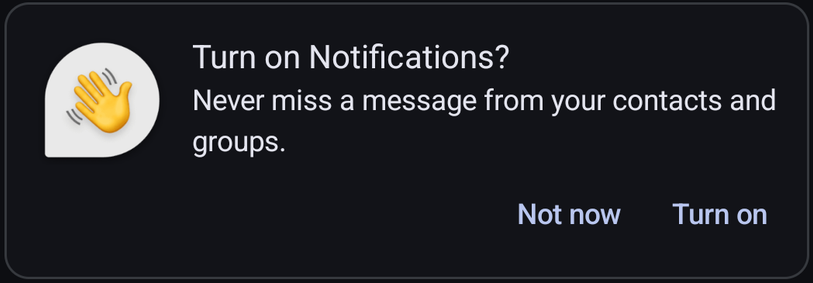
Attached: 1 image @darkuncle @[email protected] I imagine if I were to disable notifications, it would be because I intend to only engage with the app on my terms rather than having the app try to get my attention, perhaps away from other things I want to be focused on instead. But that isn't actually relevant to the problem. A user doesn't owe anyone justification for how they set something up for themselves, and an app should be something that accommodates their needs, rather than demanding certain behaviour from them. And like Aral said, the option isn't just a one-time "Yes" and "No" - as in "Alright, I'll enable notifications" vs "No, I want to keep them disabled" - it only has "Not now", which means the app will continue to send the prompt in the future, which does not respect the user's choice.
 Scott Francis