 Aral Balkan
RE: https://infosec.exchange/@molytov/116376968214888959
Gee, maybe Signal shouldn’t keep harassing people to turn on notifications and take no for an answer?
Thoughts, @Mer__edith?
RE: https://infosec.exchange/@molytov/116376968214888959
Gee, maybe Signal shouldn’t keep harassing people to turn on notifications and take no for an answer?
Thoughts, @Mer__edith?
@aral I must not see what you see (but also don't understand the logic in having a messaging app with no notifications; how would you know somebody messaged or called?)
last time I installed, I set notifications (just show there is one, do not show details) and that's the last I've ever seen or heard about it ¯\_(ツ)_/¯
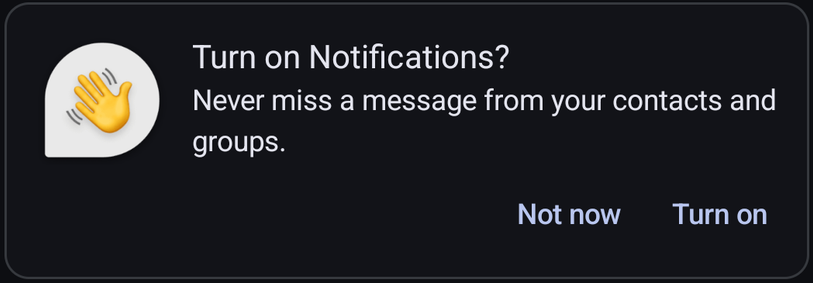
@molytov @aral when you are maintaining an app that supports both sophisticated and novice users, you sometimes have to make a decision between user choice and minimizing user risks due to tradeoffs they did not consider. (e.g., my mom last week calling me to figure out why she missed texts from her friend group all the time, and then we realized she had somehow muted the chat but did not realize.)
that said: we should be supporting user choice, while simultaneously being explicit about tradeoffs and risks. both these things are possible, and in this case I'd add "no" in addition to "yes" and "ask me later", and when selecting "no" would warn the user that all incoming calls and messages would be silent, and is that what they want. ¯\_(ツ)_/¯
@darkuncle @aral Absolutely. I think the solution for such an issue would be to properly communicate what an option means so that the user can make a proper decision.
One possible tactic that comes to mind is if a user opts to not enable notifications from the prompt, display a second prompt along the lines of "Are you sure? You won't get notified and will have to open the app to check messages. You can change this option in this menu later." and lock the confirmation and cancellation options behind a 3-5 second timer so that the user is more likely to actually read the warning and not thoughtlessly tap the confirm option just to get rid of it. I don't have years of experience designing and testing UX though so there's probably better ways to accomplish the goal.
 Scott Francis
 Molytov