TOPIC> Interactions

2025 August 19

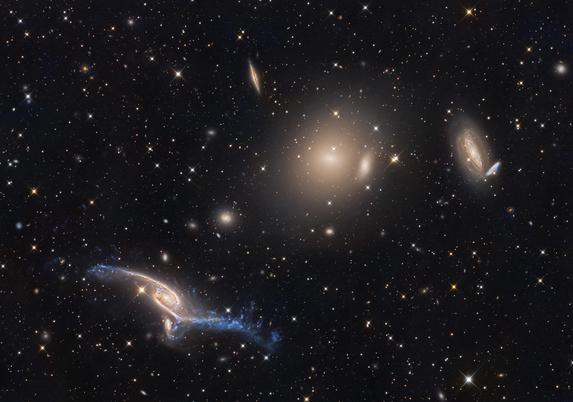
Giant Galaxies in Pavo
* Image Credit & Copyright: Adam Block
https://www.adamblockphotos.com/

Explanation:
Over 500,000 light years across, NGC 6872 (bottom left) is a truly enormous barred spiral galaxy. At least 5 times the size of our own large Milky Way, NGC 6872 is the largest known spiral galaxy. About 200 million light-years distant toward the southern constellation Pavo, the Peacock, the appearance of this giant galaxy's stretched out spiral arms suggest the wings of a giant bird. So its popular moniker is the Condor galaxy. Lined with massive young, bluish star clusters and star-forming regions, the extended and distorted spiral arms are due to NGC 6872's past gravitational interactions with the nearby smaller galaxy IC 4970, visible here below the giant spiral galaxy's core. Other members of the southern Pavo galaxy group are scattered through this magnificent galaxy group portrait, with the dominant giant elliptical galaxy, NGC 6876, above and right of the soaring Condor galaxy.
https://www.adamblockphotos.com/ngc-6872.html

https://ui.adsabs.harvard.edu/abs/2007A%26A...464..155H/abstract
https://ui.adsabs.harvard.edu/abs/2014ApJ...795...89E/abstract
https://chandra.harvard.edu/photo/2009/ngc6872/

https://apod.nasa.gov/apod/ap250819.html

#space #galaxy #astrophotography #photography #science #astronomy #nature #NASA #education
2026 April 10

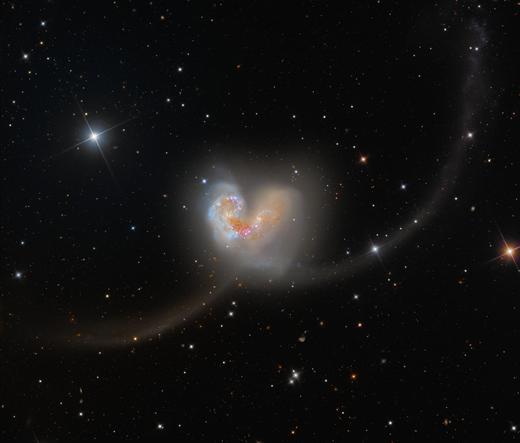
Exploring the Antennae
* Image Credit & Copyright: Acquisition - Mike Selby Processing - Roberto Colombari
https://throughlightandtime.com/
https://www.itelescope.net/robert-colombari-astronomy-in-the-rain

Explanation:
Some 60 million light-years away in the southerly constellation Corvus, two large galaxies are colliding. Stars in the two galaxies, cataloged as NGC 4038 and NGC 4039, very rarely collide in the course of the ponderous cataclysm that lasts for hundreds of millions of years. But the galaxies' large clouds of molecular gas and dust often do, triggering furious episodes of star formation near the center of the cosmic wreckage. Spanning over 50 thousand light-years, this stunning telescopic frame also reveals new star clusters and matter flung far from the scene of the accident by gravitational tidal forces. The remarkably sharp ground-based image follows the faint tidal tails and distant background galaxies in the field of view. The suggestive overall visual appearance of the extended arcing structures gives the galaxy pair, also known as Arp 244, its popular name - The Antennae.

http://hawastsoc.org/deepsky/crv/index.html
http://spider.seds.org/spider/Misc/n4038-9.html
https://arxiv.org/abs/1909.05240
https://hubblesite.org/contents/media/images/2006/46/1995-Image.html
https://apod.nasa.gov/apod/ap120604.html
https://astronomy.swin.edu.au/cosmos/t/Tidal+Tails
https://science.nasa.gov/asset/hubble/super-star-clusters-in-the-antennae-galaxies/

https://apod.nasa.gov/apod/ap260410.html

#space #galaxy #astrophotography #photography #science #astronomy #nature #NASA #education