So green and clean

"We may think that the wind turbines we see blowing in the wind up and down the country will last forever, but that's not the case at all. These blades do need to be replaced and some 11,000 tons of wind turbine blades are due to be decommissioned in Ireland by the end of this year. Unfortunately, the glass fibre materials used in the construction of these blades are not biodegradable."

https://www.rte.ie/brainstorm/2026/0401/1491819-wind-turbine-blades-recycling-reuse-podcast/

@gerrymcgovern Yikes! For some reason, I thought they were metal. That's not good.
@gerrymcgovern But at least there's this...
"Wind turbine blade reuse in civil engineering and other applications is in its infancy, and is not utilised on a larger scale, mainly because there is no information on the current stock of these blades in Ireland and their mechanical fitness to be reused in second life structures."
@DoomsdaysCW there are millions of them dumped in toxic graves that will poison for thousands of years. They just don't design this stuff to be reusable or recyclable. And we don't calculate these total costs to the environment. Once you can tick the box "reduces CO2" you can do practically any other harm you want.
RecyclableBlade

@slothrop @gerrymcgovern @DoomsdaysCW

Also wind turbine blades are not toxic.

@billiglarper
Wind turbine blades are not toxic?

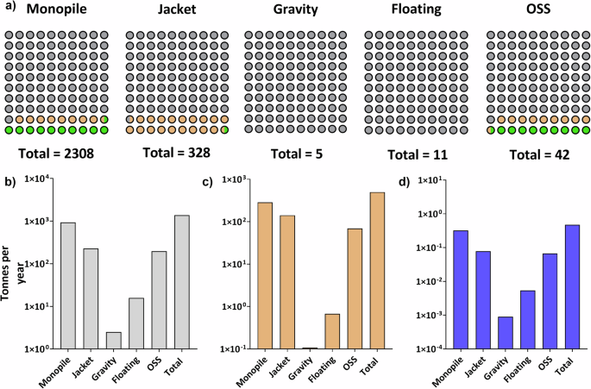
"Trace elements (TEs) from turbine corrosion-protection systems could generate significant ecosystem, economic, and human health risks. We calculate annual inputs for current European OWF capacity (30 GW) as: 3219 t aluminium, 1148 t zinc and 1.9 t indium, but these will increase ~12× by 2050, eclipsing known discharges."

"Paucity of industry data" allows harms to be hidden, as usual

https://www.nature.com/articles/s44183-024-00101-6

@slothrop @DoomsdaysCW

Offshore wind energy: assessing trace element inputs and the risks for co-location of aquaculture - npj Ocean Sustainability

Co-locating aquaculture with Offshore Wind Farms (OWFs) is a novel global energy sustainability policy driver. However, trace elements (TEs) from turbine corrosion-protection systems could generate significant ecosystem, economic, and human health risks. We calculate annual inputs for current European OWF capacity (30 GW) as: 3219 t aluminium, 1148 t zinc and 1.9 t indium, but these will increase ~12× by 2050, eclipsing known discharges. However, a paucity of industry data makes it impossible to compare water and sediment TE concentrations at operational OWFs against toxicity thresholds, therefore, ecotoxicological risks are under assessed. TE accumulation in seafood is a major human exposure route. Accumulated high tissue concentrations in oysters, mussels and kelp during co-location culture would contribute significantly to or greatly exceed (e.g. oyster zinc accumulation) an adult’s Tolerable Weekly Intake. We provide an industry/regulator ‘road map’ for implementing key policy changes to minimise unintended risks of rapid global OWF expansion.

Nature

@gerrymcgovern @slothrop @DoomsdaysCW

You linked an article on corrosion protection of offshore wind farms, not on wind turbine blades.

https://www.sciencedirect.com/science/article/pii/S0921344924004695

About 70% of wind turbine blades (WTBs) are fiber reinforced polymeres(FRPs). "In addition to FRPs, WTBs typically incorporate polymeric adhesives, sandwich core materials such as balsa wood, as well as bonded joints, coatings (such as polyurethane), and metal lightning conductors"

@billiglarper
The idea that wind turbine blades are not toxic and do not pollute doesn't stand up to scrutiny.

Leading Edge erosion and pollution
from wind turbine blades
https://docs.wind-watch.org/Leading-Edge-erosion-and-pollution-from-wind-turbine-blades_5_july_English.pdf

@slothrop @DoomsdaysCW

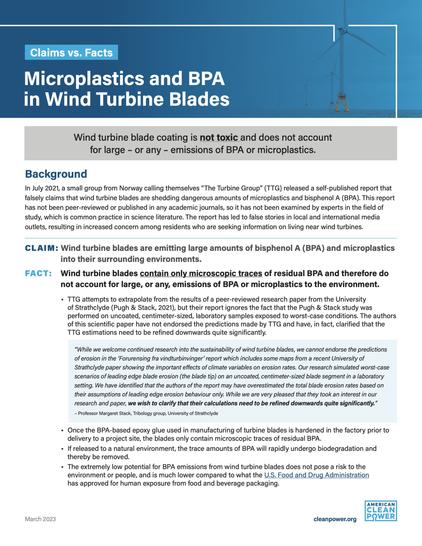
Claims vs. Facts: Microplastics and BPA in Wind Turbine Blades | ACP

Wind turbine blade coating is not toxic and does not account for large – or any – emissions of BPA or microplastics. Claims have been made that wind turbine blades […]

ACP

TBH, I'm always a bit suspicious of lobbying associations, @billiglarper . #FollowTheMoney

@gerrymcgovern @slothrop

@DoomsdaysCW @gerrymcgovern @slothrop

But making up fantasy amounts of unhardened resin is ok?

Sorry, this is just made up flooding-the-zone-with-shit disinformation.

There's not much to say about fibre-reinforced plastic when using carbon or glass as fibers. It's very inert once hardened. It's simply not toxic.

Just think about the use cases outside of wind farms. From boating to lightweight planes and helicopers, to bycicles, car parts and sports gear. 🤷‍♂️

Gotta love that block button, @billiglarper . It's great for folks who like to argue and shout down folks. @gerrymcgovern @slothrop
Heh... So, "Bill" sounds like those pro-nuclear trolls who used to harass me on the Bird site, @gerrymcgovern . Once, I managed to track down who was paying them (it was NEI).

@DoomsdaysCW Yeah, so sorry to hear that.

You deliver such wonderful information. So rich and well researched and full of real stuff you can do to make things better. Always worth a read.

@DoomsdaysCW @gerrymcgovern At this point, nuclear is only viable for grids with tons of growth, or cold and dark like say finland As dirt cheap as solar and battery are getting, nuclear is overpriced for most stable economies. India and China and maybe Pakistan and Indonesia will find nuclear to be viable, the rest of the world not so much
Nuclear is never viable. Not until we can find a way to deal with nuclear waste, @anubis2814. And not while uranium mining is still polluting Indigenous lands. @gerrymcgovern
And China has been doing a lot involving renewables, @anubis2814 . They are way ahead of everyone (even if they aren't fully sustainable and non-polluting.) @gerrymcgovern
@DoomsdaysCW You're right, you do "gotta love that block button." I 've read this thread, and it's clear who the problem is. (It's not "Bill.) Enjoy the party!