 Cat 🐈🥗 (D.Burch)
Tell me some thing blasphemous and/or sacrilegious 
@catsalad
Pirates never played accordions
🏴☠️🚫🪗
(Because they hadn’t been invented yet)
Accordions were invented during the 1800s Industrial Revolution at the same time as the telegraph, steam engine and the typewriter
100 years after the Golden Age of Piracy 1600s–1700s
So every pirate movie with an accordionist is a science fiction movie with a time-travel sub plot 🚀⌛️
And those Pirates you mention also didn't sing shanties; because they hadn't been invented yet.
Shanties were the work songs of merchant seamen from approx. the late 1820s and reported to be dying out in the late 1870s.
So, a 19th century working-class culture hijacked into "Pirate" fantasy-land.
PS. also, no, not every song mentioning the sea or sailors is a shanty.
@ecadre @AccordionBruce @catsalad
Well, wait a second... Dana reported work songs and shanties. And Hawai'ian long talk.
@ecadre @AccordionBruce @catsalad
Nope, checked my dates; Dana was 19th century; for some reason I think of him as 18th.
@ecadre @AccordionBruce @catsalad
There it is: Complaynt of Scotland, printed 1549. Chapter 6. Monologue Recreative (one of the first texts written in Scots, but published in France) has references to maritime work songs - and in particular their use in raising the anchor. https://web.archive.org/web/20220517010218/https://northernrenaissance.org/cacophonous-catalogues-the-complaynt-of-scotland-and-the-monologue-recreative/
@Amgine @ecadre @catsalad
Makes sense people would sing work songs whatever they called them
I heard the shanty tradition got stronger because the crews on commercial ships were worked so hard they needed the songs to coordinate the low-numbers
Royal Navy ships didn’t have them (as much?) because they had enough crew to do the work?
Veering, of course here
🧊 🚢
@AccordionBruce @ecadre @catsalad
My reading suggests much of the shanty tradition came through the Royal Navy, primarily due to so many sailors. The primary instruments were drum, whistle, fife, horns, and fiddle. This tradition added 'strums' - various instruments with stretched-skin sound boxes - once slave trade was established in the Caribbean.
@AccordionBruce @ecadre @catsalad
Heh, wait until the purists pull their tools to flay me. "There are no instruments in shanties!" etc.
Just a sailor, who should head down to the boat to prepare for the incoming weather.
@AccordionBruce @Amgine @catsalad
There was more than shanteys on merchant ships (and Naval ships that didn't use shanteys).
On Naval ships there was often a ships band (certainly on larger ships) and certainly a fiddler on most ships. Songs were sung even on Royal Navy ship when off-duty. These are known as fo'c'sle songs.
One of the main complaints of Captain Bligh's crew on the Bounty was that he made them dance to a the playing of a fiddle for several hours (!) each day.
@AccordionBruce @Amgine @catsalad
In Northleach in Gloucestershire there is the very little, but wonderful, Mechanical Music Musem. One of its exhibits is the small barrel organ that Captain Parry took on the 1819–1820 expedition to explore the Arctic and try to fine the NorthWest Passage.
It's not mentioned online, but you can see it on Google street maps. I was amused to realise how many of the tunes on the different barrels I knew and could play :-)
@AccordionBruce @Amgine @catsalad
And this is Captain Parrys "musical box" (the barrel organ) at the Mechanical Music Museum:
@ecadre @Amgine @catsalad
Dan Worrall’s Anglo-German Concertina history
(Worth having!)
https://mastodon.social/@AccordionBruce/116367921253583166
The Concertina at Sea chapter has a photo of the player who went only as far as Argentina (luckily?) with Shackleton’s trip to the Antarctic
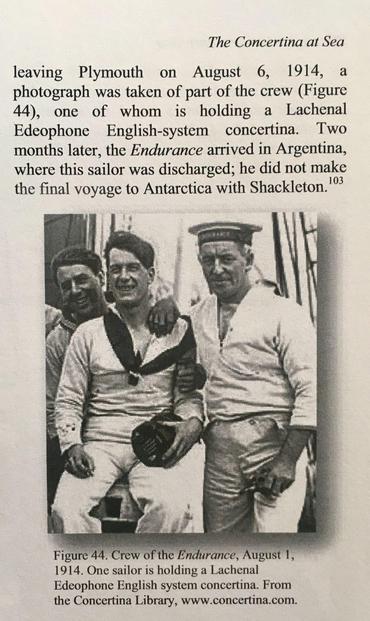
Great to learn about and see Peary’s music box!
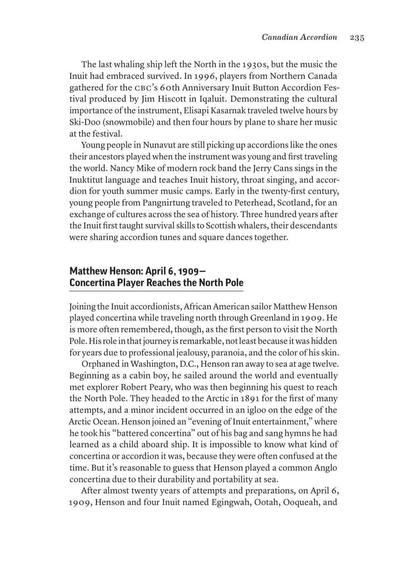
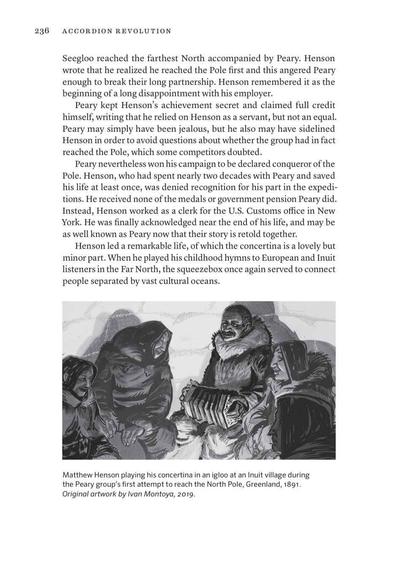
I had to commission an illustration for my #AccordionRevolution book of Matthew Henson, who may or may not have been the first squeezebox player to reach the North Pole
Ebook available free to those with visual impairments
Also DM me for the 2,000 footnote Annotated Edition which lacks illustrations, but is just a raw format PDF
 AccordionBruce
 Andrew Wigglesworth
 Amgine