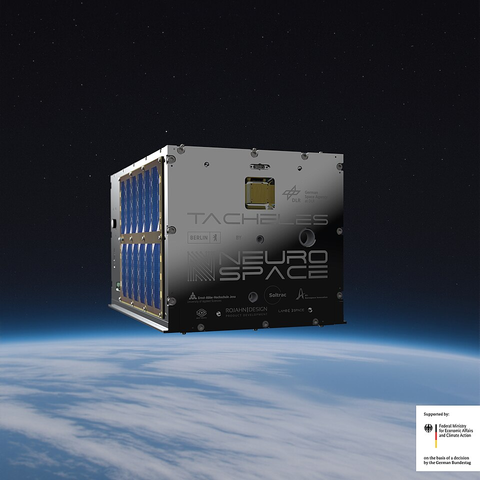
Can't find any info on the status of the TACHELES 6U CubeSat from Germany, deployed by Artemis II. Except that it is in a 156.4 x 70,254.4 km elliptical inclined orbit.

The satellite is designed to test the effect of radiation on electronics for lunar rovers being built by the German company NEUROSPACE.

The name comes from the German Tacheles, "straight talk," which is itself derived from Yiddish תּכלית (takhles, 'purpose, result').

@markmccaughrean @cosmos4u
https://www.neuro-space.de/portfolio-collections/missions/project-title-5
60/n
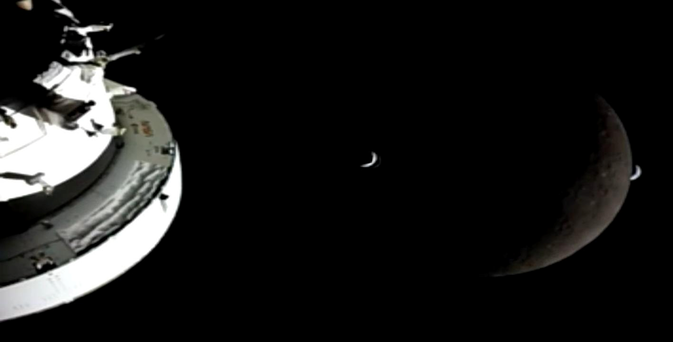
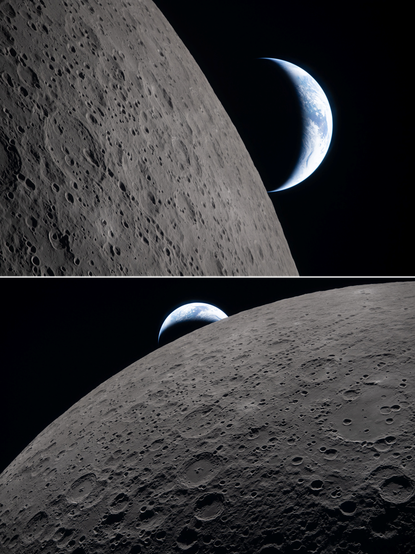
Earth-set and Earth-rise over the Moon as observed by Artemis II astronauts last night.

This is a simple composite of two images taken about 45 minutes apart by the GoPro camera located on one of the the solar arrays. Earth-set is on the right, Earth-rise 45 minutes later is on the left.

Source: https://www.youtube.com/watch?v=6RwfNBtepa4
61/n

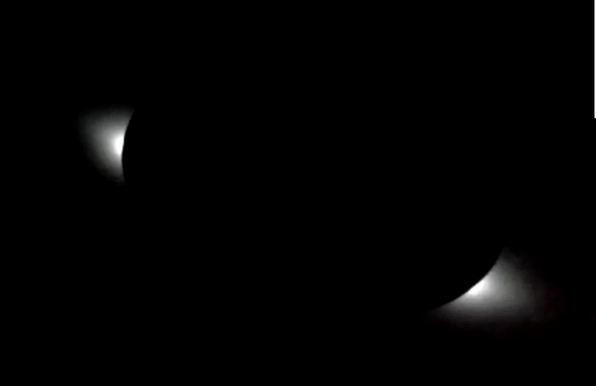
Sunset and Sunrise across the Moon as observed by Artemis II astronauts last night.

This is a simple composite of two images taken about 54 minutes apart by the GoPro camera located on one of the the solar arrays. Sunset is on the right, Sunrise ~54 minutes later is on the left.

Source: https://www.youtube.com/watch?v=6RwfNBtepa4
62/n

Hi-res Earth-set images captured using the Nikon D5 camera by astronauts aboard the Artemis II Orion spacecraft last night around 22:41 UTC.

EXIF data at https://www.flickr.com/photos/nasa2explore/55193180468/ and https://www.flickr.com/photos/nasa2explore/55193178333/
More images at https://www.flickr.com/photos/nasa2explore/with/55193462360
63/n

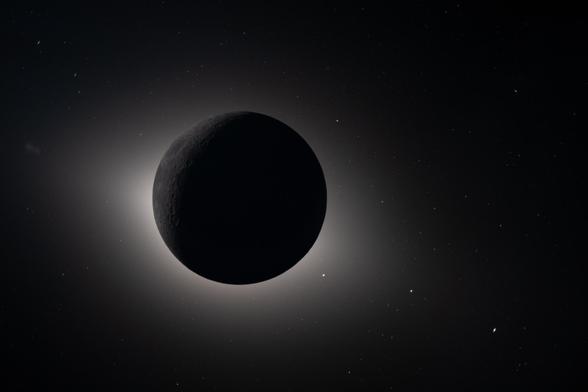
A fascinating image of the Moon's far side during the total solar eclipse, as seen last night by Artemis II astronauts around 01:06:19 UTC.

The glowing halo around the dark lunar disk is due to the zodiacal light, i.e, Sunlight reflected off space dust.

The left side of the moon is dimly lit up by Earth-shine, light reflected off Earth, located off the frame in the distance on the left.

https://www.flickr.com/photos/nasa2explore/55193054741/
More at https://www.flickr.com/photos/nasa2explore/
64/n

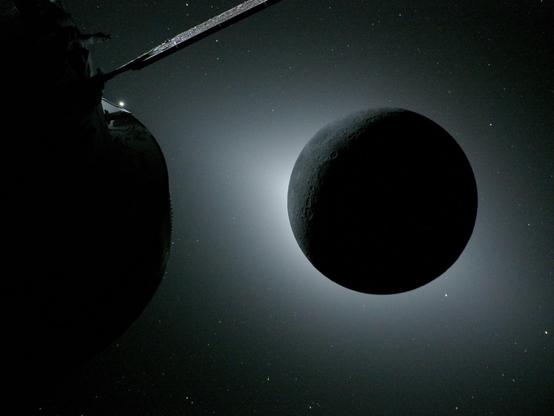
The solar eclipse imaged by the "mighty" GoPro HERO4 Black camera mounted on one of the solar arrays of the Artemis II Orion spacecraft, taken at 01:10:44 UTC.

Featuring the moon lit by Earthshine on the left, a halo of zodiacal light, planets Saturn and Mars on the lower right and stars posing for the camera.
😎
Go #Artemis. Go #GoPro.

https://www.flickr.com/photos/nasa2explore/55193566011/
65/n

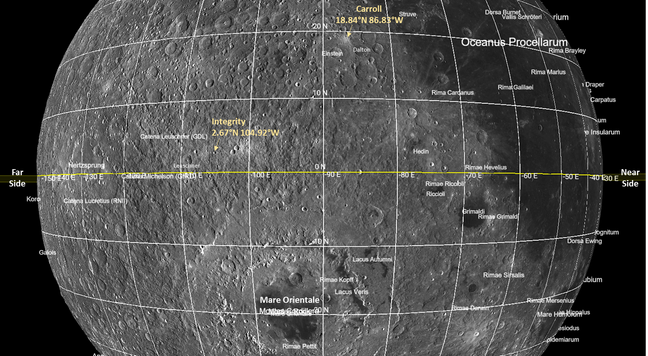
The two newly named craters on the Moon -
1. Carroll - named after astronaut Reid Wiseman's late wife, 18.84°N 86.83°W
2. Integrity - named after the Artemis II Orion spacecraft, 2.67°N 104.92°W

After the mission is complete, the crater name proposals will be submitted to the International Astronomical Union for official review and adoption.

https://quickmap.lroc.im-ldi.com/?camera=8583.1212%2C-4490898.2733%2C12862.3235%2C-0.0019%2C1%2C-0.0029%2C0%2C0.0029%2C1%2C60&showGraticule=true&stack=3314%2C3113&proj=22&defs=N4IgzAjBYgXKB7ADgQwMYEsAuBPOAGAOgBYwBfAGnEmLkVU1zgjLKA
https://en.wikipedia.org/wiki/Carroll_(crater)
https://en.wikipedia.org/wiki/Integrity_(crater)
66/n

From Josef Aschbacher, Director General of the European Space Agency.

Pic taken by one of the 4 GoPro cameras mounted on solar panels on the European Service Module (ESM).

The ESM provides propulsion, water and oxygen for astronauts, electrical power generation and storage, and temperature control.
😎
@markmccaughrean @bert_hubert @cosmos4u
67/n

@AkaSci @markmccaughrean @bert_hubert The ESM's main engine - which did the TLI burn - is U.S.-made and used (it flew on a space shuttle several times): how did ESA get hold of it? Was it a gift, part of a barter deal or bought for hard $$? This is surprisingly hard to find out. The heritage of this crucial ESM component is sometimes mentioned (like in the NASA live commentary) and most often not - even at one of the many Artemis II press conferences a NASA (!) manager stated in Q&A that everything on the ESM was European.
@cosmos4u @AkaSci @markmccaughrean @bert_hubert It's probably a good question if it was integrated on the ESM before or after arriving in the US. After would've been a whole lot less paperwork.

@simonbp @cosmos4u @AkaSci @bert_hubert According to this ESA blog post, it was an OMS-E engine installed on Atlantis & flew six times between 2000 & 2002. It was then in storage for 20 years before going to Bremen to be installed & tested on ESM-2. The nozzle though was only installed at KSC, if I've read that right.

But to Daniel's question about the "deal" by which ESA secured it, I don't know. I do know people who would know though, so can try asking.

https://blogs.esa.int/orion/2023/04/03/the-artemis-ii-engine-with-a-legacy/

The Artemis II engine with a legacy – Orion blog

News and updates on Europe's Service Module for NASA's Orion spacecraft and Artemis

@simonbp @cosmos4u @AkaSci @bert_hubert FWIW, this NASA presentation from 2013 says that the ESM main engine was one of "the agreed to NASA contributions to the ESA SM" (bottom of page 8).

That's slightly convoluted language, but suggests that the engine may have been simply given to ESA at no cost as part of the joint Orion programme.

Lots of other interesting details in there as well.

https://ntrs.nasa.gov/api/citations/20140008543/downloads/20140008543.pdf

@bert_hubert @cosmos4u @markmccaughrean @AkaSci @simonbp If I had to guess I’d go for “Customer-Furnished Item” or CFI.