 Max Leibman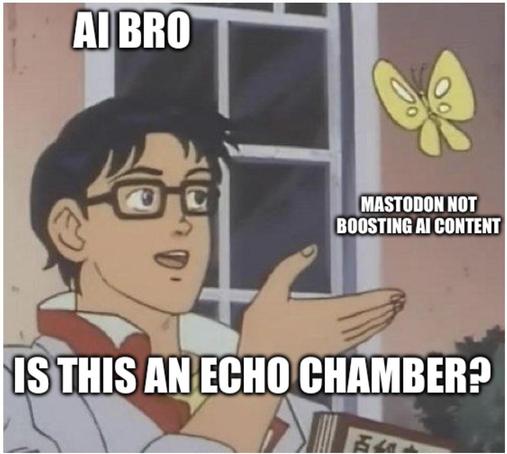
 Bogdan Buduroiu
@maxleibman Not to start a fight, but the community went on a week-long witch hunt against Cory Doctorow because he dared to use AI
@budududuroiu That’s not why people were mad at Cory Doctorow. They were mad because in the same piece he called anti-AI sentiment “purity culture,” framing it as reflexive, unthinking moralizing.
If not for that element, it barely would have been a ripple. Witness that feature article a few months ago about how Ed Zitron, one of the leading critics of AI, also represented AI companies in his marketing firm. That was way more salacious and barely got any play here at all.
@maxleibman really not here to fight, so please don't take as such, but...
> Using LLMs isn’t always popular with the cool crowd, Cory knows that. And he wants to defend his (quite modest) use, which I understand:
> Nobody likes their problematic behavior being pointed out to them. But as outlined: Life’s complicated.
Why would using an LLM be "problematic", unless there was a purity culture at play?
I digress, Mastodon is a great platform that allows one to curate their own feed to their liking, sometimes there's cross interactions between bubbles of Mastodon, so far, anecdotally, the cross interaction that bled into the ML/AI research space has been pretty negative, for no reason. Some people think that negativity is good, and that the ML/AI research space does not belong here. I guess that's where defederation comes in.

Acting ethically in an imperfect world
Life is complicated. Regardless of what your beliefs or politics or ethics are, the way that we set up our society and economy will often force you to act against them: You might not want to fly somewhere but your employer will not accept another mode of transportation, you want to eat vegan but are […]
 Kwaze Kwaze
Okay, take LLMs out of the equation so we don't have whatever baggage we have about them hanging around.
Is the use of DDT problematic? It also "works" for its purpose. But it has serious issues.
If it is "problematic", does that mean we're engaging in purity culture over which pesticides are okay and which aren't?
If it's not problematic what would you call it?
@kwazekwaze good analogy, I'll engage with it.
The purity culture argument would be that all pesticides are bad, no matter in what quantity, to what extent.
Pesticides have been one of the most significant ways in which the world, especially the Global South, increases food security. Boycotting pesticides as a whole would be an incredibly harmful process to the most vulnerable parts of the world.
Back to LLMs. Most of the research in making LLMs more efficient is done by hobbyists or nation states under sanctions (see China). More effective LLMs would mean a correction in investment into AI as a whole, and that would have a significant impact on the environmental destruction that happens in nations that extract minerals for chips for example, or vulnerable communities that have to bear the costs of data centers propping up next to them.
I see boycotting frontier labs like boycotting DDT, but boycotting all LLM research like boycotting all pesticides
EDIT: efficient not effective
Those "more efficient" models don't avoid any of the serious epistemic issues with these systems and to my knowledge are largely focused on distillation of larger models which is ultimately akin to ethics laundering. The energy efficiency is but one of the major issues here.
The entire conceit behind large models is also, in general, exploitative.
The more appropriate application of your angle to that analogy is that LLMs are DDT, the transformer is the pesticide.
@kwazekwaze This assumes that current knowledge hierarchies, even if unjust (a university in Lagos or Hyderabad still has to pay Elsevier an extortion fee even for publicly funded research), shouldn't be challenged. Nothing is laundered, imo it's a more aggressive form of redistribution.
What would a non-exploitative baseline for an LLM look like? No model trained on large internet corpus data? Everyone be compensated for text that exists because millions of people wrote it into a commons with no expectation of compensation, under no coherent property regime? A world where everyone is compensated? By whom, how, for what marginal contribution to a model weight?
Would LLMs being trained on the entirety of human knowledge and contributed back into 'The Commons' for the benefit of humanity (drug discovery, protein folding, LLMs exhaustively testing hypotheses for humans to verify) be ethical? Because that's what I'm totally for, and the only plausible alternative I see.
@budududuroiu @maxleibman
> What would a non-exploitative baseline for an LLM look like?
I don't know how you make a plagiarism machine not a plagiarism machine and I'm not interested in answering that question as I've no interest in automating plagiarism.
@kwazekwaze again, what I'm trying to say is that's a point of view afforded to you by your circumstances.
I'm sure someone outside the Western/OECD world wouldn't give two shits about plagiarism when they have to effectively pay rent to a company in the US for them having a piece of paper (a patent).
Yeah you're not going to convince me that paying rent to American companies (distillation doesn't solve this it just creates another middle man) for access to the theft engine is the answer to capitalism.
@kwazekwaze @budududuroiu "You seem very upset that we want to sell back to you the value we stole from you in the first place."
@maxleibman it's 2026, and technologists are making "you wouldn't download a car" type arguments
@kwazekwaze I don't have to convince you, US history is steeped in piracy and disregard for authorship.
Why should 18th century US literacy, and further 19th and 20th century US cultural exports be predicated on paying rent to the British crown for 'copyright'?
How the United States Stopped Being a Pirate Nation and Learned to Love International Copyright
From the time of the first federal copyright law in 1790 until enactment of the International Copyright Act in 1891, U.S. copyright law did not apply to works by authors who were not citizens or residents of the United States. U.S. publishers took advantage of this lacuna in the law, and the demand among American readers for books by popular British authors, by reprinting the books of these authors without their authorization and without paying a negotiated royalty to them. This Article tells the story of how proponents of extending copyright protections to foreign authors—called international copyright—finally succeeded after more than fifty years of failed efforts. Beginning in the 1830s, the principal opponents of international copyright were U.S. book publishers, who were unwilling to support a change in the law that would require them to pay negotiated copyright royalties to British authors and, even worse from their perspective, would open up the American market to competition from British publishers. U.S. publishers were quite content with the status quo—a system of quasi-copyright called “trade courtesy.” That system came crashing down in the 1870s, when non-establishment publishers who did not benefit from trade courtesy decided to ignore its norms, publishing their own cheap, low-quality editions of books by British authors in competition with the editions published by the establishment publishers. As a result, most U.S. publishers came to support extending copyright to foreign authors as a means of preventing competition from publishers of the cheap editions. Once the publishers withdrew their opposition, another powerful interest group came to the fore: typesetters, bookbinders, printers, and other workers in the book-manufacturing industries. These groups opposed international copyright unless it were accompanied by rules assuring that they would not be thrown out of work by a transfer of book manufacturing from the United States to England. In the 1891 Act, the typesetters achieved what they sought: a provision requiring books to be typeset in the United States as a condition of copyright. In this way, U.S. copyright law implemented an element of U.S. trade policy. The manufacturing clause, as this requirement was called, was gradually watered down over the succeeding decades and lingered in the copyright law until 1986. Yet the entanglement of copyright law with trade policy continued, in the World Trade Organization treaty system and elsewhere. As a major exporter of books, software, movies, and other articles embodying copyrighted works, the United States
 Magnus Ahltorp
@budududuroiu @kwazekwaze But right now we have a situation where only the billionaires are allowed to ”pirate”. We aren’t.
@budududuroiu
You realize the theft being discussed here is distributed and impacting all persons, correct?Hyperfocusing on a specific immaterial theft against an exploitive publishing system to discount the more egregious harms is myopic.
It's a bizarre crusade you're on to insist we must embrace fascist corporate products to fight corporate power.
You can go torrent some paywalled textbooks from an exploitive publisher right now (without an LLM) and not support a fascist tech project.
@kwazekwaze I'm not convincing you to embrace any product, just to allow people that want to disentangle capital from LLMs to discuss how to do so in peace, on the fediverse.
The only crusade here seems to be one to burn anyone discussing LLMs (unless negatively) at the stake.
@budududuroiu
When "you cannot disentangle the LLM from capital" is the topic I'm not going to just not tell you you're wrong.
Just like you didn't hesitate to tell the original tooter you thought he was wrong.
This implementation of ML only arises and gains the traction it does in a capitalist environment where consent, credit, and epistemic validity are secondary to "velocity" and output.
You can block me for telling me you're wrong but don't then try and insist there's an echo chamber.
Why would I block you? We're having a conversation, idk why your instinct is to expect being blocked.
> Just like you didn't hesitate to tell the original tooter you thought he was wrong.
It's meta-posting, the community is discussing recent flame wars across the fediverse. I weighed in.
> This implementation of ML only arises and gains the traction it does in a capitalist environment where consent, credit, and epistemic validity are secondary to "velocity" and output.
[citation needed] what would prevent a centrally planned economy from building centralised computer systems that index and ingest the entirety of the states documents and works. This is more akin to Soviet cybernetics projects like the OGAS than anything developed in the capitalist world
@budududuroiu @kwazekwaze @maxleibman Of course it is laundered if we are ”not allowed” to use the source data, but as soon as it’s been put through the machine, we are ”allowed” to use it.
Aaron Swartz was killed over this. Sunde, Neij, and Svartholm Warg were imprisoned. And yet the launderers and users of the laundered data should be praised?
Actual relevant things could be done with the data, but this situation we have is the worst: creators lose control and we still don’t get to use it.
@ahltorp yes, and I think the Swarz case is horrible. Same with TPB. Again, I wish DMCA people to sodomise themselves with retractable batons, but...
Who enforces punishments for GPL violations? No one. In fact, manufacturers like Boox actively ignore GPL and face no repercussions.
I think we have to grapple with the reality that these frontier models have already been trained and, without massive geopolitical headwinds, AI will go forward as is today, unless there's commodification.