#TechShowerThoughts:

Graphical interfaces are documentation with buttons.

The web is the documentation layer of the internet. Hyperlinking makes it documentation with buttons. So the web is also the native graphical interface of the net.

Webmail made email the first social layer of the web.

The fediverse adds another social layer to the web. As does the matrix network.

(1/?)

#fediverse #SocialWeb

The jabber network seemed like a logical realtime social layer for the web. It almost was, when Goggle integrated open federation over XMPP with GMail's web chat, and experimented with extensions to add features like voice calls (Jingle) and collaboration (Wave).

But standards-friendly engineers like @rabble say Titter tried to federate over XMPP and couldn't stretch it to fit. Could Wave have worked?

XMPP social apps do exist, like Movim and Libervia. Could 2026 be the Year of Jabber?

(2/?)

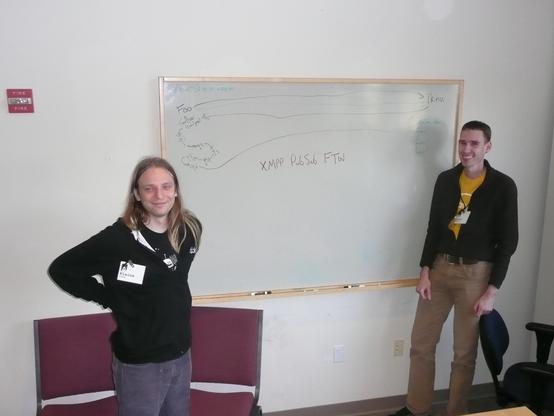
@strypey @blaine and ​@ralphm did the first federation between Twitter and Jaiku using XMPP, I think at a Foo Camp event (?).

@evan

Correct.

There was no technical reason for this to not continue to work. Wave's federation was built on XMPP PubSub, but although much hyped, the federation bit was just one person working on it part-time, and not really following standards either.

I built a federation of about ~60 social networking sites at @mediamatic using XMPP PubSub, including ActivityStreams quite successfully.

@strypey @blaine

(1/2)

@ralphm
> I built a federation of about ~60 social networking sites at @mediamatic using XMPP PubSub

Intriguing. Did you know this @rabble? What were the obstacles you hit with XMPP at Titter? I was wondering as long ago as 2017 why @evan didn't build StatusNet on XMPP.

Did/ does this MediaMatic infrastructure interop with Movim and Libervia stuff? What's the UX of that like?

@blaine

@strypey @ralphm @evan @rabble wasn't at Twitter and wasn't involved in the xmpp implementation. After I left (in May 2008), my understanding is that the ops team made a half-hearted attempt to keep the xmpp service going, but didn't have the capacity to devote time to it, so abandoned it. Unfortunately, their messaging on it was "xmpp doesn't scale" which was patently false, but it poisoned the water.

The complexity of the XMPP standards didn't help matters, of course.

@strypey it was
@blaine and @ralphm who did the work on XMPP. I gave a talk about some of the ideas and OSCON with @kellan but never worked on the Twitter code base itself or the XMPP federation.
@rabble @strypey @blaine @ralphm @kellan it was a great talk!

@evan
> it was a great talk!

I presume we're talking about the 2008 talk summarised here;

https://archive.nytimes.com/open.blogs.nytimes.com/2008/07/24/oscon-2008-day-01-sessions/

... which links to the slides here;

https://www.slideshare.net/slideshow/beyond-rest-building-data-services-with-xmpp-pubsub/525883

I note that this talk was given right around the time Identi.ca was launched. So again, I'm wondering what technical reasons @evan had for developing OStatus for StatusNet, and would the same decisions be made if they knew then what they know now about the state of XMPP at the time?

@rabble @blaine @ralphm @kellan

OSCON 2008 — Day 01 Sessions

Open Blog

@strypey @rabble @blaine @ralphm @kellan

I'd been working on XMPP for years. I was well aware of XMPP.

StatusNet, now GNU Social, ran on commodity web hosting: PHP, MySQL. Like WordPress, Drupal, MediaWiki, SugarCRM.

I wanted our federation to work on the Web, with RESTful APIs. XMPP was complicated, and required separate hosting.

@strypey @rabble @blaine @ralphm @kellan

You seem to be confused about the state of XMPP at Twitter.

There was an experiment federating text using PubSub between Jaiku and Twitter at FOO Camp in 2008. I wasn't there; I only heard about it later. It never went to production.

Twitter *did* have a chat interface to Twitter over XMPP, similar to the way it used SMS. You could receive updates over XMPP, you could post, and you could reply. Identi.ca had a very similar system.

@ralphm @strypey @rabble @blaine @kellan

So, that'd be July 11-13, 2008? Identi.ca launched the previous week -- July 3rd. Very close in time!

@evan

No, this was Social Graph FooCamp. This photo was taken on February 2. This is my presentation from XTech 2008 in May: https://ralphm.net/publications/xtech_2008/. By July we had a full federation of social networking sites over at Mediamatic Lab. My blog has some words: https://ralphm.net/blog/2008/07

@strypey @rabble @blaine @kellan

Talking Social Networks

@ralphm @evan @strypey @rabble @kellan the 2008 OSCon talk was a bit of a reprisal of Kellan and my May 2007 XTech talk, https://www.slideshare.net/slideshow/social-software-for-robots-528249/528249#1 @Ianforrester's site, heroically, still has much of the schedule: https://cubicgarden.com/2007/05/18/xtech-2007-finished-for-this-year-2/
Social Software For Robots

The document discusses social software for robots, noting that social software involves people interacting with computers that then interact with other people. It introduces Kellan Elliott-McCrea who works for Flickr and Blaine Cook who works for Twitter. Social software is defined as being made up of people, with some direct interaction between people but usually indirect interaction through computers. - Download as a PDF or view online for free

Slideshare