 AkaSci 🛰️
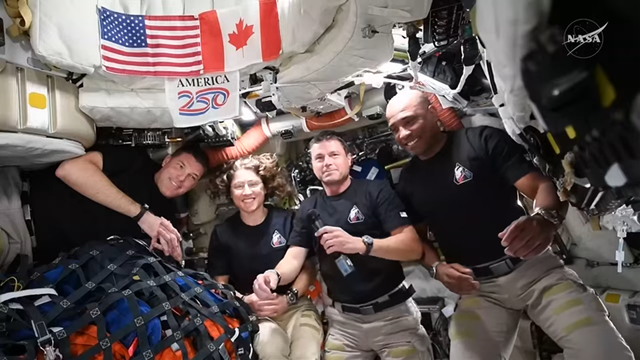
The 20-minute event last night where Artemis II astronauts spoke from space, answered questions and eloquently described their experience so far and the importance of this historic mission.
Inspiring!
Go #Artemis2
The 20-minute event last night where Artemis II astronauts spoke from space, answered questions and eloquently described their experience so far and the importance of this historic mission.
Inspiring!
Go #Artemis2

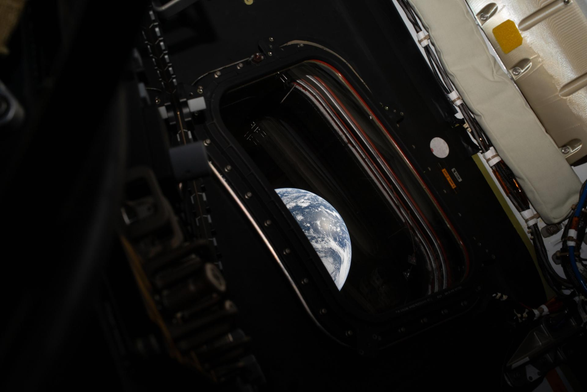
A magnificent view of a serene blue Earth taken yesterday by NASA astronaut and Artemis II commander Reid Wiseman from one of the Orion spacecraft's four main windows while approaching Earth 5 hours before the translunar injection. The Sun is to the right in the image.
Camera: NIKON D5 (DSLR, 20.8 MP)
LensInfo: 35mm f/2
ISO 250
ExposureTime: 1/250 s
CreateDate: 2026:04:02 18:53:12 UTC
Distance: 51,800 km
Image and EXIF data at https://images.nasa.gov/details/art002e000191
36/n
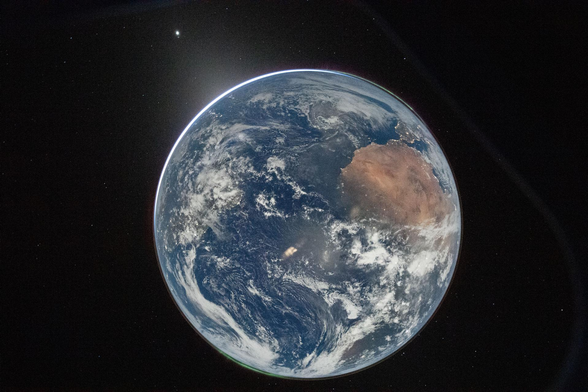
The Blue Marble imaged by Artemis II Commander Reid Wiseman ~30 minutes after translunar injection yesterday, as Orion started its sprint to the moon.
The image shows 2 auroras (top right and bottom left) and zodiacal light (top left). This is the night side of Earth lit by moonlight.
Camera: NIKON D5 (DSLR, 20.8 MP), 14-24mm f/2.8
FocalLength: 22.0 mm
ISO 51200
ExposureTime: 1/4 s
CreateDate: 2026:04:03 00:27:39 UTC
Distance: 10,150 km
Image and EXIF data at https://images.nasa.gov/details/art002e000192
37/n
This is an image of the full night-side Earth disk taken seconds before the image in the previous post but with a shorter exposure time.
In this image, we can see the electric lights of human activity. In the lower right, sunlight illuminates the limb of the planet.
Camera: NIKON D5 (DSLR, 20.8 MP)
Lens: 14-24mm f/2.8
FocalLength: 22.0 mm
ISO 51200
ExposureTime: 1/15 s
CreateDate: 2026:04:03 00:27:20 UTC
Distance: 10,050 km
Image and EXIF data at https://images.nasa.gov/details/art002e000193
38/n
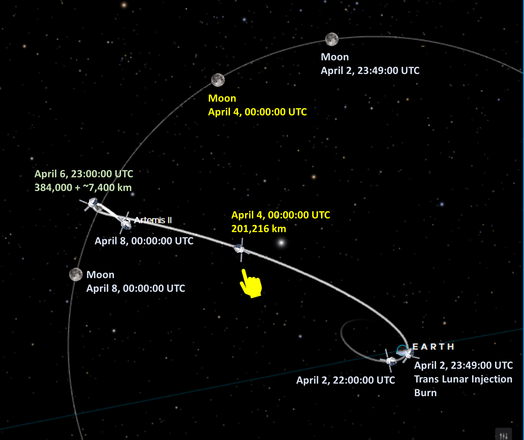
The Artemis II Orion spacecraft is now just over half way through on its journey to the vicinity of the moon.
It will take 3 more days to arrive near the moon as its velocity decreases over time, currently at 5,218 km/h.
Go #Integrity
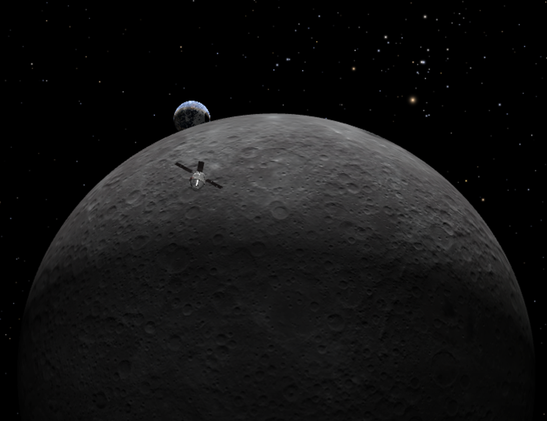
A possible view from the Artemis II Orion spacecraft at 22:35 UTC April 6 of a crescent Earth setting over the limb of a crescent Moon, as visualized using the NASA Eyes on the Solar System tool. In this image, Orion has traveled past the moon and is looking over its far side.
https://eyes.nasa.gov/apps/solar-system/#/sc_artemis_2?rate=0&time=2026-04-06T22:35:00.000+00:00
40/n
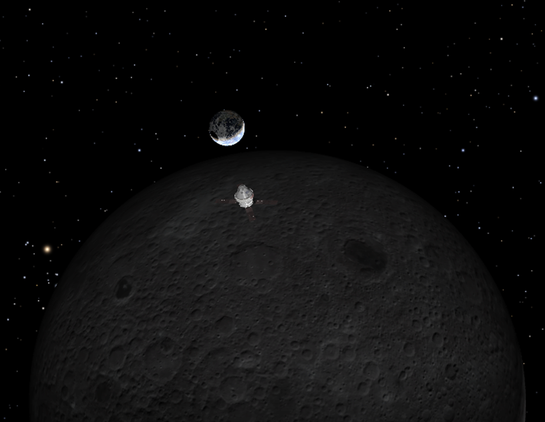
The simulated view from the Artemis II Orion spacecraft 45 minutes later at 23:20 UTC April 6 of a crescent Earth rising over the dark lunar surface, as visualized using the NASA Eyes on the Solar System tool. In this image, Orion has traveled past the moon and is looking over its far side.
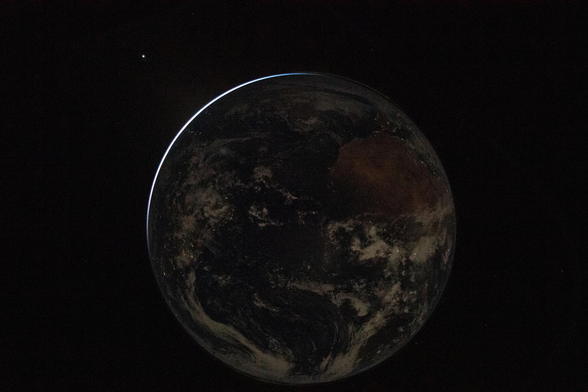
A closeup of the aurora australis over the Antarctic in the Blue Marble image highlights the thin fragile atmosphere that sustains all life on Earth. Note that South is up.
These images, the first such images taken by humans in over 54 years, remind us of the beauty and the fragility our planet, and of our shared responsibility to care of it and of each other.
🧑🤝🧑 🌍
https://images.nasa.gov/details/art002e000192
42/n
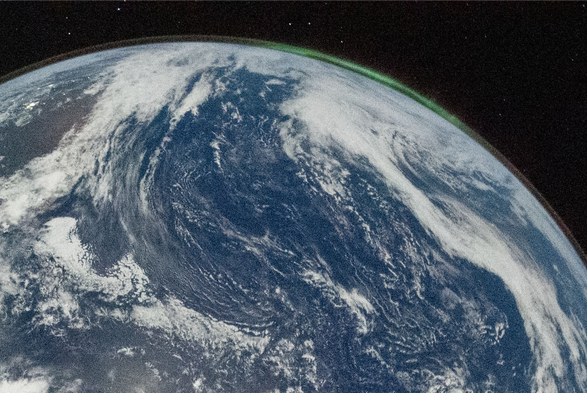
The Moon beckons!
Photo take by the GoPro camera, located on the tip of one of the 4 solar array wings, shows part of the Orion spacecraft with the Moon in the distance.
The ESA European Service Module (ESM) and its thrusters are clearly visible.
Camera: GoPro, HERO4 Black, 12MP
FocalLength: 3.0 mm
ISO 100
ExposureTime: 1/3900 s
CreateDate: 2026:04:03 14:21:47 UTC
Distance to moon: 238,900 km
Image and EXIF data at https://images.nasa.gov/details/art002e004429
Another similar image at https://images.nasa.gov/details/art002e004411
43/n
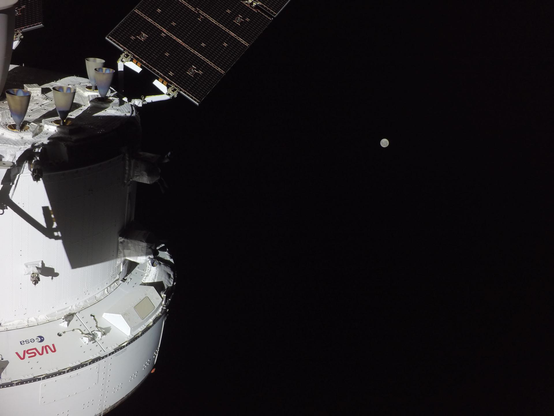
Two of the 4 CubeSats deployed by Artemis II failed to enter proper orbit.
Successfully deployed:
TACHELES, German Space Agency
Space Weather CubeSat-1, Saudi Space Agency
Failed to enter proper orbit:
K-RadCube, Korea AeroSpace Admin
ATENEA, Argentina's Space Agency
https://fosstodon.org/@planet4589.bsky[email protected]/116345118308094276
@jpshoer
44/n

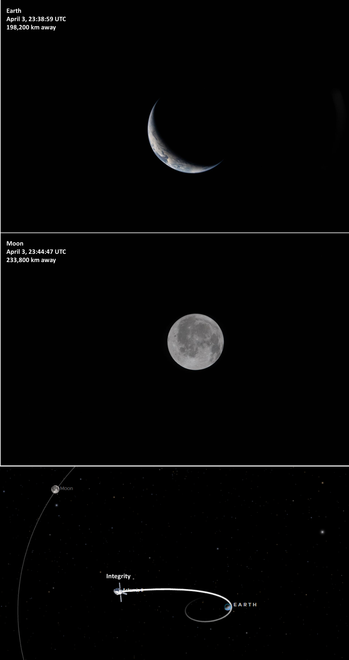
Pics of a crescent Earth and the Moon, taken from Artemis II at about the same time last night.
Earth:
Camera: NIKON D5 (DSLR, 20.8 MP)
Lens: 80-400mm f/4.5-5.6
FocalLength: 150 mm
ISO 500
ExposureTime: 1/640 s
CreateDate: 2026:04:03 23:38:59 UTC
Distance: 198,200 km
Moon:
Camera: NIKON D5 (DSLR, 20.8 MP)
Lens: 80-400mm f/4.5-5.6
FocalLength: 400 mm
ISO 500
ExposureTime: 1/500 s
CreateDate: 2026:04:03 23:44:47 UTC
Distance: 233,800 km
https://images.nasa.gov/details/art002e004437
https://images.nasa.gov/details/art002e004438
45/n
Wake-up music at Artemis II Integrity earlier today - "Chappell Roan – Pink Pony Club."
"I know you wanted me to stay
But I can’t ignore the crazy visions of me in LA
And I heard that there’s a special place
Where boys and girls can all be queens every single day
I’m having wicked dreams
Of leaving Tennessee
Oh, Santa Monica
I swear it’s calling me
Won’t make my mama proud
It’s gonna cause a scene
She sees her baby girl
I know she’s gonna scream
..."

Visualization of what Artemis II astronauts will see during the lunar flyby as Integrity approaches the Moon and flies around its far side.
The flyby will last from 2:45 – 9:40 p.m. EDT on Monday, April 6, 2026.
Highlights in the 420x time-compressed video:
00:35: Earth sets behind the lunar limb
00:35 - 00:40: Earth is eclipsed by the moon for about an hour
00:40: Earth-rise on the other side of the moon.
https://www.youtube.com/watch?v=pMr86Yrvzlo
Also at https://www.nasa.gov/blogs/missions/2026/04/04/artemis-ii-flight-day-4-deep-space-flying-lunar-flyby-prep/
NASA/Ernie Wright
47/n
Artemis II astronauts woke up on Easter Sunday to the catchy tune of "Working Class Heroes (Work)” by CeeLo Green."
"Get up, get out, go get that money
It's time to work, eh alright
Work, eh alright
Early in the morning
I'm ready and I go
It's feel like struggle
We can open up the doubts
Everybody cans crack
I got hustle in my blood
A little bit is not enough"
https://www.youtube.com/watch?v=-fKPn0t7j6Y
https://www.youtube.com/watch?v=2a1Nz-iojfY
48/n

Pic of a shrinking Earth, taken earlier today from Artemis II, as the spacecraft approaches the moon.
Camera: NIKON D5 (DSLR, 20.8 MP)
Lens: 14-24mm f/2.8
FocalLength: 24 mm
ISO 400
ExposureTime: 1/1250 s
CreateDate: 2026:04:05 06:35:18 UTC
Distance from Earth: 318,900 km
Still another 24 hours for lunar flyby, as Orion slows down in its orbital path, now traveling at 2,436 km/h.
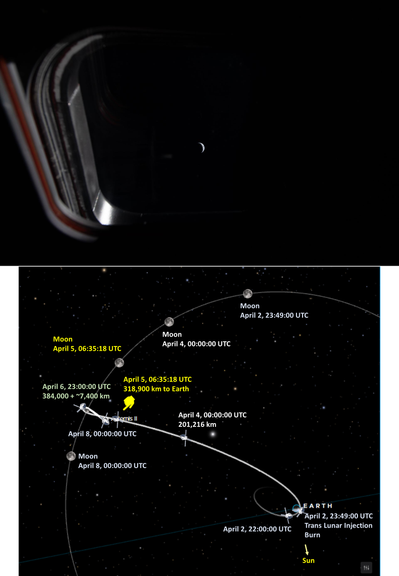

The Moon imaged from Artemis II earlier today.
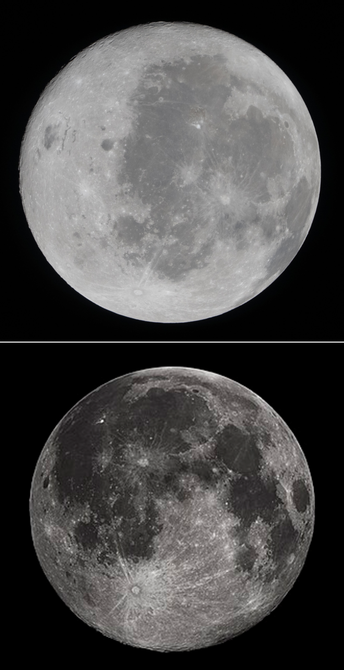
Compared to the image of the near side of moon taken from Earth (the 2nd image), this image is rotated right by about 45°, since Orion's look-angle is towards the "left side" on the moon. See post #49 for look-angles from Orion and Earth.
Camera: NIKON D5
Lens: 80-400mm f/4.5-5.6
FocalLength: 400 mm
ISO 400
ExposureTime: 1/1000 s
CreateDate: 2026:04:05 04:02:50 UTC
Distance to Moon: 142,000 km
From Earth: 311,200 km
https://images.nasa.gov/details/art002e009057
51/n
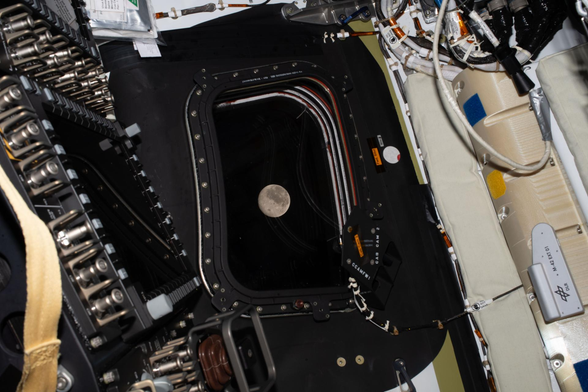
The Moon imaged from inside the Artemis II Orion spacecraft earlier today.
The image was taken a little over an hour after Integrity entered the lunar sphere of influence at 04:37 UTC, which will shape its orbit and turn it around.
Camera: NIKON D5
Lens: 35mm f/2.0
FocalLength: 35mm
ISO 400
ExposureTime: 1/250 s
CreateDate: 2026:04:06 05:45:17 UTC
Distance to Moon: 60,630 km
From Earth: 376,700 km
The Artemis II Orion spacecraft is currently 396,390.6 km from Earth, crossing the orbit of the Moon. It will go past it as the Moon slides under it, reach apogee at 23:07 UTC while observing the far side of the Moon and then head back to Earth. Closest approach to Moon = 6,550 km at 23:02 UTC.
Webcast begins at 17:00 UTC at https://www.youtube.com/watch?v=z-j1uxBmis0
Continuous coverage at https://www.youtube.com/watch?v=m3kR2KK8TEs
Nice real-time status dashboard by @chad at https://artemis.cdnspace.ca/
https://www.nasa.gov/blogs/missions/2026/04/06/artemis-ii-flight-day-6-crew-ready-for-lunar-flyby/
53/n
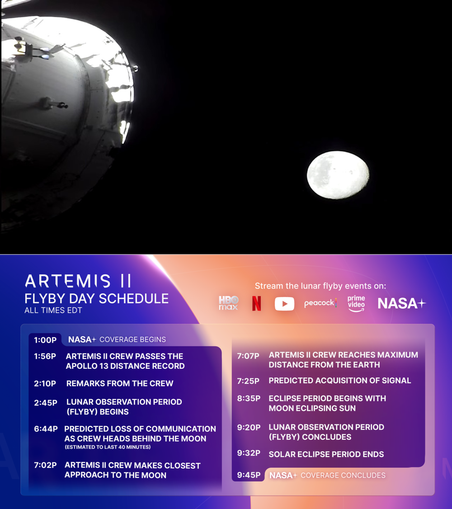
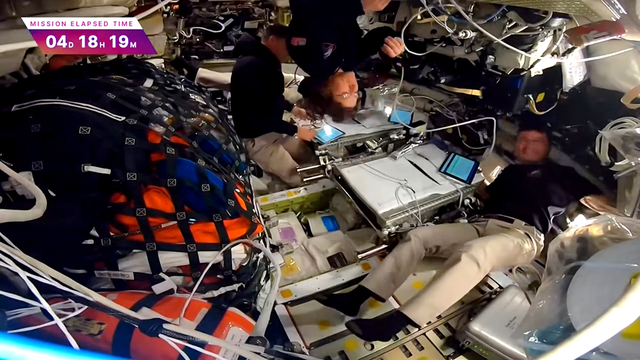
A nice shot from inside the Artemis II Orion cabin as the astronauts prepare for the lunar flyby later today. Christina is like Batwoman, generally "hanging" upside down from the "ceiling" as she works on her assignments (also when she sleeps)🦇 😎
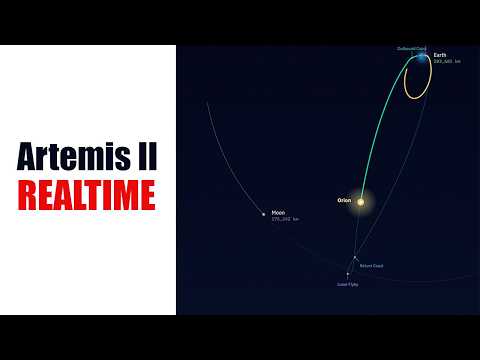
This is a good YouTube site to watch the trajectory and current location of the Artemis II Orion spacecraft and of the Moon.
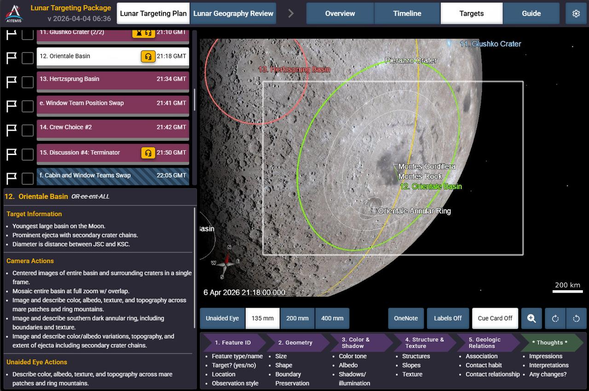
The Artemis II astronauts will be focusing on imaging certain features of the Moon during the flyby. E.g, the Orientale and Hetrzsprung Basins.
More info at https://science.nasa.gov/resource/artemis-ii-lunar-targeting-plan/
Note that most of the Moon has been imaged and mapped at sub-meter resolution by various orbiters over the past many years.
Check out this site to examine the lunar surface at various zoom levels and by searchable features - https://quickmap.lroc.im-ldi.com/?camera=-651167.7986%2C-3861610.2989%2C-1558914.2393%2C0.1545%2C0.9162%2C0.3698%2C-0.0615%2C-0.3647%2C0.9291%2C60&showGraticule=true&stack=3314%2C3113&selectedFeature=517%2C127&proj=22&defs=N4IgzAjBYgXKB7ADgQwMYEsAuBPOAGAOgBYwBfAGnEmLkVU1zgjLKA
56/n
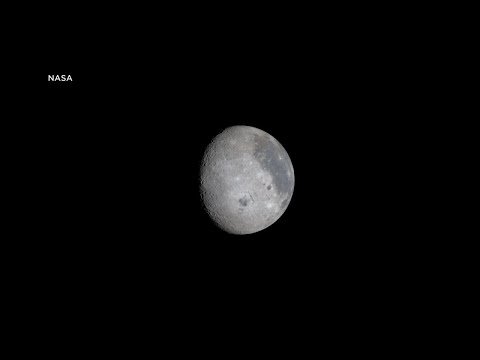
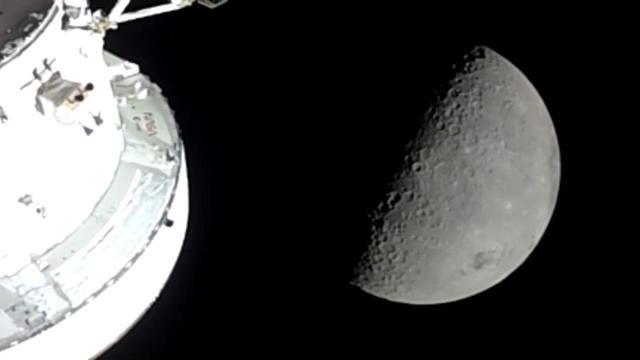
The moon as viewed by the GoPro camera on the solar panel of the Artemis II Orion spacecraft at 21:30 UTC. The day-night line bifurcates the Moon. Part of what we see here and the area under darkness is the lunar surface on the far side of the moon.
Go #Artemis2 🌓
57/n
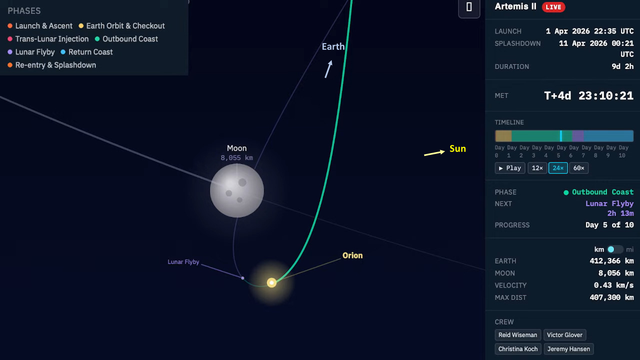
A graphic of the location of the Artemis II Orion spacecraft on its orbital path and the location of the Moon as it "slides" under it.
Source: https://www.youtube.com/watch?v=ChmaNMHU9CQ
58/n
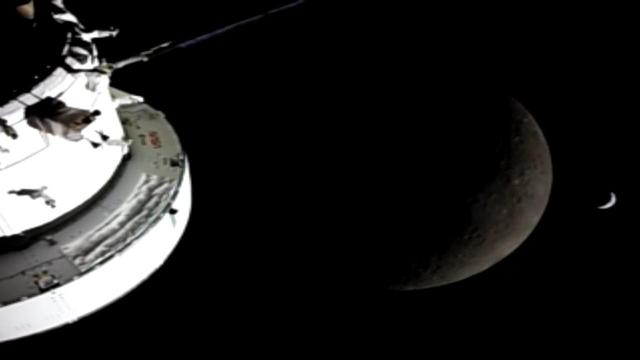
Earth-set!
Moments before the communications interruption.
Earth-rise and comms reestablishment around 7:25 p.m. EDT (23:25 UTC).
60/n
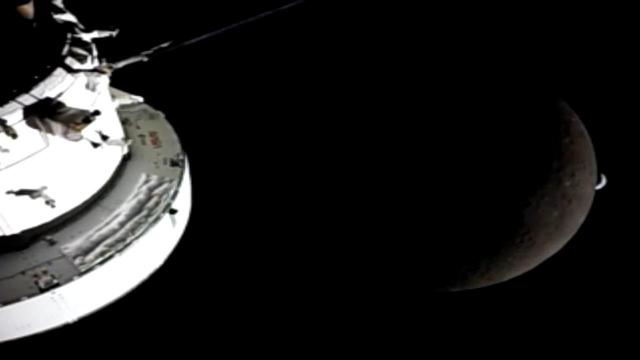
Orion is back in LOS of Earth, greeted by a crescent Earth-rise. Can't see much of the dark side of the moon with this GoPro engineering camera.
52/n
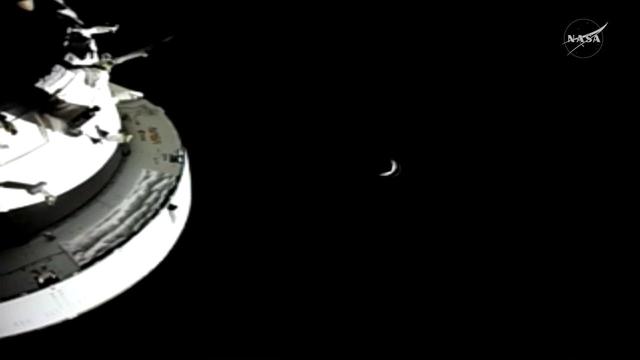
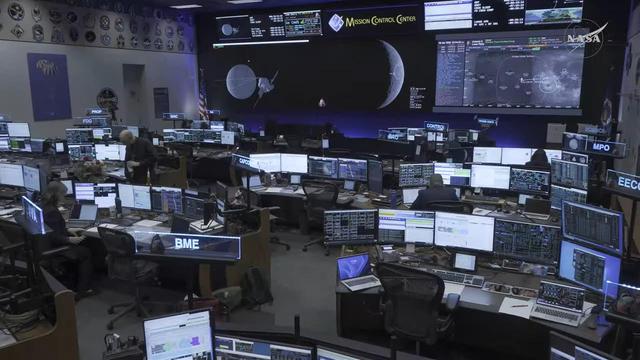
Looks like Artemis II will lose the comm link soon, as it approaches a solar eclipse at 8:25 p.m. EDT (00:25 UTC). Comms will be back around 9:00 p.m. EDT (01:00 UTC), via the DSN site in Madrid, after batteries are recharged.
53/n
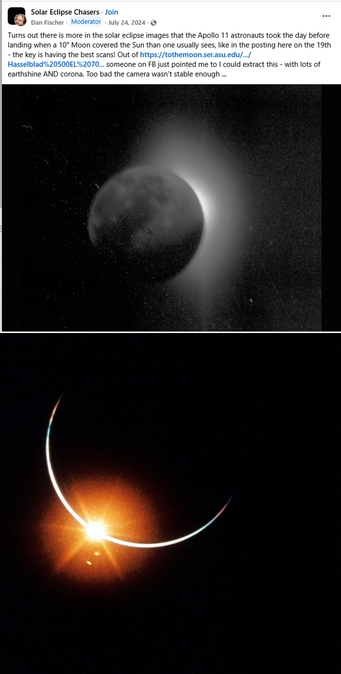
The Artemis II webcast mentioned again that astronauts will see a solar eclipse from the moon, "the first humans to ever do so."
Didn't Apollo 11 astronauts see the Sun eclipsed by the moon? Also, Apollo 12 astronauts imaged a solar eclipse caused by Earth.
Or is there some distinction between this solar eclipse and the ones during Apollo?
https://www.facebook.com/groups/SolarEclipseChasers/posts/8080799298608939/
https://science.nasa.gov/resource/eclipse-apollo-12/
54/n
@AkaSci @cosmos4u @markmccaughrean good question, I don't know the particulars. Could be whether or not they were in totality, or how long they were in totality, or how much of the disk was covered…
I don't even know if the Apollo 12 eclipse was something they'd explicitly planned for, but I believe it's very deliberate for #Artemis2
@AkaSci @cosmos4u @markmccaughrean the relative position could definitely affect the characteristics of the eclipse they'd observe, though, which seems like it would be pretty important to the science goal(?) of trying to observe solar plumes/etc. around the occluded disk.
I can't find very much good information about the Apollo 12 eclipse in a few quick web searches but I could definitely believe it was an annular eclipse or otherwise not quite comparable
@EricFielding @markmccaughrean @cosmos4u @SnoopJ
Six, according to the NASA blog at https://www.nasa.gov/blogs/missions/2026/04/06/artemis-ii-flight-day-6-crew-wraps-historic-lunar-flyby -
"They reported six light flashes created by meteoroids impacting the lunar surface while traveling many thousands of miles per hour."
It is also disappointing that NASA prefers to use Imperial units.
@EricFielding @AkaSci @cosmos4u @SnoopJ Ha – it's a space*ship* after all.
A nautical mile is at least semi-physical: it was originally 1 minute of arc at the equator, so nicely linked to celestial navigation, but is now hard-defined as 1852 metres (yes, a very mixed up unit), so ~6076 feet, 1.151 normal miles.
 SnoopJ
 Daniel Fischer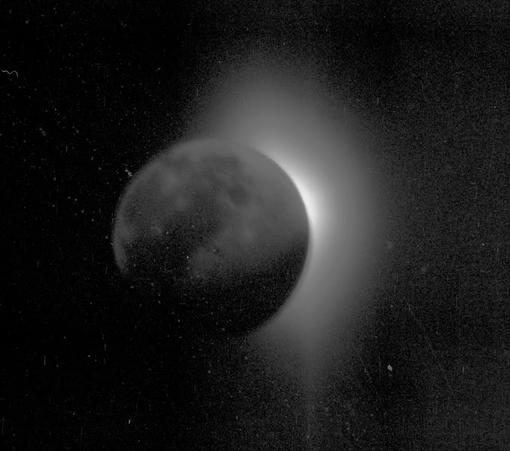
 Mark McCaughrean
 Dr. Eric J. Fielding, PhD