Knowing Enough..
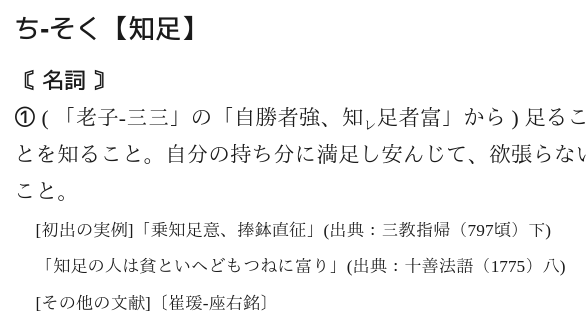
> ち‐そく【知足】
1 《「老子」三三章の「足るを知る者は富む」から》みずからの分をわきまえて、それ以上のものを求めないこと。分相応のところで満足すること。
> He who knows he has enough is rich.^2

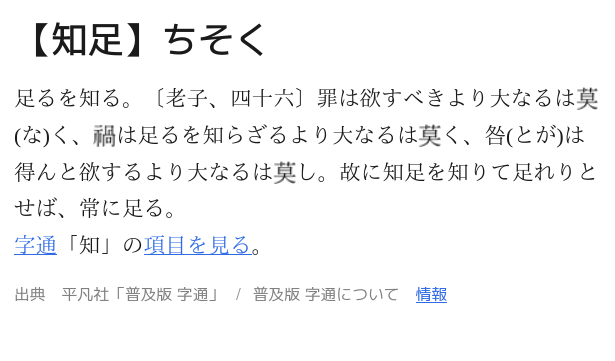
> 【知足】ちそく
足るを知る。〔老子、四十六〕罪は欲すべきより大なるは(な)く、は足るを知らざるより大なるはく、咎(とが)は得んと欲するより大なるはし。故に知足を知りて足れりとせば、常に足る。
> .. [They] who know... that enough is enough will always have enough.^3

https://kotobank.jp/word/知足-565925#w-3042958

^2 https://www.wussu.com/laotzu/laotzu33.html

^3 https://www.wussu.com/laotzu/laotzu46.html

https://terebess.hu/english/tao/_index.html

#老子33 #老子46 #LaoZi33 #LaoZi46 #LaoZi #老子 #LaoTzu
> ... it is not the quantity of the words we are acquainted with, but the quality of our understanding of them, which matters. The chief vice of foreign-language learning (and indeed of much native-language learning) is picking up words without learning quite what they mean, accepting them with indefinite and vague meanings that thereafter obscure their real uses from us.
https://web.archive.org/web/20081204112933/http://www.hltmag.co.uk/sep05/mart05.htm#C5
#BillTemplar quotes #IARichards on #EnoughEnglish
Articles on NLP, EFL, ESOL, Whole Person, Humanistic Language Teaching and more

Humanising Language Teaching Magazine offers lesson plans, student exercises, articles by top EFL professionals, new TEFL publication notices, and much more for teachers and educators of English as a Foreign Langauge. Produced in associated with Pilgrims Limited.