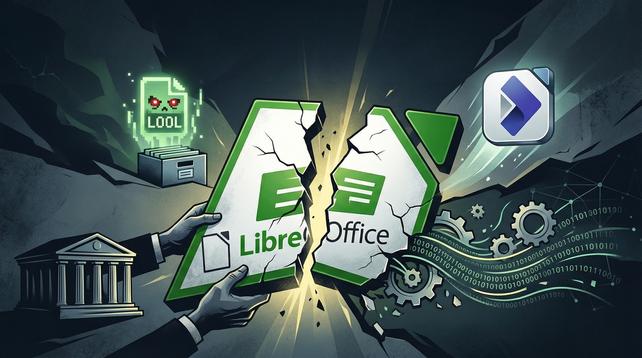
Forken und Spalten. #LibreOffice

@kid37

Ich bin nicht deiner Meinung. Es gibt da offensichtlich ein unüberwindbares Problem zwischen dem OpenSource Gedanken und der kommerziellen Ausrichtung.

Das kann man beurteilen wie man will, aber offensichtlich können die Differenzen hier nicht überwunden werden.

Dann ist es besser, dass jeder seinen Weg geht.

Persönlich glaub ich, dass es dem Projekt nicht schaden wird.

https://blog.documentfoundation.org/blog/2026/04/05/lets-put-an-end-to-the-speculation/

Let's put an end to the speculation - TDF Community Blog

Ideally, we would have preferred to avoid this post. However, the articles and comments published in response to Collabora’s and Michael Meeks’ biased posts compel us to provide this background information on the events that led to the current situation. Unfortunately, we have to start from the very beginning, but we’ll try to keep it brief. The launch of the LibreOffice project and The Document Foundation was handled with great enthusiasm by the founding group. They were driven by a noble goal, but also by a bit of healthy recklessness. After all, it was impossible to imagine what would happen after September 28, 2010, the date of the announcement. At the time, nobody could imagine that the companies that had supported OpenOffice.org until then would create a project to kill LibreOffice. Also, if the project were to be successful, it would require resources greater than those available, and above all, a deep management experience. Fortunately, the project grew quite rapidly. However, the founders’ different backgrounds and opinions were at the same time the reason for some bold decisions – many of which right – as well as a few mistakes, which are the root cause of some of the current

TDF Community Blog
@anthrazit Ich bin nur normaler Anwender und an diesen Geschichten überhaupt nicht interessiert. So was (wer auch immer da wann, wie, warum und weshalb angefangen hat) zerstört Vertrauen und lockt bislang skeptische Wechselwillige auch nicht unbedingt an. Die Außenwirkung ist da ganz schlecht.

@anthrazit (Den von dir verlinkten Beitrag hatte ich gelesen, so wurde ich überhaupt aufmerksam. Dann habe ich diesen hier überflogen, und wenn man die Kommentare dort liest, denkt man, LO ist tot, die Leute suchen aktiv Alternativen. Für Außenstehende ist das ein ganz schlechtes Signal.)

https://forum.linuxguides.de/core/index.php?article/54-libreoffice-am-abgrund-wie-die-document-foundation-ihre-eigenen-gr%C3%BCnder-vor-die/

LibreOffice am Abgrund: Wie die Document Foundation ihre eigenen Gründer vor die Tür setzte - Linux Guides Community

LibreOffice steckt in der schwersten Krise seit seiner Gründung. Die Document Foundation hat im April 2026 über 30 Kernentwickler aus ihren Gremien ausgeschlossen - darunter die Leute, die fast die Hälfte des gesamten Codes geschrieben haben. Der Trick: Erst verklagt man den Partner, dann schliesst man seine Mitarbeiter mit Verweis auf die laufende Klage aus. Collabora, das Unternehmen hinter den ausgeschlossenen Entwicklern, schlägt mit einem eigenen Desktop-Produkt zurück, das technologisch einen klaren Bruch mit dem alten LibreOffice darstellt. Droht LibreOffice das gleiche Schicksal wie Apache OpenOffice? Eine Analyse der Eskalationsspirale - vom gescheiterten Branding-Experiment 2020 über den Krieg um die Cloud bis zum endgültigen Bruch im April 2026.

Linux Guides Community

@kid37
Bei mir war die Reihenfolge der Artikel umgekehrt, was aber egal ist.

Persönlich glaub ich nicht, dass das ein Problem wird. Ich glaub eher, dass der Schritt notwendig war, um interne Konflikte aufzulösen. Manchmal geht es nicht anders.

Im Endeffekt ist das Program sekundär, das wichtigste ist das Format.

Siehe dieser Artikel.

https://blog.documentfoundation.org/blog/2026/04/02/document-formats-a-mystery-to-many/

P.S.: Einen ähnlichen Konflikte gibt es zwischen EuroOffice - OnlyOffice. Es bleibt spannend.

Document formats: a mystery to many - TDF Community Blog

Euro-Office’s announcement – which sees IONOS, Nextcloud and other companies coming together to create a European alternative to office productivity software – has predictably sparked a wave of comments. Most of these focus on the issue of licensing: is the code open source? Who controls the repository? What are the conditions for forking, modifying or implementing it? While these are all valid questions, they fail to address the most important issue. The fact that almost no one is asking the question that matters tells us something significant about how the debate on digital sovereignty has been framed and who benefits from that framing. A licence tells you who owns the software, while the format tells you who owns the data A licence can be renegotiated, modified or updated. The history of FLOSS is full of projects that have changed governance models, divided communities, or changed course under new management. Licence terms are important, but they operate at the level of the software artefact. The native document format operates at a completely different level. It is the encoding level of every document produced, archived, and exchanged by institutions that adopt the software. It is the invisible structure of administrative memory within

TDF Community Blog

@anthrazit Vielfalt ist immer super wegen der Möglichkeiten. Aber es ist wie mit den Distros - Neueinsteiger schreckt das einfach ab. Die wissen nicht, wie sie sich (am besten) entscheiden sollen. (Weshalb Leute in Siedlungen meist den Rasenmäher/Grill/Akkuschrauber kaufen, den der Nachbar hat, wenn sie unsicher sind.)

Na ja. Jeder Tag legt ein neues Ei ins Nest ;-)