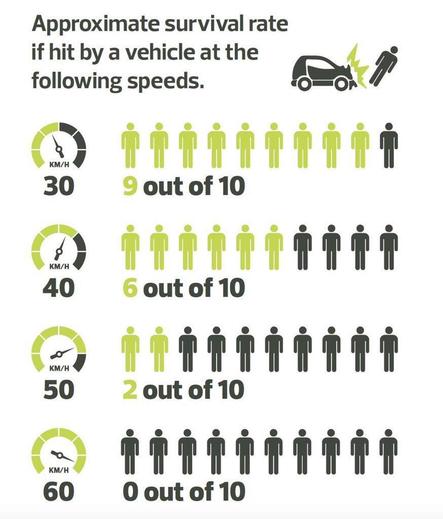
fuck cars and live a little

https://lemmy.ca/post/62898452

This needs to be updated.

Getting hit by a pickup truck at 30 MPH is similar to getting hit by a Honda Civic at 120 MPH for kinetic energy.

That’s besides the fact that pickups have a much taller hood vs sedans so there are significantly higher rates of head injury.

Taller cars and trucks are more dangerous for pedestrians, according to crash data

www.chicago.gov/…/vehicle-size-and-speed.html

I am not sure why the difference in energy related to vehicle mass is relevant here as humans have an insignificant amount of mass compared to either vehicle, so transferred energy should be roughly the same. However, the difference in how the collision plays out (pulled under Vs thrown above) should be a huge impact
The higher mass and force transmitted by a truck means the human will be thrown further and possible impact other objects at a higher speed
Not all of that energy is transferred. The car doesn’t stop as if it hit a wall. Usually it barely slows down. The human on the other hand gains at most the kinetic energy corresponding to their body mass and the speed of a human bouncing forward off the car at around the same speed as the car was going, so a tiny fraction.
The issue is energy transfer doesn’t care about weight of the human, more kinetic energy will impart more speed to the human during the impact impulse. Imagine a solid bowling ball hitting a beach ball vs a plastic hollow bowling ball hitting a beach ball
You are thinking of perfectly elastic collisions. That’s a fantasy and not applicable to the real world. A human body isn’t a beach ball and cars have crumple zones (although I believe pickups suck in this regard as well).

Car crumple zones are tuned to prevent damage to the car, not to pedestrians. If they were they would have airbags on the front of the car. A car can kill a pedestrian by hitting them with a crumple zone, without that zone crumpling.

This means most of the non-elasticity is in the pedestrian’s body; how they flop onto the hood of a normal car, and how their bones crumple and flesh splatters before their brain and vital organs do.

Of course if a car hits a pedestrian hard enough, the crumple zone will crumple to reduce damage to the car, but that’s overkill as far as the pedestrian’s life is concerned.

That said, if you (unrealistically) assume the speed at impact and the geometry of the hood are the same, the difference between a car that weighs 20 times what a person does and one that weighs 40 times that is (40/41 - 20/21), or only about 2.5%.

Realistically, the weight increases the braking distance and the hood geometry makes the pedestrian’s body perish more elastically.

Well, yeah. I can kick a dent into a car, but mostly I just raised crumple zones to emphasize that these are inelastic collisions we’re talking about.