 slothrop
fuck cars and live a little
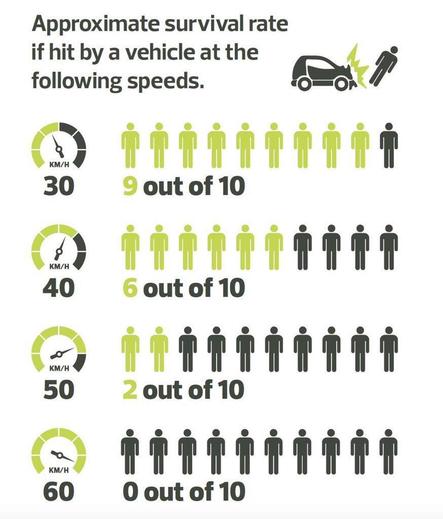
This needs to be updated.
Getting hit by a pickup truck at 30 MPH is similar to getting hit by a Honda Civic at 120 MPH for kinetic energy.
That’s besides the fact that pickups have a much taller hood vs sedans so there are significantly higher rates of head injury.
Taller cars and trucks are more dangerous for pedestrians, according to crash data
The bowling ball will not slow down in the slightest when is hits the beach ball, accelerating the beach ball up to it’s speed.
The plastics ball will lose significant speed hitting the beach ball, bringing itself down so amount of speed and the beach ball up.
I’m going to pick some easy math speeds/masses for demonstration. 2,000 kg sedan, 4,000 kg pickup and 100 kg human. Starting speed of 20m/s and 0m/s. An impact time of 1s.
The sedan hits a pedestrian with (f=ma) of 40kN. It takes 2kN to bring the human up to 20 m/s. So the sedan will be somewhere around 38kN, or 19m/s at the end of it and the human absorbing 1.8-2kN.
The truck has f=80kN. Same 2kN for the human. So the truck will be somewhere around 78kN or 19.5m/s at the end. With the human absorbing 1.9-2kN
In either case the we talking a difference of 1.8-2kN for the human. Regardless the mass (and total force) of the vehicle, the relatively small human as a maximum force they can absorb. And that maximum force is heavily related to the speed of the larger object.
Not to say trucks/SUVs aren’t deadly for other reasons (like where and how the force os transferred)
Car crumple zones are tuned to prevent damage to the car, not to pedestrians. If they were they would have airbags on the front of the car. A car can kill a pedestrian by hitting them with a crumple zone, without that zone crumpling.
This means most of the non-elasticity is in the pedestrian’s body; how they flop onto the hood of a normal car, and how their bones crumple and flesh splatters before their brain and vital organs do.
Of course if a car hits a pedestrian hard enough, the crumple zone will crumple to reduce damage to the car, but that’s overkill as far as the pedestrian’s life is concerned.
That said, if you (unrealistically) assume the speed at impact and the geometry of the hood are the same, the difference between a car that weighs 20 times what a person does and one that weighs 40 times that is (40/41 - 20/21), or only about 2.5%.
Realistically, the weight increases the braking distance and the hood geometry makes the pedestrian’s body perish more elastically.
 Landless2029