 (Roughly) Daily
“It is not the fact of liberty but the way in which liberty is exercised that ultimately determines whether liberty itself survives”*…
As the U.S. curdles and Ukraine twists in the wind, a look back.
In the summer of 1941, World War II has been raging for almost two years; still, of course, the U.S.– while it had emerged as the “armory” of the Allies– was a non-combatant. A majority of Americans favored continuing to “to help Britain, even at the risk of getting into the war.” But stoked by isolationists and Nazi sympathizers (like Henry Ford and Father Coughlin), a third of Americans were opposed.
Into this gamy situation, Dorothy Thompson, the first American journalist to be expelled from Nazi Germany, back in 1934, released a powerful– and ultimately very influential– essay in Harpers…
It is an interesting and somewhat macabre parlor game to play at a large gathering of one’s acquaintances: to speculate who in a showdown would go Nazi. By now, I think I know. I have gone through the experience many times—in Germany, in Austria, and in France. I have come to know the types: the born Nazis, the Nazis whom democracy itself has created, the certain-to-be fellow-travelers. And I also know those who never, under any conceivable circumstances, would become Nazis.
It is preposterous to think that they are divided by any racial characteristics. Germans may be more susceptible to Nazism than most people, but I doubt it. Jews are barred out, but it is an arbitrary ruling. I know lots of Jews who are born Nazis and many others who would heil Hitler tomorrow morning if given a chance. There are Jews who have repudiated their own ancestors in order to become “Honorary Aryans and Nazis”; there are full-blooded Jews who have enthusiastically entered Hitler’s secret service. Nazism has nothing to do with race and nationality. It appeals to a certain type of mind.
It is also, to an immense extent, the disease of a generation—the generation which was either young or unborn at the end of the last war. This is as true of Englishmen, Frenchmen, and Americans as of Germans. It is the disease of the so-called “lost generation.”
Sometimes I think there are direct biological factors at work—a type of education, feeding, and physical training which has produced a new kind of human being with an imbalance in his nature. He has been fed vitamins and filled with energies that are beyond the capacity of his intellect to discipline. He has been treated to forms of education which have released him from inhibitions. His body is vigorous. His mind is childish. His soul has been almost completely neglected.
At any rate, let us look round the room…
[And so, in a way both enlightening and entertaining, she does, concluding…]
It’s fun—a macabre sort of fun—this parlor game of “Who Goes Nazi?” And it simplifies things—asking the question in regard to specific personalities.
Kind, good, happy, gentlemanly, secure people never go Nazi. They may be the gentle philosopher whose name is in the Blue Book, or Bill from City College to whom democracy gave a chance to design airplanes—you’ll never make Nazis out of them. But the frustrated and humiliated intellectual, the rich and scared speculator, the spoiled son, the labor tyrant, the fellow who has achieved success by smelling out the wind of success—they would all go Nazi in a crisis.
Believe me, nice people don’t go Nazi. Their race, color, creed, or social condition is not the criterion. It is something in them.
Those who haven’t anything in them to tell them what they like and what they don’t—whether it is breeding, or happiness, or wisdom, or a code, however old-fashioned or however modern, go Nazi. It’s an amusing game. Try it at the next big party you go to.
Eminently worth reading in full: “Who Goes Nazi?” from @harpers.bsky.social.
(And in a very effective testament to Thompson’s technique, Rusty Foster– who anchored a recent (R)D— asks “Who Goes AI?“)
See also: “The MAGA Theory of Art,” from Art in America, which reviews the roles that arts and design played in Nazi Germany, then compares them to what’s transpiring today. Also eminently worth reading in full; a sample:
There is a fable that persists in even themost respectable quarters, perhaps because it has retained its power to shock for more than half a century. Get any card-carrying liberal into a sufficiently confessional mood and she will tell you, sotto voce, that there was one domain in which the Nazis were perversely and chillingly formidable: the domain of the aesthetic…
… It is tempting, then, to take one look at the shambolic flailing of the Trump administration—the ham-handed takeover of the Kennedy Center, the tawdry gilding of the Oval Office, the AI slop, the women with too much filler, the men on too many steroids who boast about eating too much meat, the tweets with their erratic capitalization, the general air of carnival grotesquerie—and conclude, as Karl Marx did, that history repeats itself “first as tragedy, then as farce.”
Of course, there are obvious continuities between MAGA and its antecedent on the Rhine. “Fascism is theater,” Jean Genet wrote of the Nazis, and it is hard to think of a politician with more theatrical flair than Trump, who adores Andrew Lloyd Webber and once harbored ambitions of becoming a Broadway producer. If Hitler fostered “the modern era’s first full-blown media culture,” as the film scholar Eric Rentschler claims, then Trump is surely responsible for the postmodern era’s first full-blown social media bonanza. He has the Führer’s instinct for pageantry, the Führer’s gift for glister and grandiosity.
Trump’s resentments, too, recall those of his forbears. In his study of Nazi art policy, the historian Jonathan Petropoulos writes that art collecting was important to top brass in the party because it served “as a means of assimilation into the traditional elite.” Much to their chagrin, their political ascendency had failed to confer the cultural capital they craved; now they had to seize prestige by other means. The MAGA gentry is more resigned; Trump and his lackeys more or less accept their status as philistines and content themselves with exacting revenge on the gatekeepers, yet their air of wounded arrivism is all too familiar.
Here it may seem that the similarities come to an end… While Trump has hosted motley rallies, and even made one deflating attempt at a military parade, he has yet to produce any of the disciplined displays that so effectively reduced the bodies of their participants to raw geometries.
Above all, MAGA lacks the aesthetes who are dutifully trotted out as evidence of fascism’s scandalous refinement. Who is the MAGA Hugo Boss, the MAGA Leni Riefenstahl, the MAGA Knut Hamsun, the MAGA Gabriele D’Annunzio, the MAGA Ezra Pound? Mar-a-Lago has more in common with any suburban Cheesecake Factory than it does with the monumental austerities of Albert Speer…
(Image above: source)
* Dorothy Thompson
###
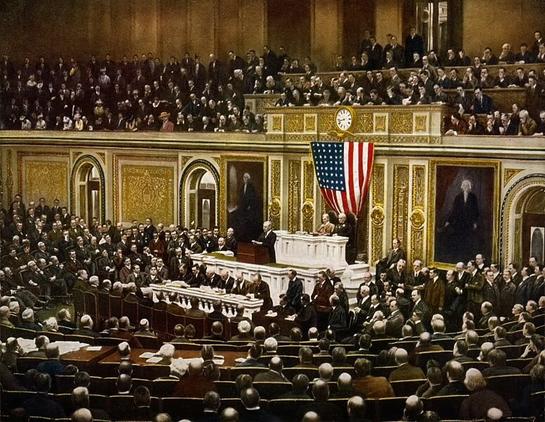
As we cast our eyes around, we might recall that it was on this date in 1917 that the U.S. entered World War I, formally declaring war against Germany and entering the conflict in Europe, which had been raging since the summer of 1914. It ended in November of 1918– one of the deadliest conflicts in history, resulting in an estimated 15 to 22 million military and civilian casualties and genocide (and via the movement of large numbers of people, a major factor in the catastrophic Spanish flu pandemic that followed).
The Paris Peace Conference of 1919–1920 imposed settlements on the defeated powers. Under the Treaty of Versailles, Germany lost significant territories, was disarmed, and was required to pay large war reparations to the Allies. The dissolution of the Russian, German, Austro-Hungarian, and Ottoman empires led to new national boundaries and the creation of new independent states including Poland, Finland, the Baltic states, Czechoslovakia, and Yugoslavia.
The League of Nations was established to maintain world peace, but failed to manage instability during the interwar period, contributing to the outbreak of World War II in 1939. Indeed, those unresolved tensions in the aftermath of World War I created the conditions for the rise of fascism in Europe (and militarism in Japan).
President Woodrow Wilson asking Congress to declare war on Germany on April 2, 1917… it took four days. (source) #AI #art #artificialIntelligence #authoritarianism #culture #design #DorothyThompson #Fascism #film #history #MAGA #MAGAArt #movies #NaziArt #NaziGermany #politics #RustyFoster #WhoGoesNazi #WorldWarI #WorldWarII