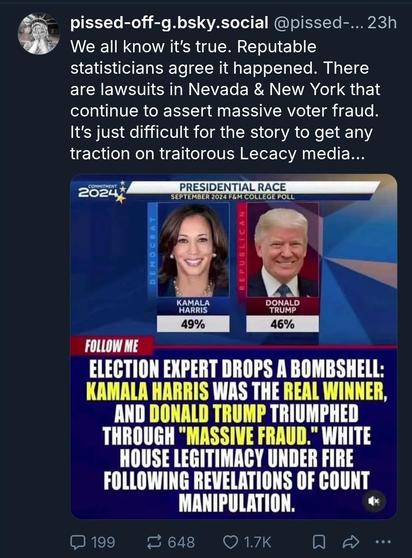
The "2024 election was stolen" conspiracy theories are just a rehash of the "2020 election was stolen" conspiracy theories and this is both sad and frustrating.

People choose to believe these narratives because they validate feelings and beliefs about how unfair the outcome of the election is; because they are profoundly ignorant of how the elections are conducted, secured, and validated; because it's easier than looking at America for what it really is.

If you see these kind of posts and can't help but notice the presentation style has a certain "FOX News" aesthetic, yeah, that's kind of deliberate.

@soatok For historic context, do you remember how the 2000 election was stolen? 

@soatok The problematic design of Diebold's voting machines was an #infosec topic for years. One of the reasons why Estonia pointedly refused to adopt USA-style machine voting while designing and implementing a crypto-based Internet voting scheme was, well, that.

And, irony of ironies, while conspiracy theorists virtually always talked about ballot stuffing and stuff (there were some long threads about supposedly weird coincidences in county-level tallies which, AFAIK, were thoroughly checked and didn't yield anything actionable), the actual security breach sat in the SCOTUS the whole time. Non-constructive paranoia is weirdly predictable (and exploitable) that way. It tends to prefer the bogeyman to be somewhere close, and to resemble popular tales of historic narratives.

But, strangely enough, The Influencing Machine is also a known paranoid ideation pattern.

@soatok FWIW, I find the moniker 'BlueAnon' to be problematic. It arose as an artificial simulacrum to the QAnon, and is commonly interpreted as indicating a symmetry of "both sides", except there is nothing QAnon-like on either the left side or Democratic Party's side of USA's politics; everything commonly attributed to "BlueAnon" is just small and temporary outbreaks of unfounded gossip.

There's a very interesting write-up of the general pattern by Richard Hofstadter, The Paranoid Style in American Politics. In 1960s, he just described his observations, but the underlying psychology has been thoroughly studied in the decades since, and, well, the systematic paranoia is politically asymmetric.

Ironically, one of the recent developments has been attempts to invent an "LWA", "Left-Wing-Authoritarianism", as a similar both-sides counterpart to RWA, and I believe I have already ranted here about its methodological problems. (Empirically, Altemeyer made kind of a point to look for the left-wing counterpart to RWA as soon as he identified it, back in the eighties, and, basically, what he found is, left-wing brains just don't work the same way, and when they get paranoid, their paranoid ideas — founded or unfounded — are generally not very much like the dominant fascist paranoid ideas, either.)

@riley Fair, but I'm still annoyed at democrats spreading the same genre of misinformation as the QAnon bastards

@soatok Calling out the counterfactual rumours makes sense. An important functional difference between the 'sides' is, most people left-of-the-watershed stop repeating rumours once they positively know they're false (and the small subminority who doen't, plus the trollbots, tend to have a degree of isolation, most of the time). QAnonists hardly ever care about fact-checking, and nowadays, are closely integrated into the mainstream GOPster social networks.

If there's a QAnon counterpart on 'our side', the tankie movement is more defensibly that than the pattern of baseless rumours getting sometime rumoured. And the tankies really aren't on our side.