 InterestingUsername
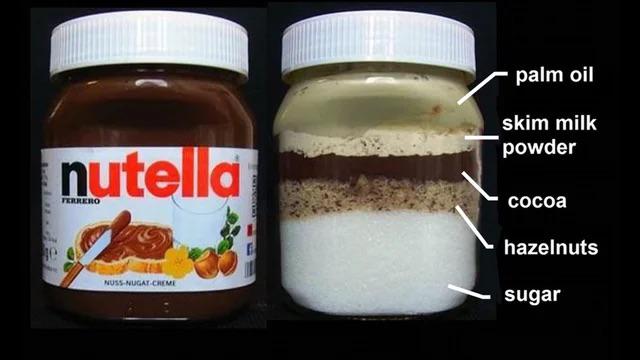
The contents of a jar of Nutella
ah yes. the only two options.
definitely not something someone has made as a prop to show the proportions
They sure tried advertising it as a health food in the USA 20-ish years ago when it was relatively new to the market—“simple, quality ingredients like hazelnuts, skim milk, and a hint of cocoa.” They were sued for deceptive advertising and had to pay millions of dollars.
But yeah, one bite or a look at the ingredients and nutrition label should be enough to warn anyone. The first ingredient is sugar and more than 50% of the food’s mass comes from added sugar.
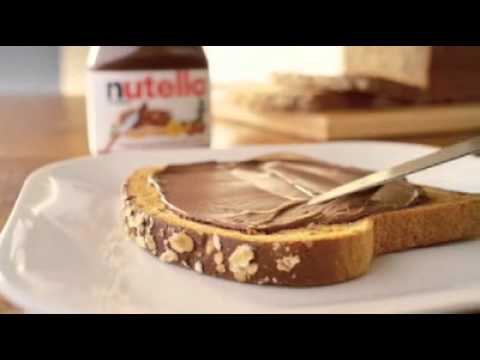
It’s amazing that anyone was fooled by this marketing. It shows you the power of it I guess.
The first time I tried Nutella I immediately knew what it was: chocolate hazelnut cake frosting. The fact that people slather it on their toast every day seemed as absurd to me as eating cake frosting every day.
North America has long had sweet treats as breakfast or early morning food so I’m surprised you’re surprised.
Things like Danish, donuts, pop tarts, toaster strudel, breakfast cereal… Etc etc
Everyone knows those cereals are for kids and only as a special treat, not an every day thing.
If someone wants to have banana Nutella crepes for breakfast once a month I don’t think that’s a big deal. But having toast with Nutella every day (or cookie cereal) is not a normal thing to do.
Lol, the commercials for said cereal were always literally about everyone saying it was cookies for breakfast, and who doesn’t have the same breakfast every day? If there was a box of cereal, that’s what we were eating until it was gone and then you open the next box of cereal or switch to toast/waffles/pancakes/biscuits/oatmeal until that box is used up, and so on and so forth until it’s time to go back to the grocery store.
If your parents bought the cookie cereal (and there were apparently enough to keep it on the shelves for years) then you were eating it everyday as a normal thing.
Well, it was supposed to be mainly a hazelnut cream with some sugar, cocoa and maybe a few other minor ingredients. And in fact, when it was new and conquering markets, that was what was.
I think the decades starting with the early 1990s had desensitized a lot of us to enormous amounts of sugar, and in the end we didn’t even consciously notice anymore how sweet that stuff had gotten.
I guess I’ve seen so many of these things that I’ve stopped being surprised. This one was really popular for a long time.
Hmmm, look at the labels. They each say something something “1000”.
Not the right language, but maybe something like per 1000? Like per 1000 grams of water? Or… something about volume?
IDK, it would be a weird way to do it. But something like that might explain why so much sugar, seemingly more than can fit in the can.
Sugar is heavy, there’s no way 39 grams is the same size as the can
Good god man, a single teaspoon in my tea is too much. If I do super strong tea or coffee, like 3 tea bags in a half cup, mixed with half whole milk, a full teaspoon is about right to taste.
10 is just too much, it’s horrible for you too, even if you don’t get diabetes, it crashes your energy level, cut it out for a couple of weeks then get a big dose of sugar and you will see what it does to you.
Like, for solid food, 50% sugar is what’s typically in sweets, that means 50g sugar in 100g food. 10% sugar (that means 10g sugar in 100g liquid) is what’s in sweet drinks like soda.
The WHO recommends restricting your sugar intake to a maximum of 10% of your calories intake. So for solid food that would be 10g sugar per 100g food, assuming the rest of the food is calorie-rich. For liquids it would be virtually 0g sugar per 100g liquid as liquids contain essentially no other calorie source.
 AFK BRB Chocolate (CA version)
 Quokka
 jqubed
 BedbugCutlefish
 diverging
 A_norny_mousse
 Dimi Fisher
 dandelion
 flango
 gandalf_der_12te