Natasha 🇮🇪🇪🇺🏳️🌈
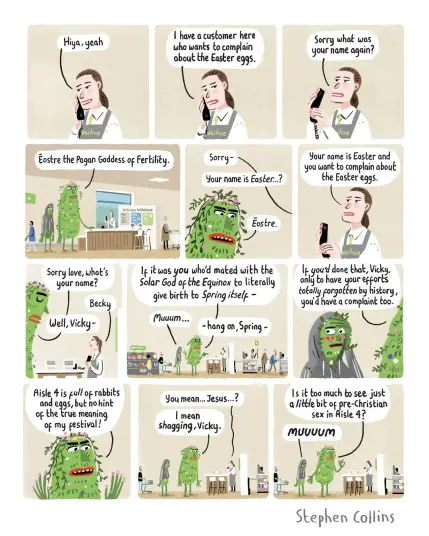
The true meaning of Easter, by Stephen Collins (who writes his own amazing #AltText)
"PAGAN GODDESS: Aisle four is full of products, with no hint of the true meaning of the festival!
BECKY: You mean … Jesus …?
PAGAN GODDESS: I mean shagging, Vicky."
The true meaning of Easter, by Stephen Collins (who writes his own amazing #AltText)
"PAGAN GODDESS: Aisle four is full of products, with no hint of the true meaning of the festival!
BECKY: You mean … Jesus …?
PAGAN GODDESS: I mean shagging, Vicky."
@Natasha_Jay For what it's worth, I very recently saw that this might not actually be true. I thought it was for decades though, because it does make a lot of sense.
@vwbusguy @Natasha_Jay the name "Easter" may derive from that of an Anglo-Saxon goddess, but we have almost no evidence for that - literally two lines in a history written by a medieval monk who had no first-hand knowledge of paganism. The festival (which in every non-Germanic European language is called some variant of "Pesach") is certainly not derived from Eostre's rites, if they even existed. See the series of posts starting at https://cavalorn.livejournal.com/502368.html
(I enjoyed the comic, though!)
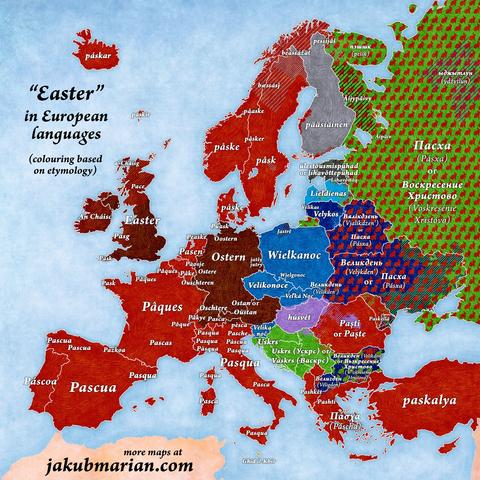
@goedelchen oh, interesting! I think the map @mirabilos is talking about is the one at https://brilliantmaps.com/easter-name-europe/ - it's not quite as simple as "all non-Germanic languages call it some variant of Pesach" (for instance, cz/sk/pl call it "Velikonoce", meaning "Great Night"), but Eostre/Ostara is confined to Germanic languages. So, it's interesting that not all varieties of German use Ostara-variants!
 Scott Williams 🐧
 Pozorvlak
 Sveinn í Felli
 mirabilos
 goedelchen