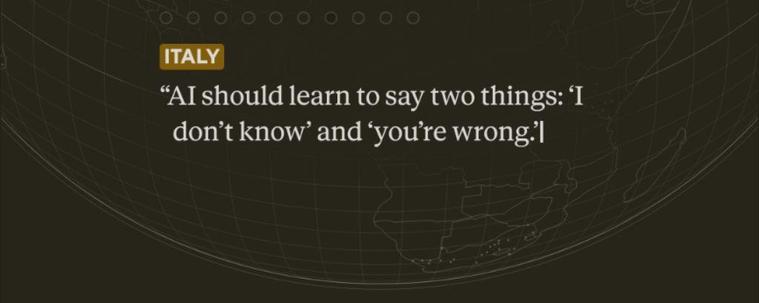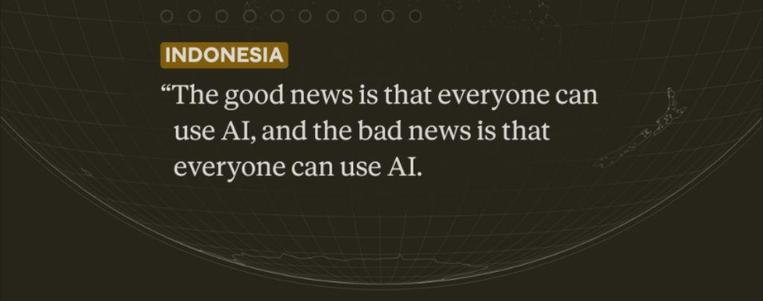
Here are four of the ten looping Claude user quotes on anthropic.com homepage... Mind you, these are not dynamic, they chose these explicitly. Are they trying to represent user sentiment accurately or are they reading these very differently than I am?

I went there after watching this talk: "Nicholas Carlini - Black-hat LLMs", from one of their engineers. There's definitely good work by talented and conscientious people that's going on there.

I'm rewriting this post because I'm cynical of corporate motives but I also don't think that interpreting everything cynically is helpful. Even after the VC funding runs out (hopefully before we destroy the planet and society), these tools won't disappear especially for malicious actors. So if they're also building tooling to mitigate harm / defend against threat actors, do I dare to hope they're reading the quotes the same way I am? Or is it more of:

I feel like I'm creating more dependency than knowledge.

#AI #Anthropic #Claude #Blackhat #LLM #SoftwareSecurity #Cybersecurity #ThreatActor
@shom
Conscientious people always exist, even in the worst of environments. Many a time they are useful in providing the facade a company may need to move attention away from problematic areas. But can those good & conscientious engineers define or even influence company policy?

By their nature private companies try to maximize profits. If there is no regulatory obligation for them to do otherwise, they can correctly assume that it's not their job to self-regulate. Even SCOTUS doesn't.

1/

@shom
Cynicism assumes there are moral criteria that apply. Companies operate on the basis that those are embedded into regulations and the law. But that's not what the public is lead to believe; the public expects somehow companies to act morally, as if they were fellow citizens. They are not. Hence the dichotomy.

The only way for the system to work as expected is to codify people's expectations to regulations and laws. But that would be the case only in a democracy.

2/2

@65dBnoise

Many a time they are useful in providing the facade a company may need to move attention away from problematic areas.

This is absolutely the reading I generally have (not exclusive to AI companies). For profit institutions will always prioritize profits over anything else (most of the time short term profits over even self-survival) and there are no shortages of examples.

I'm struggling with how if all the consentious people are rightfully not engaging and there is total regulatory capture then what does that look like in the long run. I'm quite befuddled by how callously a lot of the public uses AI without any thought given to any of the moral and ethical impacts: I'm talking about frivolous use here all the way from benign generating videos for a laugh to the revolting non-consensual porn. I don't see this same public holding politicians to account to create and enforce regulations.

I'm not discounting use of LLM as tools altogether, I'm in data and analytics and providing an interface to our business users to help craft queries so they can solve their needs (with governance and validation) isn't a thing without merit.

I'm not arguing a specific point as much as thinking out loud about how do I talk to less technically plugged-in people about LLMs now. They're actually useful in some contexts now and dismissing then outright isn't going to help those folks avoid the downsides. Hanving these conversations, thinking critically, understanding hallucinations in the machine and brain atrophy in people and then being able to non-judgementally inform and engage folks is a lot of work. I think it's work worth doing, and in a way I'm just taking Mr. Rogers' advice and "look(ing) for the helpers".

@shom
I can't blame companies for doing what companies do within this political system, so long as they do not break the law. But, what law?

The big problem IMO is that the people are not able to get their expectations formed into policy proposals by the political organizations. There is a huge imbalance in power in 21st century western societies which claim to be democracies. Worse, people have developed an aversion to the only activity that could give them the

1/

@shom
power to implement their expectations through their government. And that's politics; by now a derogatory word for many. Instead, most of us are looking for the helpers, indeed.

But I can't blame the average Joe, either. Our so called "democratic" societies have a hierarchical political structure, with representatives, judges and executives paid in advance to do the political work. When they don't, they should be called out, and suffer real consequences. They don't.

LLMs

2/

@shom
are like every other technology, only with an artificially inflated importance for the little result they produce. Which, in any case, even if it were truly exceptional, would solve absolutely no problem unless society itself decided what problems there were to be solved. But what we see here is the exact opposite. A few companies decide what tool the society should be using, shoving it down the throat of those who might think differently. #technofascism is a fitting term.

There are

3/

@shom
individuals and some organizations that strive to explain the fallacy of AI. Problem is, almost all are unable or unwilling to connect the observable with its causes, and are thus missing its most important aspect, the political dimension. So instead of using the individual problems to form a coherent view for a political solution, people are trying to solve problems separately at a non-political level, treating the symptom, but not the disease.

In my view, the only hope for progress
4/

@shom
is strong political organization of the people, aspiring to govern a country and not merely grassroots movements. But decades of propaganda pushing individualism and consumerism, and a maliciously crafted narrative about democracy's ability to exist in a political environment of exploding inequalities are hindering the prospect. So people are content with "leaders" chosen by the elites and the donors, always under extortion with the argument that the alternative will be worse.

5/5