 AkaSci 🛰️
A crescent Earth as seen from the Artemis II Orion Integrity spacecraft, now over 46,000 km away. The spacecraft is located above the north-east coast of Brazil, where it is night-time
22/n
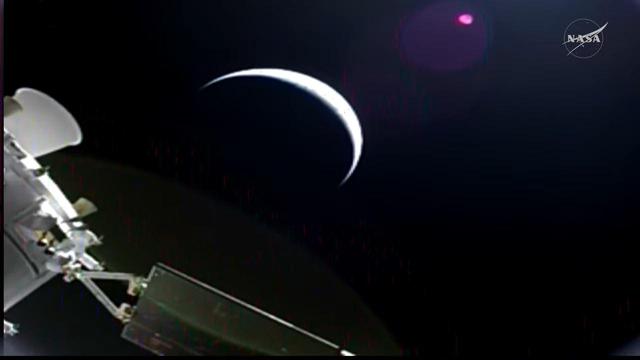
A crescent Earth as seen from the Artemis II Orion Integrity spacecraft, now over 46,000 km away. The spacecraft is located above the north-east coast of Brazil, where it is night-time
22/n
The serene view of the Pale Blue Crescent from the Artemis II Orion Integrity spacecraft this morning, now located 70,920 km away in its elliptical orbit, high above the Pacific Ocean, west of Peru, as the astronauts grab some sleep after a hectic day yesterday.
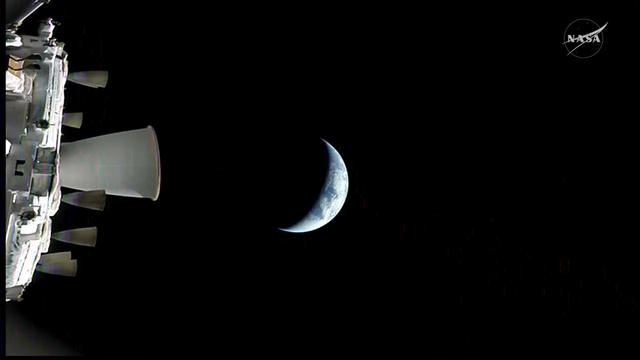
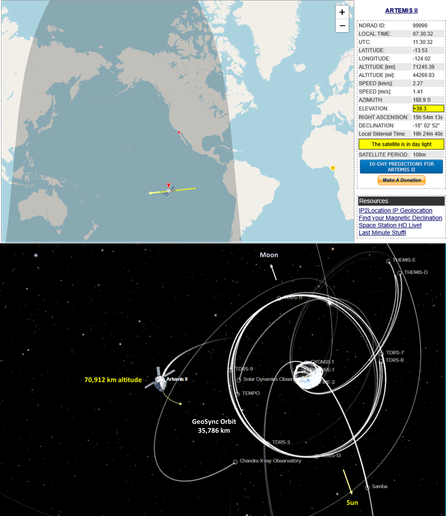
Integrity, the Artemis II Orion Integrity spacecraft, is located 71,245 km away, almost 2x the alt. of GSO, in a highly elliptical orbit, above the Pacific Ocean, west of Peru.
After reaching Apogee, it will turn around and execute a Perigee Raising Burn at around 8:15 a.m. EDT (12:15 UTC) and head back towards Earth.
12 hours later, at Perigee, it will execute the Translunar Injection Burn and shoot for the Moon.
https://www.n2yo.com/?s=99999&live=1
https://eyes.nasa.gov/apps/solar-system/#/sc_artemis_2
https://www.nasa.gov/artemis-ii-press-kit/
24/n
Artemis II astronauts woke up this morning at 7:06 a.m. EDT with the song “Sleepyhead” by Young and Sick.
They then completed the perigee raise burn by igniting the Orion service module’s main engine for 43 seconds, which modified the trajectory to a 191x70133 km elliptical orbit. Perigee in another 12 hours or so.
The crew members will rest for another 4.5 hours before they are again awakened to start their first full day in space.
https://www.youtube.com/watch?v=hIW-w-P2nOc
https://www.nasa.gov/blogs/missions/2026/04/02/artemis-ii-flight-update-perigee-raise-burn-complete/
25/n

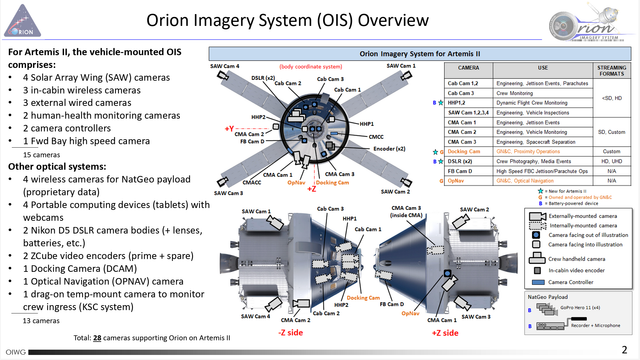
Artemis II has a total of 28 camera systems, many for internal and external inspection and navigation, 4 located on each of Orion’s 4 solar arrays.
The fixed engineering cameras are primarily meant for in-flight inspection of the spacecraft. But they also opportunistically capture images of Earth and the moon in the background.
The astronauts carry two handheld Nikon D5 digital SLR 20.8 MP cameras for hi-res images and videos.
https://talkoftitusville.com/2025/12/24/what-cameras-will-the-artemis-ii-astronauts-have-aboard/
https://ntrs.nasa.gov/api/citations/20230017638/downloads/1325_Melendrez_Orion%20Imaging%20Capabilities.pdf
26/n
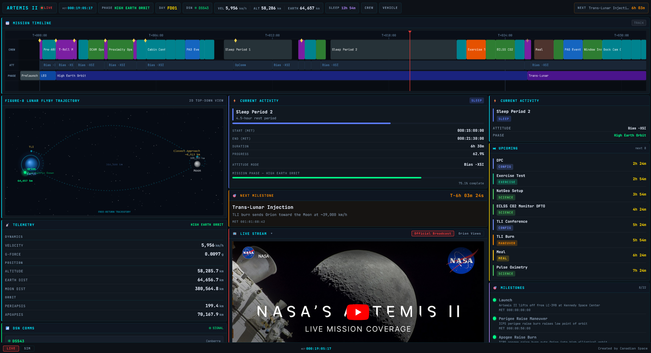
Check out this dashboard for real-time status and telemetry from Artemis II.
h/t @cdnspace
https://fosstodon.org/@cdnspace@mstdn.ca/116336006900298832
27/n
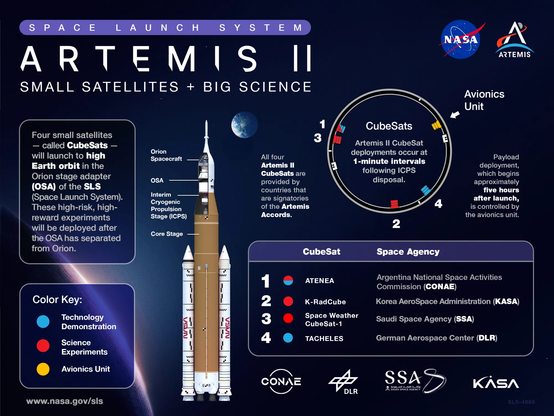
Cubesats deployed by Artemis II in High Earth Orbit:
TACHELES, German Space Agency: Effects of space env on electrical components.
K-RadCube, Korea AeroSpace Admin: Space radiation and its biological effects
Space Weather CubeSat-1, Saudi Space Agency: Space weather at a range of distances from Earth
ATENEA, Argentina's Space Agency; Assess radiation shielding methods, measure Earth's radiation spectrum, collect GPS data and validate a long-range comm link
https://digitalcommons.usu.edu/cgi/viewcontent.cgi?article=6197&context=smallsat
28/n
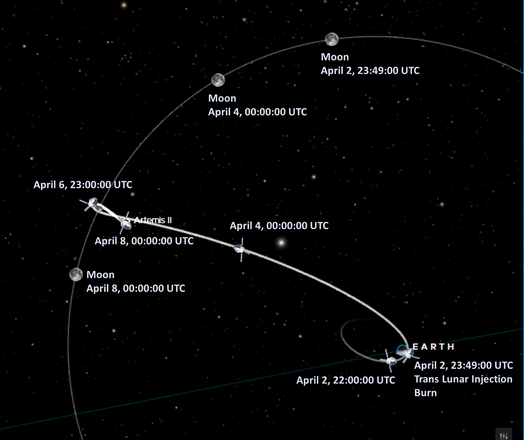
Artemis II Trans Lunar Injection (TLI) burn coming up at 7:49 p.m. EDT.
The 349-second burn will increase Integrity's speed of ~11,000 m/s by 388 m/s and stretch the current 191x70,133 km elliptical orbit to go ~7,400 km beyond the moon and return back to earth.
A few minor burns will be made during the trip to fine-tune the trajectory.
The graphic below shows the approx. location of Integrity and the moon - now, during TLI and around April 6-8.
Go #Artemis2!
One might consider it foolhardy for Artemis II Orion to come screaming down at 11 km/s to 191 km altitude, cross the paths of the LEO constellations and debris around 500 km, perform the TLI to adjust its speed and trajectory and race away, without colliding with anything.
But we can be assured that all that is taken care of and LEO satellites will maneuver to get out of the way as needed.
😱🤞
https://satellitetracker3d.com/track?norad-id=27426
30/n

Artemis II TLI complete. All systems good.
Here is a view of Earth from the spacecraft at altitude ~200 km during the TLI.
Integrity and the 4 astronauts are now headed for the moon.
Current orbit is 202x501,181 km, but the actual values will be slightly smaller due to gravitational interaction with the moon.

31/n
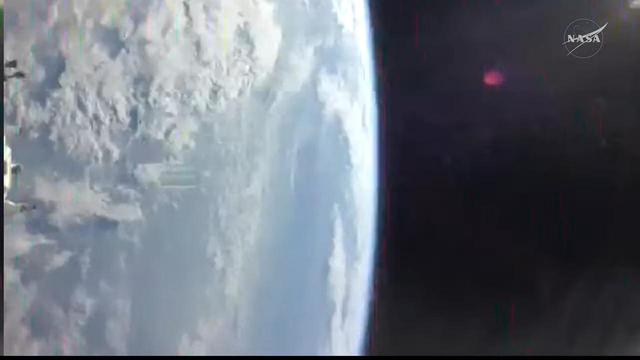
It's lonely out there 😞
Artemis II Orion is now 33,668 km away, traveling at 15,347 km/h, approaching geo-sync orbit, as Earth recedes in the dark distance, while the Moon beckons.
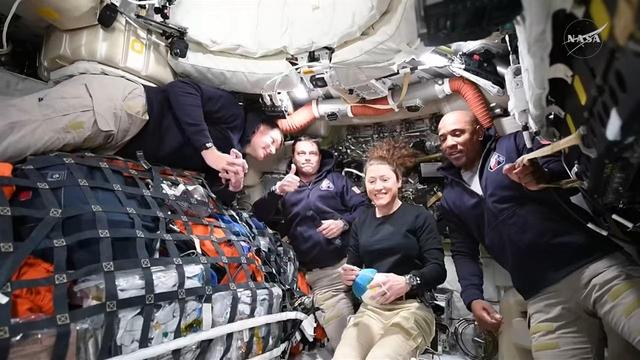
Astronauts have plenty of work and activities to keep them busy during the mission. Live media event with the astronauts coming up soon.
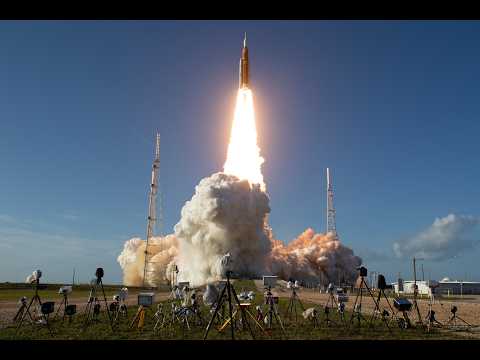
Immersive 360° view video of the launch of the Artemis II mission.
The 20-minute event last night where Artemis II astronauts spoke from space, answered questions and eloquently described their experience so far and the importance of this historic mission.
Inspiring!
Go #Artemis2

A magnificent view of a serene blue Earth taken yesterday by NASA astronaut and Artemis II commander Reid Wiseman from one of the Orion spacecraft's four main windows while approaching Earth 5 hours before the translunar injection. The Sun is to the right in the image.
Camera: NIKON D5 (DSLR, 20.8 MP)
LensInfo: 35mm f/2
ISO 250
ExposureTime: 1/250 s
CreateDate: 2026:04:02 18:53:12 UTC
Distance: 51,800 km
Image and EXIF data at https://images.nasa.gov/details/art002e000191
36/n
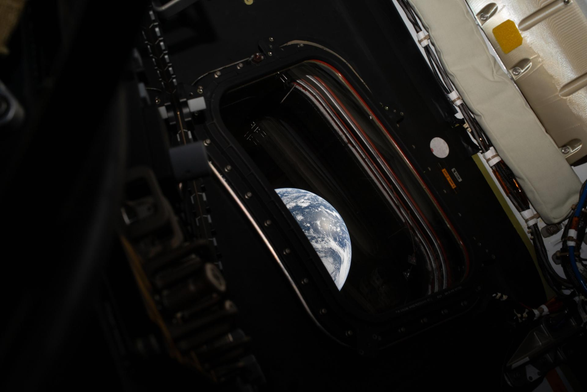
The Blue Marble imaged by Artemis II Commander Reid Wiseman ~30 minutes after translunar injection yesterday, as Orion started its sprint to the moon.
The image shows 2 auroras (top right and bottom left) and zodiacal light (top left). This is the night side of Earth lit by moonlight.
Camera: NIKON D5 (DSLR, 20.8 MP), 14-24mm f/2.8
FocalLength: 22.0 mm
ISO 51200
ExposureTime: 1/4 s
CreateDate: 2026:04:03 00:27:39 UTC
Distance: 10,150 km
Image and EXIF data at https://images.nasa.gov/details/art002e000192
37/n
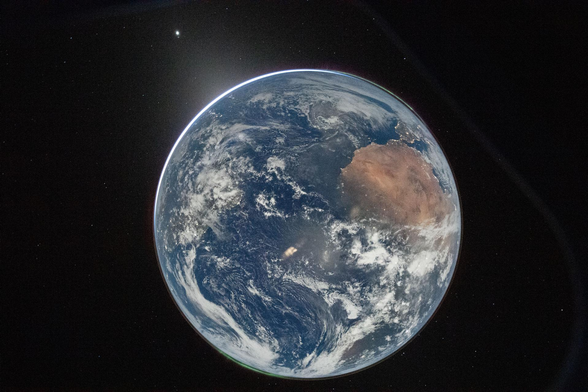
This is an image of the full night-side Earth disk taken seconds before the image in the previous post but with a shorter exposure time.
In this image, we can see the electric lights of human activity. In the lower right, sunlight illuminates the limb of the planet.
Camera: NIKON D5 (DSLR, 20.8 MP)
Lens: 14-24mm f/2.8
FocalLength: 22.0 mm
ISO 51200
ExposureTime: 1/15 s
CreateDate: 2026:04:03 00:27:20 UTC
Distance: 10,050 km
Image and EXIF data at https://images.nasa.gov/details/art002e000193
38/n
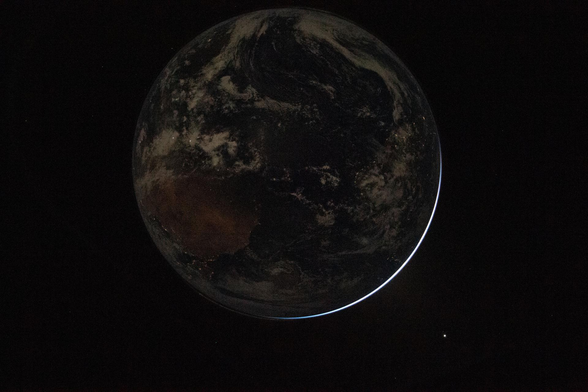
@AkaSci These photos being seen today from Mission Commander Wiseman's camera will be from the time when Specialist Hansen's conversation with CapCom was basically, "yeah, we'll get to that soon, but right now we can't pry Reid off the windows".
Those very human moments and emotions are my favourite parts of the mission so far.
 John Ulrik
 Natanox 🇺🇦🇵🇸
 Martin Pigeon
 Matt Craig
 ZenHeathen 🇨🇦