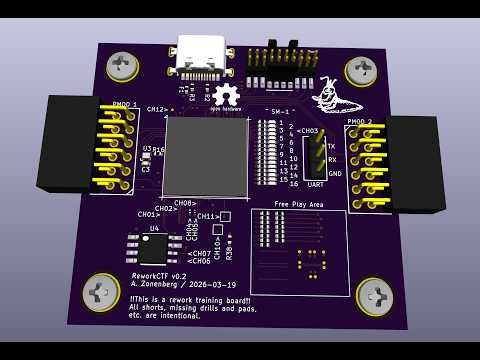
Going live at noon Pacific (just under 2 hours from now): second stage of the ReworkCTF playthrough

Plan is to do the pre-assembly rework of the BGA site (challenge 13), populate the board, then get as far as I can working my way through the challenges.

https://www.youtube.com/watch?v=cuiM8zESF1w

ReworkCTF part 2: Under-BGA prep, front side assembly, and more

YouTube

Post stream: the board is fully populated and challenges 3 and 13 have been (hopefully correctly) solved, but I won't know for sure until I get firmware written to electrically test the connections.

I've hooked up JTAG and the MCU is alive, still need to write firmware to actually grade the challenges so that will be the next step.

Banged up some quick grader firmware.

Confirmed challenges 3 and 13 (the only two I've attempted to bodge to date) are passing, all others failing as expected including the simulated reflow defect on balls A2 and A3.

The simulated reflow defect is the bit I was most concerned about: I put no solder paste apertures on those balls in hopes of creating an open circuit failure, but I didn't know if I might have a good-enough contact between the ENIG and the SAC305 ball sans flux/paste to still make some level of contact.

I got exactly the result I wanted, it failed open.

@azonenberg missing a paste aperture on a BGA pad is such an evil defect.

I've had panels with aperture problems where the ball manages to bridge the gap on, like, 10% of inventory, or in one really nasty case, only along one edge of the panel (temperature gradient I guess?)

@cliffle Fun, lol.

Anyway it should be pretty trivial to rework (squirt some flux under it then hit it with hot air). Somebody on linkedin suggested it when I was posting around soliciting fun defects to put on the rework challenge and I figured sure, why not give it a try.

The intent here is to simulate a solder paste printing issue or some kind of reflow problem. It would definitely be hellish to debug but luckily this is a rework challenge not a debug one, so we tell you which balls are bad and you just have to fix it

@azonenberg oh good. I don't have a CAT scanner at home. 😉

@cliffle I've diagnosed similar reflow defects in the past by elimination (drive the pin high, see the trace isn't high, etc). In ~every case it was due to me terminating the reflow too soon on a high thermal mass board.

The fix was just to squirt some flux under the chip with a syringe from all sides and do a second, longer reflow cycle and in every case it was fine afterwards.

Doesn't happen often now that I have my setup pretty dialed in but on my old single element no-convection toaster oven I remember doing it a handful of times.

@azonenberg I think lately, the "dry ball" class of issues I've found on boards have usually been caused by, like, incomplete plugging of via-in-pad slurping the paste into the netherworld, or similar.

But yeah, Oxide's got some crazy stackups that really need to bake thoroughly, and we had some thermal inconsistencies in reflow early on. That one's at least easy to fix with heat.

@cliffle I've never had a ViP plug fail on me except the one time I put a BGA on an unplugged massive via (like 250um drill or so) just so I could cross section it to show people why it was a terrible idea. I fully expected it to suck the paste away, and it did.