 Phil Ewels
Super excited to be launching two things today: #RustQC 🦀🧬 and rewrites.bio 🚀
I used AI to rewrite 15 RNA-seq QC tools into a single Rust binary (I've never written any Rust). It ended up being over 60x faster. Here's the story 🧵
Super excited to be launching two things today: #RustQC 🦀🧬 and rewrites.bio 🚀
I used AI to rewrite 15 RNA-seq QC tools into a single Rust binary (I've never written any Rust). It ended up being over 60x faster. Here's the story 🧵
By the end of the weekend I had replaced all 15 QC tools in nf-core/rnaseq: dupRadar, featureCounts, RSeQC, preseq, samtools stats, Qualimap.
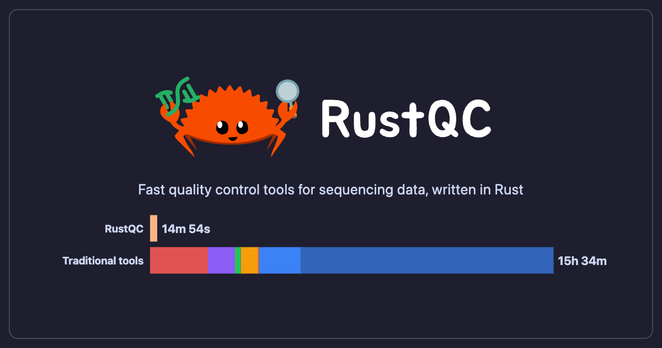
RustQC produced all outputs with a single read of the BAM file. Time went from 15 hours to 15 minutes, >60x faster.
Suddenly this wasn't a joke any more!
I'm not unique in getting here. 3 days into my effort, @rob wrote about using AI to rewrite piscem (https://combine-lab.github.io/blog/2026/02/15/a-skeptics-guide-to-generative-ai-coding.html). Then
Fulcrum Genomics released #fgumi this week (https://blog.fulcrumgenomics.com/p/introducing-fgumi).
Something has clearly shifted in AI capabilities..
I'm both excited and a little terrified. It feels like a wave of AI-assisted tool rewrites is coming to bioinformatics whether we like it or not.
We figured that the best we can do is to try to get ahead of it, so we wrote down some principles for doing it responsibly:
rewrites.bio is all pretty common sense stuff: credit original authors, emulate output exactly, maintain what you ship, don't spam open-source maintainers with AI-generated bug reports.
I wrote a second blog post covering this part of the story here:
Writing code is cheap now, but the scientific insight and community trust behind the tools being rewritten hasn't changed. I'm feeling cautiously optimistic.
→ RustQC: https://seqeralabs.github.io/RustQC/
→ rewrites.bio: https://rewrites.bio
→ RustQC blog: https://seqera.io/blog/rustqc
→ rewrites blog: https://seqera.io/blog/rewrites-bio/