
Bonding over fish:

The fish eating cultures of South and Southeast Asia have a lot in common.

Despite the 'everybody is vegetarian' myth that people somehow believe about South Asia, the fish-eating peoples of coastal India, Bangladesh, through the porous hills of Bangladesh / Myanmar, Thailand, Vietnam, all the way to southeast China, to Indonesia share many things.

For centuries, there was so much trade and sea-faring adventures between these places. While we now think of those locations are completely separate geographic spheres, there were Hakkas in Calcutta and Dhaka, and there were Bengalis in Malaysia, Indonesia and beyond.

Heck, the I-Ching says there were regular ships between the Bay of Bengal and the Srivijayan empire (..700 AD?)
#Food #Asia #StoriesAboutFood

On the streets of Yangon, you still hear Gujarati, Tamil and Bengali.

In Yogyakarta, you see signs of a former glorious Indic past in the street signs and in the temples of Borobodur.

When I think of the 'fish-eating people of this part of the world', I think of the Bengalis, and the Teochews, in India and China respectively. And everyone in between.

As a Teochew person who has traveled the entire region between southwest China to Bengal, I feel a continuous line of cuisine enjoyment through different fish dishes of the places I've passed through.

Today, here in Philadelphia, I bought my Bangladeshi hosts a can of black bean dace that I told them was 'southern Chinese poverty food'. They opened it and ate it and said it went with all of their food. I thought they would like it because when I had a salted ilish in Bangladesh, I thought it tasted like black beans and dace.

We walked around and went to a Burmese grocery store, where my hosts rummaged through a freezer looking for fish from home. The Rohingya shop owner was able to speak with them and help them; they have the same fish dishes.

I always feel as if you can drop me anywhere in this entire swath of Asia between the Bay of Bengal and southwest China and Indonesia, and I would feel very much like home. I would speak most of the languages, and love most of the food.

And by fish-eating people, I don't just mean 'we eat fish sometimes'. I mean, 'most of our meals are fish', peoples.

Our cultural norms are fish-related.

For example, my Teochew family did not believe I was an adult until I learned to clean and process a whole fish. Stories about my childhood are told around fish (she has been really picky about fish quality since she was a baby! β€” a very positive thing)

When I dated a Bengali person, I had so much fun laughing at how they had exactly the same language. ("You're traveling inland.. what will you do when you don't have fresh fish daily?")

My travels down the Konkan coast, into Kerala and Kanyakumari, and up through the coastal seafoods of Chettinad and Erode, to the many, varied fish dishes I had on both sides of Bengal.

No matter where I went, I could always find someone who wanted to feed me: a piece of fish that felt like home.

Last night, I enjoyed hearing my friends talk about two generations of Chinese food in Dhaka, from their memories:

- In the 70s, Chinese food was the only international food that people would go out for in Dhaka
- There was a basic, 4-5 dish menu that my friend remembers
- His wife remembers that 20 years later, Chinese food was still the most popular
- But that the menu had vastly expanded
- They spoke of the Hakka Bangladeshi families they knew who were deeply ensconced in Dhaka life, who ran laundries and hair salons and restaurants
- This made me remember how, when I first started visiting Kolkata, random people would say to me, 'I only like Chinese hair cuts' and I was so confused (Hakkas and Cantonese in West Bengal also do the same businesses)

Some times I think of how in our rapidly nationalistic world, where the governments of China, India, and everywhere in between try to drag us into weird ethnicity-based conflicts with each other, I really appreciate the shared history, foods and cultures between the millions, billions of people who call that patch of the world our home.

And how one time, I caused a stir on Bengali Twitter: I went to a high end Chinese restaurant and posted a photo of a US$200 steamed rui fish. (I didn't order it, but it would have been very, very good)

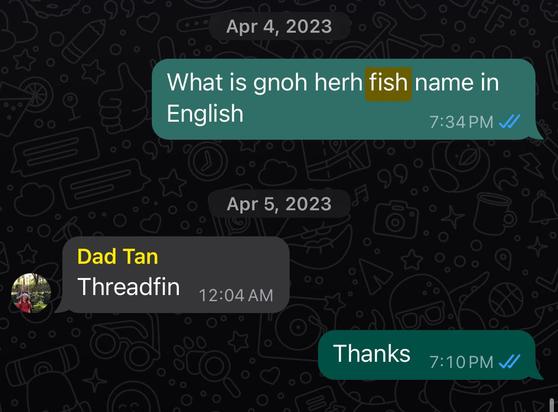
Among my favorite things to do: learn the names of every single fish we all eat and learn their names in Malay, Tamil, Hindi, Bengali, English, Teochew, and Cantonese.

My head is a busy place, and half of it, fish names in many languages.

Also, half of my family group chats are like:

This book, "Following Fish" is one of my favorite travel books about India:

https://samanth.in/books/following-fish/

#Books #Food #India

@skinnylatte I feel this so much, as a Filipino American from the East Coast US, whose ancestries are all sea peoples: Philippines, Northern England and Wales, Northern Germany and Denmark. Fish and seafood are staples of all these cuisines.

I have lived most of my life within a proverbial stone's throw of one ocean or another, and it wasn't until I moved to Vermont that I stopped having access to truly fresh fish and seafood. It's so weird! (and outrageously expensive, here!)

@skinnylatte Growing up, living near the beach, I always thought I would prefer the mountains. It wasn't until I actually moved to the mountains that I realized how much my "normal" is living on the coast of an ocean.

The nearest ocean beach to my home now is about 200 km away to the East.

I don't eat as much fish as I would really like, because it's too expensive, here, but yes, a whole fish on the table for everyone to share is the thing to do.

@skinnylatte Even when I lived in the NJ suburbs of Philadelphia, my wife and I would frequent a little Thai restaurant just down the street from our condo, and especially when my brother was in town, we'd order a big fat whole fish, and the Thai staff were always impressed, because unlike most of their patrons we would expertly clean the bones of that fish in no time, at all. Of course we would, we're Filipino!

@skinnylatte I'm thinking about the Laguna Copperplate, the oldest known written inscription found in the Philippines, dating to about 900 CE; it is written in Old Malay, with Sanskrit. South Asian and Chinese influence has always been very strong in maritime SE Asia.

https://en.wikipedia.org/wiki/Laguna_Copperplate_Inscription

Laguna Copperplate Inscription - Wikipedia