 Judith Beyer
#Listening
By putting the ear on a par with the eye, one equalizes the senses & takes what one hears as seriously as what one sees. But why do we find it easier in the #humanities to scrutinize the latter, not the former? Why do we fiercely debate what we see, but what we hear often seems a given?
But why do we also tend to trust what we see more than what we hear? The productive engagement with the visual is much higher than with the aural. “But what about the success of podcasts in recent years?” you might ask. “It’s often by and for people who like to hear themselves talk”, I’d respond.
How much of “listening” is really being done amidst seas of talking?
I am not even beginning to bridge from listening to understanding. This is precisely the operation that I find undertheorized in qualitative empirical research such as #anthropology & #sociology. In conversation analysis it is often intentionally bracketed out. You either have meaning or structure.
Much of today’s talk is of the order “I am what I say I am.” But what does this mean for the person who listens? Which scope is there, really, for reception, if all understanding is necessarily interpretation?
Concretely, in #anthropology we are way beyond “giving voice” to our interlocutors and no one would dare to “speak for them” any more. But what is the kind of collaboration we should strive for? How does it manifest in the way we listen? Does the often demanded “allyship” really mean being mute?
And then, of course, there is such kind of #listening to 'local' voices that we find in international politics bsky.app/profile/dipl...
RE: https://bsky.app/profile/did:plc:vlpy6zuqqum5tumv7b6dw5fp/post/3mi5yulh6n226
RE: https://bsky.app/profile/did:plc:vlpy6zuqqum5tumv7b6dw5fp/post/3mi5yulh6n226
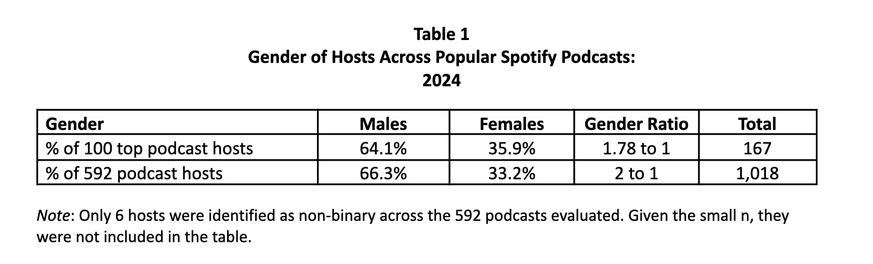
Across the 100 most popular #podcasts of 2024 on Spotify, a total of 167 hosts were identified. A full 64.1% (n=107) were men, 35.9% (n=60) were women and none were nonbinary.
Study: assets.uscannenberg.org/docs/aii-ine...