 Alison Wilder
I'm not going anywhere tonight.
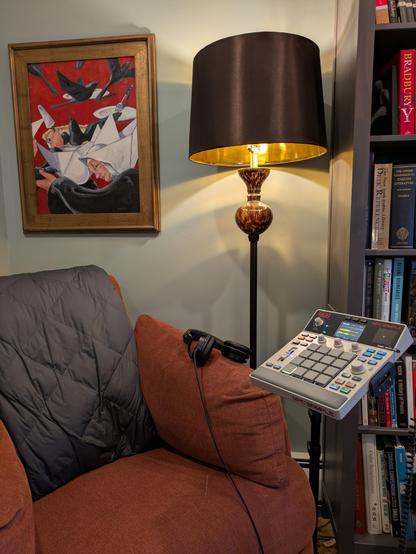
It can change time signatures, ooh la la
I imagine this is standard MPC stuff, but I haven't ever used one.
I had an Akai Force, and you literally couldn't be in any time signature except 4/4. It was absolutely shocking.
Okay, I just updated the firmware. On Linux. In 2 minutes.
These AKAI people might know wtf they're doing. After the epic frustration-bordering-on-rage that was how I experienced the 1010music Bento, this feels like a Cadillac.
(For those not in the US, USians use "like a Cadillac" to mean the top-tier experience of something, even though that is demonstrably not true.)
Also holiest of holies the MPC Sample shows up as a working stereo audio interface on Linux. So I can record it straight into my laptop or wherever with a USB cable. How neat!!
I wouldn't be surprised to see this become one of my most-often-used pieces of gear. This combo of fun + convenience + simplicity is so so good, and although it's not particularly feature-rich, I kinda consider that a good thing.
@sknob i'll try to grab some audio of something I made with the default samples before I delete them all, lol. It really is for beat making, but beat making can be stretched pretty far.
Basically it's a very well crafted little sequencer for samples. Honestly, I think something like this might really suit your music. I can easily see myself using it for songwriting.
@sknob I hear you. Something about producing music often triggers my hyper focus mode, which is pretty fun, but it is a huge pain also.
I have fantasized about having a loose affiliation of musicians locally that can help each other record things. Easier said than done, though.
@BorrisInABox it is almost knob per function, although there are shift functions, and certainly knobs have different functions depending on what section you have active, eg. sequencer or sampler. There's haptic feedback in the form of clicks on the main knob, although not on the small knobs at the top.
I imagine it would be possible to use eyes free, but difficult. That said, I don't have any experience with that myself, so I could be overlooking something major that would make it impossible.
@alisynthesis I would like to play with one just to see, but I have to say, the bar is exceptionally high these days with Ableton move now having an onboard screen reader thanks to Schwung, formerly Move Everything. It can easily be toggled on and off, and I quite often disable it when I want it out of the way. More stuff needs this.
When I was in high school, a piece of software was released that read out the screens from Kurzweil keyboards using MIDI strings that Kurzweil implemented years ago across their entire range. Didn't get to use it for long, but that sort of thing is what I'm talking about. Instant and immediate access to everything in a non-obtrusive way.
@BorrisInABox totally agree, it seems like something that should be thought about from day one. It's very cool that the Ableton Move has a screen reader.
I love the idea of a SysEx/MIDI tool for that. Seems like something that could easily be part of the MIDI protocol. (Okay, "easily" is doing a lot of work in that sentence. I mean, it should technically not be that difficult.)
@BorrisInABox @alisynthesis
This reminds me of something else that happened in the late 1980s.
I was a regular BBS user, and my local boards had a small group of blind people, all of whom were active in the general discussion areas, and across FidoNet.
The first affordable sound cards (from AdLib and later Creative Labs) for IBM PC compatible computers were big news for all kinds of reasons (especially for gamers and musicians) but with TTS software they were a game changer for blind people.
@BorrisInABox @alisynthesis
Prior to that, Text To Speech on a PC typically meant buying an expensive card from a specialist accessibility vendor, with expensive single-purpose software.
I was using an Amiga at the time, which had good sound on board, and decent TTS software included with the OS.
"My computer is better than your computer because" was a common theme in BBS tech discussions, so most PC users knew exactly what all the other platforms could do. Likewise, we knew about PC features.
@BorrisInABox @alisynthesis
It definitely happened like that in Ireland, for a significant set of users.
I probably only read the "good news" stories, but I remember reading anecdotes about specialist accessibility vendors pushing back against this new threat to their profit margins.

@iBlame I was honestly a bit skeptical, but it is quite fun! This is the first time I've actually used an MPC and I can tell that the lineage of live music making is super strong.
There are so many great design choices that make everything immediate and intuitive.
@KaraLG84 thanks 🙂
I hope so too!
Uah, an AKAI Professional MPC Sampler! I envy you (a tiny little bit). 😃
 sknob
sknob Borris
 Francois Dion
 Dec [{(
 )}]
)}] Elif Yalvac
 fourmiune
 Matthew Lyon
 Kara Goldfinch
 Scott
Scott みやくモード
 Jonathan
 Gavin Volure’s Peanut Butter
 Ryan Hyde 🇺🇦🏳️⚧️🇵🇸
 🔊🎶 N U N D
 Aki Moranaga