"The US has caused an eye-watering $10tn in global damages to the world over the past three decades through its vast planet-heating emissions, with a quarter of this economic pain inflicted upon itself, new research has found.

China, now the world’s largest emitter, is responsible for $9tn in GDP damage since 1990, according to the findings of the paper."

https://www.theguardian.com/environment/2026/mar/25/us-climate-damage-research

US has caused $10tn worth of climate damage since 1990, research finds

US, top carbon emitter in history, has ‘a lot of responsibility’ for causing ‘substantial’ harm globally, scientist says

The Guardian

"Developing countries have called for wealthier nations, which have emitted most of the greenhouse gases since the industrial revolution, to assist them financially to deal with loss and damage stemming from disastrous heatwaves, floods, droughts and crop failures worsened by escalating temperatures.

The US has long resisted the idea of being held legally liable for its planet-heating pollution."

https://www.theguardian.com/environment/2026/mar/25/us-climate-damage-research

US has caused $10tn worth of climate damage since 1990, research finds

US, top carbon emitter in history, has ‘a lot of responsibility’ for causing ‘substantial’ harm globally, scientist says

The Guardian

From the Nature paper:
"One tonne of CO2 emitted in 1990 caused US$180 in discounted global damages by 2020 ($40–530) and will cause an additional $1,840 through 2100 ($500–5,700). Thus, settling debts for past damages will not settle debts for past emissions.

In other illustrative estimates, a single long-haul flight per year over the past decade leads to about $25k ($6,000–77,000) in future damages by 2100."

https://www.nature.com/articles/s41586-026-10272-6

Quantifying climate loss and damage consistent with a social cost of carbon - Nature

A new framework links specific emissions to monetized, location-specific climate damages, showing that future harms from past CO2 emissions far exceed historical damages and that delayed carbon removal cannot fully offset these losses.

Nature

"The economic damage yet to come from carbon dioxide emitted decades ago far exceeds the harm it has wrought so far.

Emissions tied to the production and use of oil between 1988 and 2015 by Saudi Aramco, the world's single largest corporate emitter, resulted in $3 trillion in global damages by 2020, the study found. If those emissions remain in the atmosphere through the end of the century, the damage could rise more than 20-fold to $64 trillion."

https://phys.org/news/2026-03-co8322-emissions-bigger-future-economic.html

Past CO₂ emissions may drive far bigger future economic losses

The economic damage yet to come from carbon dioxide emitted decades ago far exceeds the harm it has wrought so far, according to a new Stanford University study. The research, published in Nature, puts a dollar value on the harm done to individual nations and the world by carbon dioxide emitted over time by countries and major companies.

Phys.org

If I understand the Nature paper correctly, it seems to be saying that the social cost of carbon SO FAR is $ 180 per tonne (could be anywhere between $40 and $530).

But the longer-term social cost, to 2100) is $180 + $1840 = $2020 per tonne.

And the damage doesn't stop after 2100.

In a word: Yikes.

https://www.nature.com/articles/s41586-026-10272-6

Quantifying climate loss and damage consistent with a social cost of carbon - Nature

A new framework links specific emissions to monetized, location-specific climate damages, showing that future harms from past CO2 emissions far exceed historical damages and that delayed carbon removal cannot fully offset these losses.

Nature
Climate change will ultimately cost humanity $100,000 per ton of carbon, scientists estimate

UChicago study: ‘Ultimate cost’ of carbon 1,000 times greater than cost to current generation

University of Chicago News

@tom_andraszek @CelloMomOnCars

It's good that the 2 geologists and the philosopher focussed the long-term damage.
But the one-dimensionality of wanting to express the world in €€€ figures is a big part of the underlying problems that caused our econ system pervert into the EconObscene.

The one-dimensional concept is so strong that these three non-eConomists forgot to factor in: to cause economic € damage there has to be a society which trades goods for money, and the future damaged society's complexity level has to be comparable to ours, ie not like one from the 1400s.

That's not going to happen. I wish, good thinkers like those 3 non-economists would start to figure out regional collapse thresholds: how big can climate stress like, eg, food insecurity become before, just as an example, the nation of India becomes ungovernable and hence, unproductive? How big can the pressure on India from already deteriorating neighbors Pakistan and Bangladesh get before India crumbles too?
Because an unproductive India is certainly one of the breaking points for our complex global tech civilisation.
So.
When this civilisation ends, and let's say, only 10% of the global population survive the turmoil, the damage function becomes meaningless.
Climate then changes too, by the way. Which might even reduce the cost of the then-obsolet damage function. But ther will be no one left to care.

#RCPcollapse #ClimateEconomics

@anlomedad @tom_andraszek

I would agree with you,
but also the $$$ numbers is a language, and one necessary to make people understand.

After all, the current argument against climate action is that "it's so expensive". These dollar numbers puts the reality in an apples-to-apples comparison, and it's a good antidote to that toxic argument.

@CelloMomOnCars @tom_andraszek

Are astronomically high numbers still a language that can make people understand. I doubt it.

As I doubt all the fiddling with price tags on things we are about to lose.
Only in the fine print or foot notes that no one reads are the caveats and omissions listed. No one reads those.
And omissions are only the ones that the authors can think of. Meaning, listed omissions aren't comprehensive and you and me would add a host of more items.

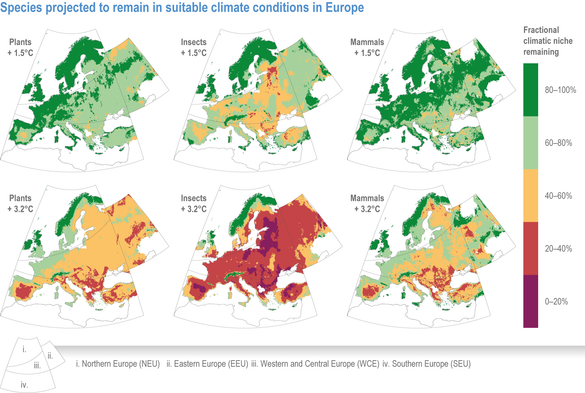
Do you believe, for example, that any of these dice-casting eCONomists thinks of species loss in Europe by 2030 / 1.5C and ~2050 / 3C?
it's not listed in the fine prints bc eCONomists have no clue what they're playing with and just strut around with their loaded toy guns in their hip holsters.

Figure is from Chapter 13 in AR6-WG2.