RE: https://zeroes.ca/@datum/116288248099142236

#COVID19 QUESTION:

at the beginning of the pandemic some scientists created a site graphing all its mutations and it blew mind by how many there were.

i think they stopped due to the speed of reports. am assuming its a consequence of how well epidemiology systems are integrated to the internet.

SO:

1. are we seeing more mutations vs other viruses due to faster reporting or because the virus itself is prone to mutate fast?

2. what makes #SARSCOV2 mutate so much? reinfections w/o immunity?

@blogdiva

In 2020 when I read the virus outbreak was coronavirus I thought "Oh shit."

Coronaviruses, as a family, have been known for many years to have a particularly fast mutation rate.

There are many viruses which cause the "common cold"; some of those are coronaviruses and mutate fast, which is why there's never been a vaccine for the cold and might never be. This is one reason the original SARS virus outbreak was so worrisome and triggered a huge world-wide effort to shut it down.

@CliftonR @blogdiva it's interesting to think about. Fast mutation really means its genetic code is pretty unstable, getting transcription errors with high frequency as it reproduces. But also coupled with a fast reproduction rate so it continues to survive even with a lot of errors.

@CliftonR @blogdiva

There are many viruses which cause the "common cold"; some of those are coronaviruses and mutate fast, which is why there's never been a vaccine for the cold and might never be

Cliffton really nailed it here.

(Meanwhile there are microbiological reasons for the shared high mutation rate, but I know I don't understand implications of https://www.nature.com/articles/s41467-025-61555-x )

But this base fact is MULTIPLIED by two more things:

1) as jdm2 said the sheer number of hosts

corollary 1.A) Rare per person is not rare at pandemic billions-of-infections scale. People with rare one-in-a-million immune dysfunction can suffer long term SARS-CoV-2 infection and serial passage https://www.medrxiv.org/content/10.1101/2021.09.14.21263564v2 . The mainstream hypothesis says that these conditions are the origin of variants containing large jumps of 20+ mutations at a time

2) the viral volume per host while contagious. (Note re-gaining contagiousness does rarely occur.). And to my understanding, it turns out that since SARS-CoV-2 is a vascular disease, and our bodies have blood vessels everywhere, there's a lot of viable host tissue; simultaneous to that it has a higher viral copy count than several other common viruses https://pmc.ncbi.nlm.nih.gov/articles/PMC7476607/figure/fig2/

#COVID19 #COVID #SARSCoV2 #CovidIsNotOver #virology

The mutational landscape of SARS-CoV-2 provides new insight into viral evolution and fitness - Nature Communications

Here, we report the mutation rate of SARS-CoV-2, the virus responsible for COVID-19. We find that the secondary structure of the RNA-encoded viral genome is crucial to modulating the mutation rate and evolves under strong selective constraints.

Nature

@CliftonR @blogdiva also note from that first link that while SARS-CoV-2 DOES have a mutation correction mechanism, that mechanism's effectiveness is focused:

the mutation rate is significantly reduced in regions that form base-pairing interactions and that mutations that affect these secondary structures are especially harmful to viral fitness

https://www.nature.com/articles/s41467-025-61555-x

#SARSCoV2

The mutational landscape of SARS-CoV-2 provides new insight into viral evolution and fitness - Nature Communications

Here, we report the mutation rate of SARS-CoV-2, the virus responsible for COVID-19. We find that the secondary structure of the RNA-encoded viral genome is crucial to modulating the mutation rate and evolves under strong selective constraints.

Nature

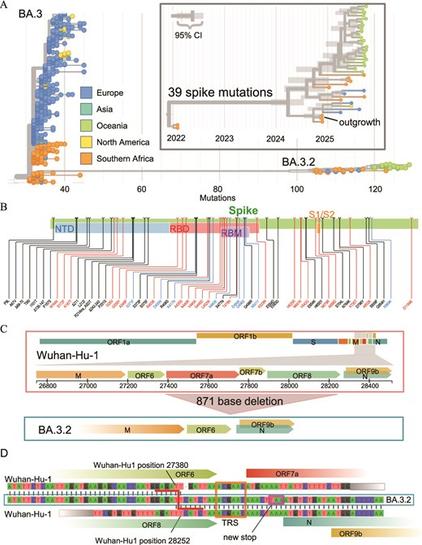
@blogdiva on eactly that point, trending on zeroes right now is a paper that found

The emergence of long branch subvariants like BA.3.2 without intermediates likely indicates that unmonitored persistent infections continue to drive large evolutionary shifts in this virus.

https://academic.oup.com/ve/article/12/1/veag011/8490867?login=false

Evolution and viral properties of the SARS-CoV-2 BA.3.2 subvariant

Abstract. The SARS-CoV-2 Omicron subvariant BA.3.2 descends from BA.3. It emerged two years after BA.3 ceased to circulate and differs by 39 spike mutation

OUP Academic