 lumpenproletariat
boiling water again
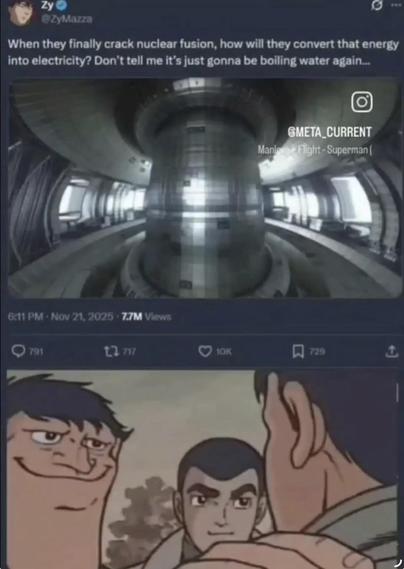
I refuse to believe this.
You’re telling me that Humanity is able to understand what goes on at the heart of stars, and is on the brink of being able to harness that power (“Soon TM”), and the best we can come up with is a big tea kettle? I’m not buying it.
There’s got to be a better way of capturing all that energy - like, solar panels but for other types of radiation? Or if that’s not possible because wavelengths or something , maybe make something glow and use normal panels? Or like, can’t we take a particle accelerator and flip it around and pull energy from the particles that go zooming?
I’m sure there’s a reason why all of that is hard, but surely not impossible?
The majority of the energy released will be heat, relatively few high energy photons are released so ‘solar’ isn’t a viable option and your suggestion about a particle accelerator just doesn’t make any sense.
Boiling water is literally the best way to capture the energy released.
I’m not disputing what the current gold standard is, I’m looking for theoretical possibilities.
When you say heat, in fusion, most of the energy would be a neutron moving really fast, right? It sucks that it doesn’t have a charge because then it would be really easy, but there’s options here if we get creative.
Maybe there’s some sort of material yet to be invented that can be slapped by a neutron and “deformed” in a way that causes electrons to shift/make holes and exploit that to make electricity.
And that free neutron will eventually decay into a proton and electron, and those have a charge, so if we keep them going around a loop until that happens perhaps we could harness it.
And to be clear, it’s harnessing the energy released by state changes in materials.
Water is the most abundant, cleanest, and most effective material to state change and harness.
True, but that’s just one part of the process. Compared to actual chemical energy in the source fuel, most plants
If nothing else, there’s an absolute efficiency limit from Carnot’s theorem. Even for the most modern and efficient gas plants, the limit seems to be ~60%, and for nuclear or coal, it’s much lower at around 30-40%.
i mean, they can run the plasma through some magnetic fields…
But it’s less efficient that boiling water.
Well, not an engineer myself, either, but generally speaking that would greatly increase the systems complexity, which generally increases maintenance costs, down time, and the initial cost of the system.
You might be able to eke out a bit more power, but there’s more to the decision than total output and how efficient it is.
What I would imagine were a fusion-powered MHD being useful would be as a front end to fusion-based plasma propulsion. (Basically something like the VSIMR, Hall effect or whatever plasma thruster, where the fusion reaction generates both some power to create the thrust and its exhaust plasma is also the reaction mass.(I mentioned I’m not an engineer… right? Just an incorrigible nerd who likes sci-fi.)
Reading a bit more about it, the MHD generator does indeed reduce the temperature and velocity. The Rankine cycle (steam turbines) is most efficient with a large difference between inlet and outlet temperatures, so if you have MHD first, you have a very cold inlet and the steam turbine won’t be effective.
The other way around doesn’t work either, as the steam turbine system would absorb all the heat from the plasma, making the MHD ineffective.
I think the idea was to provide a redundant method of charging in case you’re unable or forget to recharge it externally. But ideally yes, it would be entirely internally powered so you wouldn’t be tethered to the grid.
edit:
A more promising approach is this which is, somewhat unglamorously, just a small turbine implanted into the heart that is spun by bloodflow. oh, no, this is a different study than the one I was thinking of! This uses a flexible generator that generates power from the deformation of the Vena Cava. Fascinating, I’ll have to dig thru it.
www.darpa.mil/research/programs/rads-watts too.
But yeah, steam turbines are remarkably efficient and if you are designing a reactor today, you definitely assume one of them will be used.
There are also some chemical modes of electricity generation (Alkalai batteries, etc). Also using flowing water to move Turbines like dams.
But then the meme isn’t as fun here, and those are such a small minority of how we generate powers.
 NeatNit
 ByteJunk
 Ghostwurm
 MinnesotaGoddam
 ekZepp
 FuglyDuck
 vaultdweller013
 Jyek
Jyek